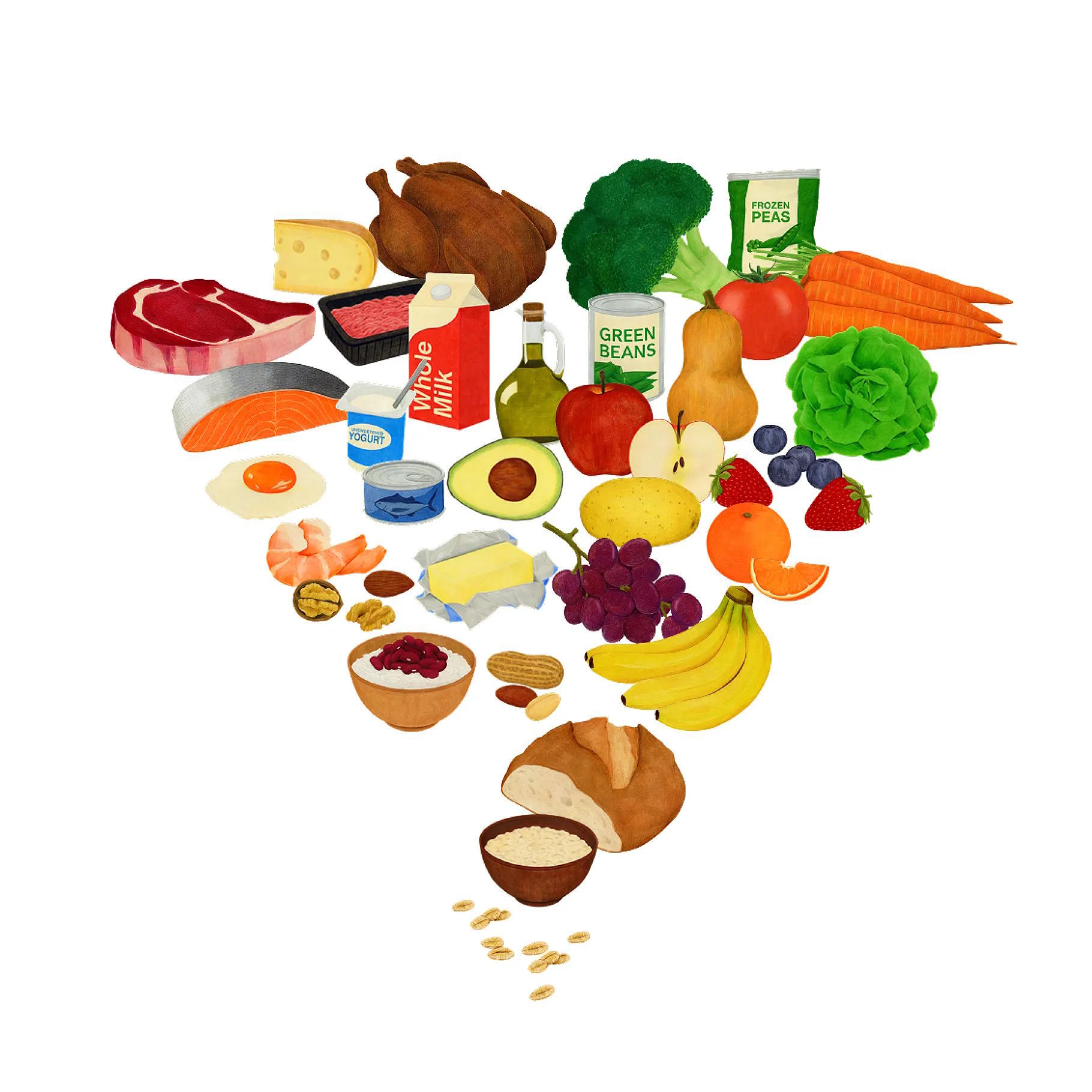
Under the mantra Make America Healthy Again (policies aiming to make the United States healthy again), the Trump administration has presented its new dietary guidelines. The announcement has quickly become a topic of strong polarization on social media among health experts. A classic confrontation between supporters of paleo and keto diets vs. other trends. Why does the new food pyramid divide nutritionists?
What changes
"What stands out at first glance is that the food pyramid has been inverted," explains Ismael Galancho, a specialist in nutritional planning, lecturer at several universities, clinical sports dietitian for a long list of influential figures and elites, fitness trainer, researcher, disseminator, and member of the Spanish Society for the Study of Obesity (SEEDO).
The traditional model placed carbohydrates at the base: bread, pasta, rice, and cereals were the foundation of the daily diet. Then came fruits and vegetables, and at the top, proteins and fats of animal origin (meat, fish, dairy) were recommended in moderation. "This generated significant criticism among supporters of an evolutionary diet," says Galancho.
Kennedy's proposal reverses this hierarchy. Now proteins, especially those of animal origin, take a leading role in daily nutrition. Carbohydrates are relegated to a secondary role, and there is an emphasis on drastically reducing refined carbohydrates (sugars, white flours, processed products).
What's worrying you?
The controversy arises because the guidelines, which do not deviate too much from the dominant nutritional advice, do not exactly correspond to the illustration being circulated, confirms Galancho. "There is a certain inconsistency. If the pyramid or visual graphics give prominence to red meat and whole dairy, that communicates that they should be the basis of the diet. However, the text maintains limits on saturated fats and does not eliminate the recommendation for moderation. The result is a visual contradiction with the written message that can confuse the population," he criticizes.
The nutritionist gives practical examples: "They recommend between two and four servings of whole grains per day. However, in the drawing, they minimize them. They advise two fruits a day. However, they place them in the middle, even slightly below the pyramid. Then, regarding saturated fat, they tell you not to exceed 10% of the total calorie intake, but according to the drawing, with red meat at the top, that's what you should prioritize."
Furthermore, Galancho points out that "promoting proteins without distinguishing sources is another practical inconsistency." It does not direct towards plant sources, which have a better cardiovascular risk profile, or towards white meats like chicken over red meat, he indicates. "What is written corresponds to scientific evidence, but not what is seen in the drawing. This, for me, is the most serious issue," he concludes.
According to the nutritionist, it is not wrong to slightly increase protein consumption, but it should mainly come from lean animal foods, such as poultry and fish, which are practically absent. "They place fatty fish, like salmon, at the base, which is healthy, but there is a lack of poultry, white fish, and then sources of plant protein."
Finally, Galancho's main concern is the place occupied by butter. "I find it regrettable because it is saturated fat almost entirely and not the most recommended. There is no harm in consuming a little, but it is not the most optimal in the diet."
Overall, he finds the illustration "even less intuitive than MyPlate." And he believes it poses a risk if not clear: "At a population level, without clearly indicating a preference for plant proteins and without clarifying for whom higher protein requirements are, the change could lead to more saturated fats."
Traditional nutritional science has associated excessive saturated fats with a higher cardiovascular risk (high cholesterol, heart problems...). However, advocates of this new approach argue that refined carbohydrates are more harmful and that animal proteins offer significant metabolic benefits. Juan Bola, a nutritionist, technician in Physical Activities and Sports, and author of "Nutrición evolutiva: el despertar de la especie" (Evolutionary Nutrition: Awakening of the Species), celebrates this 180-degree turn by the American administration. "The nutritional pyramid followed by the West has been disastrous and has led us to illness. It has been proven to be a failure," he opines.
For the nutritionist, saturated fat is not the problem if it comes from animal sources: "The problem lies in that from the food industry. Neither meat nor butter nor eggs make people sick, but sedentary lifestyle, stress, consumption of ultra-processed foods, and refined carbohydrates do."
Bola adds that in Europe, there is a strong push towards not consuming animal-based foods. "There is a 2030 Agenda advocating for this reduction in its guidelines. Vegans are delighted with this decision because it favours their lifestyle, but in the United States, which is not as restricted, a historic step has been taken: stating that the dietary foundation should be animal-based with low glycemic index vegetables," he asserts. And he highlights the most beneficial aspect from his point of view: "Advocating for a higher protein intake and reducing simple sugars and refined flours."
In the same vein, Alejandro Pérez, a nutritionist and supplement formulator at Synsera Labs, believes the new pyramid "corrects the mistake of blaming meat, eggs, and fats for heart problems, removing refined carbohydrates from the diet." For him, this is "less dogma and more biology."
What does the evidence support
Of course, not everything is black and white. There are many nuances. For example, the guidelines have been endorsed by the American Medical Association, a group that had vehemently condemned Kennedy's reform of the childhood vaccination schedule just days before. On the other hand, the American Heart Association issued a lukewarm statement supporting the new guidelines, expressing concern that they may lead people to consume too many saturated fats and sodium.
The most positive aspect, and one on which all nutritionists could agree, is the strong stance against added sugars and highly processed foods. Reinforcing the recommendation to avoid sugary drinks and limit added sugars is appropriate and strongly supported by evidence due to their impact on obesity, diabetes, and cavities.
It is also coherent in public health goals to emphasize reducing "refined and highly processed carbohydrates," such as cookies, snacks... However, regarding alcohol, the guidelines are vague and recommend consuming "less," but do not offer specific guidance on what that means. Previous guidelines had recommended that men not consume more than two drinks a day and women not more than one.
New York Times has published the presence of experts with possible conflicts of interest, which diminishes public trust and can introduce biases into recommendations affecting school policies. Kennedy had criticized the previous guidelines for being influenced by the food industries, but five out of the current ten scientists revealed recent financial relationships with beef, dairy, or pork industries, or with food companies, infant formulas, or supplements.
"Another methodological issue is not taking into account the preliminary scientific report, which had its own public consultation, and establishing the new guidelines through individuals with strong ties to the dairy and meat industry who should be excluded from the development of such guides due to the significant conflicts of interest involved," points out Gonzalo Quesada, pedagogical director of the Nutrition area and data scientist at Fit Generation.
A final conclusion
A thorough evaluation of the new nutritional guide would lead to an endless list of nuances, applause, and objections in equal parts. Quesada agrees with the consulted nutritionists that reducing sugar-rich products is unquestionable. "But it forgets to include in this recommendation foods high in salt, which were included in previous guidelines and are also not healthy," the expert opines.
Another thing they have done well, according to their criteria, is to maintain a maximum of 10% of calories from saturated fats, but this recommendation is accompanied by another that he finds clearly contradictory and confusing: "They recommend consuming meat, fish, whole dairy, and eggs, something that in previous guidelines, according to the American Heart Association, was not the case, as they recommended low-fat dairy and certainly not cooking with butter or beef fat. Following both recommendations is difficult to comply with," he points out.
And, like Galancho, he believes that the pyramid is constructed in a somewhat strange way: "They recommend higher consumption of fruits and vegetables, which is very good, but at the same level as sources of animal fat and yet whole grains appear at the bottom peak," he concludes.