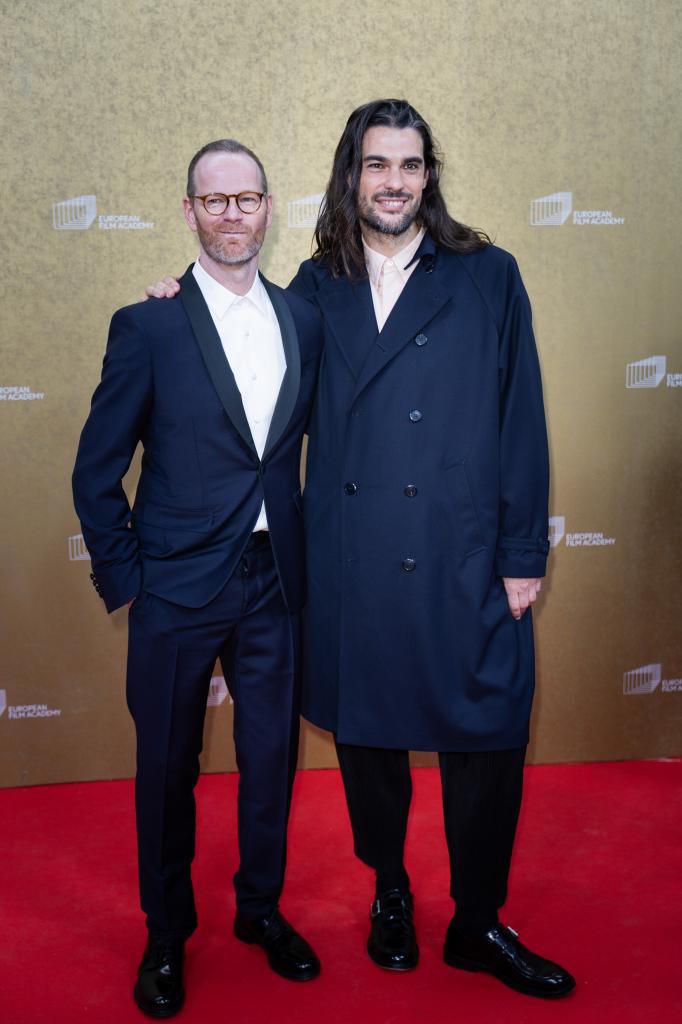
The Berlin night left no room for surprises, a characteristic that perhaps best defines those hours in the German capital, so prone to improvisation and chaotic disorder when the sun sets. This was not the case because the European Film Academy, despite being based in the German city, is more inclined towards firm tradition. And no one embodies this term better than Joachim Trier, the natural heir to the Scandinavian independent film tradition and the big winner of the European Film Awards where Sentimental Value, as much a heir to that tradition as its creator, took home the five main awards that, even before the gala began, were already considered a given.
The European Film Academy repeated with Trier's film what it had done in 2024 with Emilia Pérez; in 2023, with Anatomy of a Fall; in 2022, with The Triangle of Sadness, and in 2020, with Another Round. The night's triumph was in excellence, with no division in the five main categories except for the impossibility of not awarding those statuettes to those projects. Sentimental Value had candidates for Best Film, Director, Actor, Actress, and Screenplay and, therefore, all of them went to the Norwegian film - also music to make it six awards in total. A clean sweep for the most traditional of films about tradition that crowns Trier, as well as his actors Stellan Skarsgård and Renate Reinsve, just a few days before the Oscar nominees are announced, where Sentimental Value is a strong contender.
However, even amidst tradition, there is room - especially in Berlin - for radical choices. This was what Oliver Laxe led with Sirat, his great rave that has been winning over international critics. The Galician film, which received nine nominations, the highest number of the awards tied with Sentimental Value, triumphed in all the technical categories it was part of. The film excelled in Best Cinematography, Best Editing, Best Sound, Best Casting, and Best Production Design. Five awards - just one below the big winner of the night and the highest number ever achieved by a Spanish film at the European Film Awards alongside Talk to Her - leaving the Spanish film in the second tier of the awards ceremony, with the last Palme d'Or winner from the Cannes Film Festival, A Simple Accident, by the Iranian Jafar Panahi, being the big overlooked film of the night, failing to win any of the four awards it was nominated for. "The kind of cinema we should make is about the right zas [making a cutting gesture in the air]," defended Laxe when he went up to collect one of the awards.
There was no glory either for Evenings of Solitude, the documentary film about bullfighting by Albert Serra, which was aiming for Best Film and Best Documentary Film. The film in which the Catalan director follows the bullfighter Roca Rey was a strong contender for the documentary category, which was ultimately won by the Croatian film Fiume or Morte!. The other Spanish contender, Olivia and the Invisible Earthquake, which was in the running for the Best Animated Film award, also left empty-handed. The award went to the French film Arco.
And of course, politics also had its place at the gala, at a time when Europe is looking towards its extremes and borders with repression and violence on the rise. It began with the opening of the gala by the Iranian director Jafar Panahi, after weeks where the ayatollah regime has been intensifying repression against protesters demanding the end of his mandate, with thousands of deaths accumulating in the streets of Tehran. "When truth is crushed in one place, freedom suffocates everywhere. And then no one is safe anywhere in the world. Not in Iran, not in Europe, not in the United States, not anywhere," started the filmmaker, who has been imprisoned and still has an arrest warrant in his country. "That is precisely why today our task as filmmakers and artists is more difficult than ever. If we are disappointed with politicians, at least we must refuse to remain silent. Because silence in times of crime is not neutrality. Silence is participating in darkness," concluded Panahi, whose film, despite winning the Palme d'Or at Cannes, one of the most prestigious European festivals, left empty-handed in the German capital.
When Joachim Trier went up to collect his Best Director award - he had first gone up with Skil Vogt for Best Screenplay - he also urged his colleagues to "make free cinema" at a time when "polarization is growing significantly in many parts of the world, including Europe." The Norwegian filmmaker recalled that his adolescence coincided with the fall of the Berlin Wall, gripped by "fear" of the Cold War, and in the same city that erected and tore down that wall, he called for unity among citizens. "The other is not our enemy, and art can help us have empathy. We must keep cinema alive," asserted the director of Sentimental Value.
The speeches of the two honorary award winners, Liv Ullmann and Alice Rohrwacher, also had political undertones. The Norwegian, an absolute legend of 60s and 70s cinema, stated that thanks to cinema, "people will know who we are and why we are" in the future and also that thanks to this art "we are learning that we are all here together despite this world." A world that the actress described as "strange" and "terrifying" as well as "difficult to fix," referring to the meeting held on Friday at the White House between Donald Trump and María Corinna Machado, where the Venezuelan opposition leader presented him with the medal she had been awarded the Nobel Peace Prize. "It is very difficult to understand. I am Norwegian, we gave the Nobel Prize to someone who gave it to another who... We have laws that say if you misuse the Nobel Prize, we take it away from you," emphasized Ullmann. The Italian filmmaker, Alice Rohrwacher, who first thanked her sister and "great love," actress Alba Rohrwacher, also wanted to conclude her speech with a political message urging viewers to be "stubborn" and "oppose" those who stand on the side of war, weapons, and extractivism.
And so, between politics and tradition, another of the many dates in the awards season came to a close, with the Oscar nominations on the horizon this Thursday.