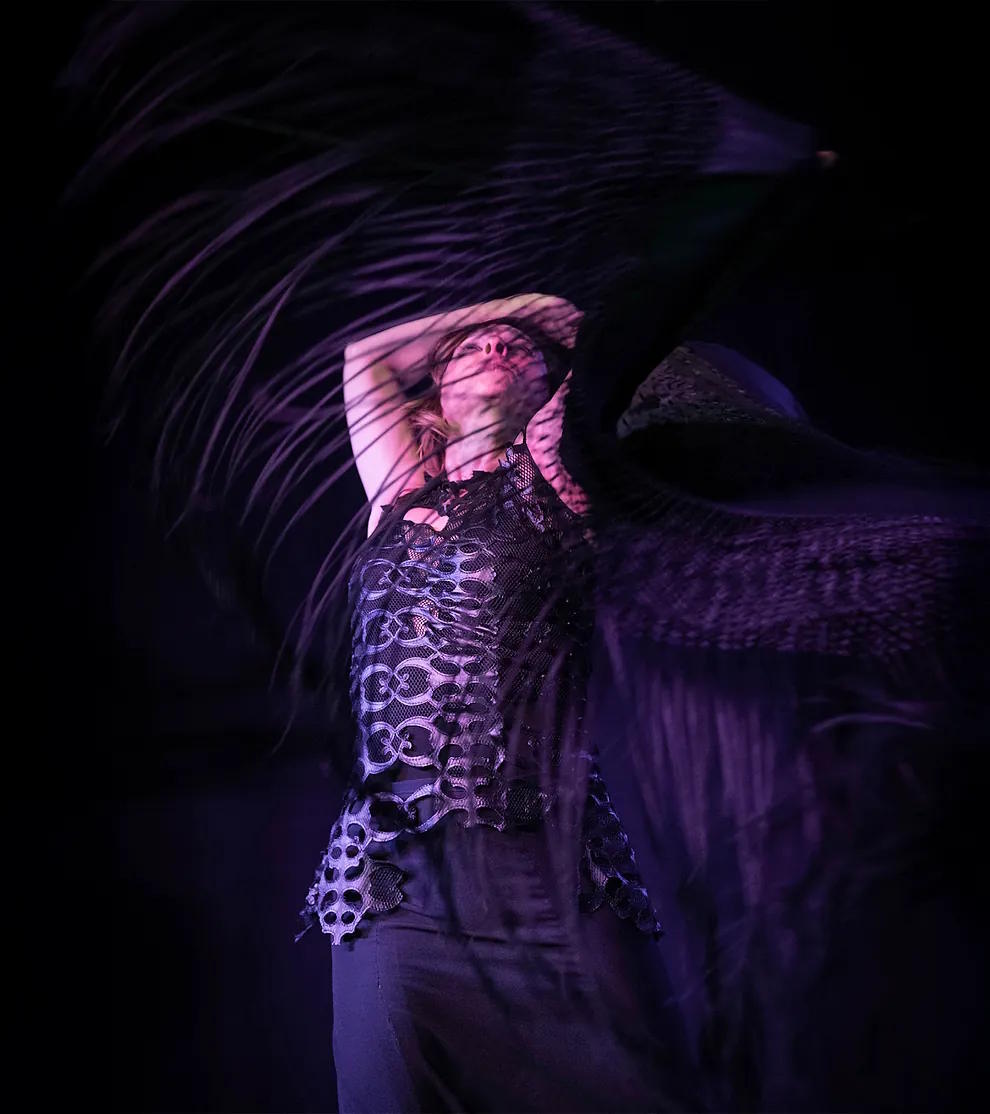
"I'm not sure how to explain it, but I can feel the plane through the seat. My body senses any variation and allows me to anticipate. That comes from dancing. I also have a lot of situational awareness; instrument navigation has always been very easy for me because, in my mind, it works like a choreography. And what about coordination. To fly, you need your hands, feet, and head. Just like in dance."
Pedro Monje started dancing at six and didn't stop until he was 33. For the past six years, he has been a commercial pilot at Air Nostrum. "It's a long process, like a divorce. You say goodbye to dance, and it says goodbye to you until each goes their separate way," he recalls, illustrating his abrupt turn of events, abrupt for anyone... except for him: "In aviation, you can't start a flight without an alternative, and that should be the life philosophy of any dancer: always have a plan B. There is life after dance, but it requires a lot of work to ensure that life doesn't go to waste."
"Suddenly, I saw myself old and out of shape. I was entering the unknown, completely." Alice Renavand, a star dancer at the Paris Opera Ballet, began reflecting on what piece she would perform on the day of her farewell three years before turning 42, the age of forced retirement in a company whose physical demands make it impossible to continue on stage beyond that age. Until then, the idea of afterwards had always been there, and yet, it was like peering into the abyss. A camera from the Arte channel accompanied her throughout the process, capturing, over a one-hour documentary, her Goodbye to the Opera.
There is no equivalent documentary in Spain. Nor is there retirement at 42 for dancers. Hardly anyone here talks about what happens when the body starts to fail on stage, or when the phone stops ringing because no one believes that the physique can maintain the level of youth.
"It's an absolute taboo, the dark side of a profession as demanding as it is glamorous. And yet, reality extinguishes everything too soon, and you go from a life where everything revolves around dance to a total void that is very frightening," laments César Casares, speaking from experience. A decade ago, he had to reinvent himself before reaching the midpoint of his professional life. Today, he works in the commercial department of an engineering company and, as a link to his previous life, keeps the conversation alive about what happens when a dancer stops dancing at the Transit Dance Studies and Initiatives Table for Professional Transition in Dance, formed by representatives of the main associations and companies in the sector in Spain, of which he is responsible for Institutional Relations.
"In no other job does professional training start so early, and in no other job, when you reach senior status, do you have to switch to something else," emphasizes Casares, also Secretary of Trade Union Action of the Confederation of Performing Artists ConARTE and President of the Dance Professionals Association in the Community of Madrid (APDCM). "30 years ago, it was assumed that, stepping off the stage, the dancer automatically became a choreographer or a teacher, but that idea no longer holds: there are not enough conservatories. Then, they all started becoming technical show technicians. That doesn't work either: there's not enough room for everyone. I made my professional transition from scratch, and my goal is that no other dancer has to go through the same hardships." He speaks of hardships as a former dancer, not choosing his words randomly. The end of a dancer's active life often leads to an existential void that can result in serious psychological and social disorders.
"As early as 35, many professionals start to encounter difficulties in working and feel rejected. By 40, no one wants them because their bodies don't perform the same. Injuries also take their toll, leading to a terrible lack of security and confidence," describes Amador Cernuda, a psychologist and neuroscientist specializing in High Performance and Deputy Director of the Alicia Alonso University Dance Institute at the Rey Juan Carlos University in Madrid. After collaborating with athletes in eight Olympics, he met the Cuban legend when she decided to turn her discipline into a university program and ended up specializing in the psychology of dancers. "They are high-performance athletes in every sense, except that, instead of competing, they create art; the processes are very similar, and the problems in retirement, too. We must prepare them so that this process does not end in tragedy," he explains.
After three decades of international research with retired dancers, the psychologist lists unfortunately common problems: "They face self-esteem and depression disorders that often lead to substance abuse and alcohol, eating disorders, and sleep disturbances. 70% show emotional disorders. Going from fame to oblivion is hard to accept."
Pedro Monje, the dancer-pilot featured in this report, says he doesn't consider himself an example of anything but rather an exception. Many of his colleagues have had less fortunate outcomes. "I was clear from the beginning that dancing had an early expiration date and, moreover, I had a very marked second vocation," says the Madrid native, who started dancing flamenco with the gypsies in his neighborhood as soon as he could stand and turned it into his passion until life demanded a change. "When they premiered the movie Billy Elliott, some journalists came to do a report at the conservatory, and I already told them I was going to be a dancer and then a pilot. Imagine, I was a child, and I already saw it very clearly."
At six years old, Pedro stood out in extracurricular activities at school. At nine, he passed the tests for the Real Conservatory of Dance Mariemma and specialized in Spanish and flamenco dance. By 18, he was performing professionally worldwide. At 22, he returned from a tour in Italy where he had been treated like a star and found himself without money to take a taxi home. "My mindset changed; that life couldn't be forever," he recalls. It wasn't an easy decision or, above all, a cheap one. Becoming a commercial pilot costs around 100,000 euros, a mortgage that the dancer could never afford. He was at the peak of his career and it made him immensely happy, but he knew that his professional stage, at that level, wouldn't last long. So, a family member paid his tuition, and then every euro he earned from dancing went towards his pilot training.
"I took any job I could. I danced in places where no one wanted to go: Lebanon, Russia, Niger, China, and hundreds of Spanish towns I can't even remember," he says. "I worked a lot because I needed the money. And the truth is, I enjoyed it a lot." At 23, he began his pilot training in parallel with a rising career on stage, and three years later, he turned down an offer from Qatar Airways, which offered to finance his training if he stayed with them because it wasn't the right time: "I wanted to dance. The planes would come when the music stopped."
The silence arrived gradually. At 27, he saw himself on stage and liked himself. At 31, not so much. "Deciding to become a lawyer or economist when you see the twilight of your career approaching is pointless. You have to start preparing when you're still at the top."
"It's like a divorce, you say goodbye to dance, and it says goodbye to you until each goes their separate way."
Right at that vital moment is Aitor Arrieta, at 31 years old the lead principal at the English National Ballet (ENB), the highest distinction in the British company, and a second-year student in a double degree in Business Administration, Finance, and Accounting after completing a higher vocational training in Business Administration. "I've been good with numbers since I was little, I even enrolled in Telecommunications, but only lasted six months because I joined the National Dance Company (CND) and it was completely incompatible," he explains over the phone from London, where he arrived in 2016 with Tamara Rojo.
The uncomfortable conversation about what happens when a dancer gets older is a common topic in England that is addressed without any trauma. "Having a plan B is clear here from the moment you enter this world," says the Guipuzcoan. The organization Dancer's Career Development is responsible for supporting professionals in that transition, which begins long before it actually becomes a reality: they provide guidance through talks and meetings several times a year and also fund their studies through a private scholarship fund financed by sponsors. "In Spain, it is unthinkable for a company to give money to a dancer to study. It is a cultural but also fiscal issue, here that patronage relationship is highly encouraged," explains Arrieta.
"You have to consider it from the beginning: it is impossible to keep dancing until you are 60," he admits. With that in mind, in 2019 he founded Nexus Company with two other Spanish dancers - one of them still active in the CND and the other already retired - Nexus Company, an events company inspired by a highly successful model in the UK. "Here it is very common to hire the ENB for company dinners. Between the first and second course, some dancers perform a choreography," he explains, laughing when the interviewer asks: "like a student music band?" "So, my studies are focused on managing my company. It has been a natural progression, not a sudden decision to become an accountant, although a colleague of mine became a plumber and is doing great," he says.
The first time César Casares heard about professional transition was at a European meeting in 2009, and suddenly everything made sense to him. He started going to conservatories to gauge how they received those two terms, and they asked him if his intention was to create young ballets. "The transition is the entry into the profession, yes, but I am talking about the other side, the exit," he responded, realizing that the revelation he had had was not even being considered in education. "It meant introducing a disruptive element into a highly hierarchical system of absolute physical and psychological dedication," he explains. He then embarked on a "slow and steady" effort that now includes a proposal for the development of a program in Spain based on models that other European countries have been perfecting for half a century, involving public funding for retraining studies through contributions from both the artist and the company, and the creation of a public foundation to manage that subsidized training to prevent fraud, similar to the one advising the National Ballet of England.
"In countries with specialized professional transition programs, 80% find work in what they were trained for in the first year," argues the pilot program draft. "The earlier this process begins, the better the prospects for success." "In countries that support this transition, dancers continue to be active citizens who pay taxes. In our country, dance is a world of very low remuneration, a way to waste talent and very regrettable personal skills," adds the author.
The precariousness makes dance professionals a group at risk of social exclusion. According to the Socio-Labor Study of Actors and Dancers in Spain 2023/2024 by the AISGE Foundation, responsible for managing the intellectual property rights of actors, dubbing artists, dancers, and stage directors, only 23% earn over 1,000 euros gross per month, and 48% earn less than 3,000 euros per year. 72% of Spanish performers are below the poverty line. Not surprisingly, the National Dance Company and the National Ballet are in negotiations with the Ministry of Culture after a strike attempt. The gross salary of a dancer in the Spanish elite is around 24,500 euros per year, about 1,700 euros per month, with an additional 300 euros for schedule changes and overtime. And they, at least, have a contract. "I handle files of dancers who are 60 years old and have only four contributions. What do you do with that person?" asks the Transit spokesperson.
"Freelancers who haven't managed to make a big name for themselves suffer greatly in this country," confirms Ana Arroyo, who is still active in her 40s, although she has been aware for over five years that her future is to reinvent herself or perish. "I feel very good physically, but at my age, I can no longer aim for certain companies or accept certain choreographies. I can't go all out like before. An injury now is more serious, and if I stop, I don't eat," she explains from the flamenco stage Las Tablas, in Plaza de España, Madrid, between photos. For her, turning 40 marked a before and after in her professional life. She returned after five years between Brussels and Macao with Franco Dragone, one of the creators of Cirque du Soleil, and a lifetime in the forefront of Spanish dance and flamenco, and she collapsed, "from the top to absolute nothingness." "As if I had died. Little by little, things are emerging, but you go from three simultaneous productions to having nothing. I admit that I'm struggling with this, I can't live with this instability anymore."
Arroyo is resisting fiercely to stay away from the stage, although she has come to realize that her place is increasingly behind the scenes. After the pandemic, she started studying production, something she has been doing all her life although she has no official recognition for it. "You move to the other side and it seems like you're starting from scratch," she laments. "You rely on friends and acquaintances, but if you don't get a helping hand, it's very difficult for a company to trust you over someone who has just finished studying, even with much less experience. You learn to relax, otherwise, all dancers would have heart palpitations, but inside you, there's a clock that keeps ticking: tick-tock, tick-tock!"
César Casares argues that, beyond political will, the change must start from within, breaking a historical taboo that, for him, would make dance stop being "a grinder of people." "It is said that dancers don't sweat, they shine," he says. "But it must also be stated unequivocally that here, they sweat, and a lot. The show must go on, but only as far as it can go."