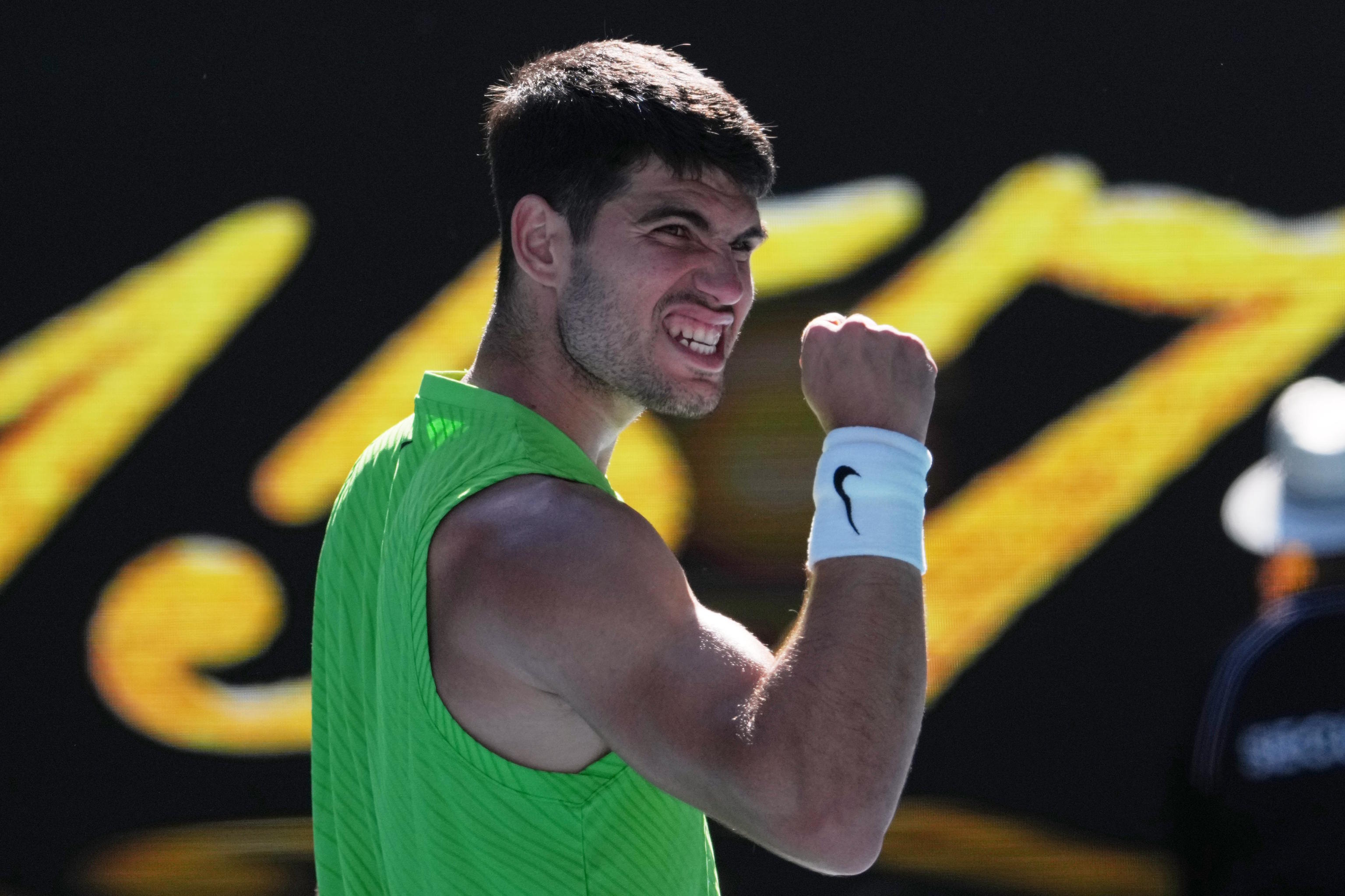
A couple of hours before the match, Carlos Alcaraz was having a chicken breast at the Cambio de Tercio restaurant inside the Rod Laver Arena, observing the swaying of the trees at Melbourne Park through the large glass windows of the venue, and acknowledging what was coming: it wasn't going to be easy. Summer in southeastern Australia is as cheerful as summer anywhere else in the world—those who love the cold won't understand—but there are days when it hides. A cold Antarctic wind rises, and you are in shorts. A cold Antarctic wind rises, and Alcaraz has to deal with it on the court.
As in the first round against Adam Walton, his victory in the second round of the Australian Open against Yannick Hanfmann, by 7-6(4), 6-3, and 6-2, was complex, uncomfortable, and unattractive. He has not yet enjoyed a calm day in the Grand Slam. Perhaps it will come in the third round, on Friday, against Corentin Moutet.
Or perhaps it won't come in the entire tournament; that would also be logical. In his return after a two-month break, Alcaraz is seeking that rhythm, that feeling, that something that competition gives you, and when he finds it, he will face the most powerful opponents. Against Hanfmann, he appeared nervous, affected by the time change—he debuted at night and this time it was noon—and bothered by the wind. After certain points, he showed signs of bewilderment and even made some disparaging remarks; complaints in the air, quite literally. In the first set, a period that lasted 78 minutes, he started with issues with his forehand that led to several unforced errors, and soon found himself with a break against him. The 1-3 on the scoreboard was a threat.
There was a long time when nothing was going right for Alcaraz. If he juggled with the racket, it fell. If he played with the balls, they slipped away. But Hanfmann's break of his serve forced him to react as quickly as possible. In the following game, he regained the break, and in the decisive tie-break, he was brilliant. His serve and his backhand down the line, the two shots that are working best for him in Australia, secured the victory, and the rest of the match unfolded differently. Before the start of the third set, in fact, Hanfmann was left with abdominal pain, and his game suffered.
It was a pity for him. Because until that moment, he deserved more, much more, at least to take a set. At 34 years old, outside the Top 100 of the ATP ranking, the German appeared before Alcaraz as a seasoned opponent. A strong guy, one of many, already in decline. Indeed, the Spanish player could even recall how in 2019, when he was only 16 years old, he defeated him in the challenger in Seville and imagine an easy victory. But Hanfmann was making a statement.
With a delightful forehand, very similar to the one that brought glory to Andy Murray, he took all possible risks and besieged Alcaraz as much as he could. His return, deep inside the court, showed that if he had to go down, he would do so fighting. In the Rod Laver Arena, before a massive audience, he was determined to prove that his tennis could be better than his record indicates. And with that, he forced the number one to act like a number one. Amidst the wind, the time changes, and the lack of rhythm, Alcaraz stayed standing, which is ultimately the only essential thing.
"The audience looks at the ranking and thinks it will be an easy match. But each opponent is different, and there are opponents who make you feel uncomfortable on the court. Also, the conditions change, the other day I played at night, today there was wind... I am very happy to have overcome the first set and improved afterwards," analysed the Spanish player who, at the end of the match, sent a message to the victims of the train accident in Adamuz: "Lots of encouragement to those going through in Spain."