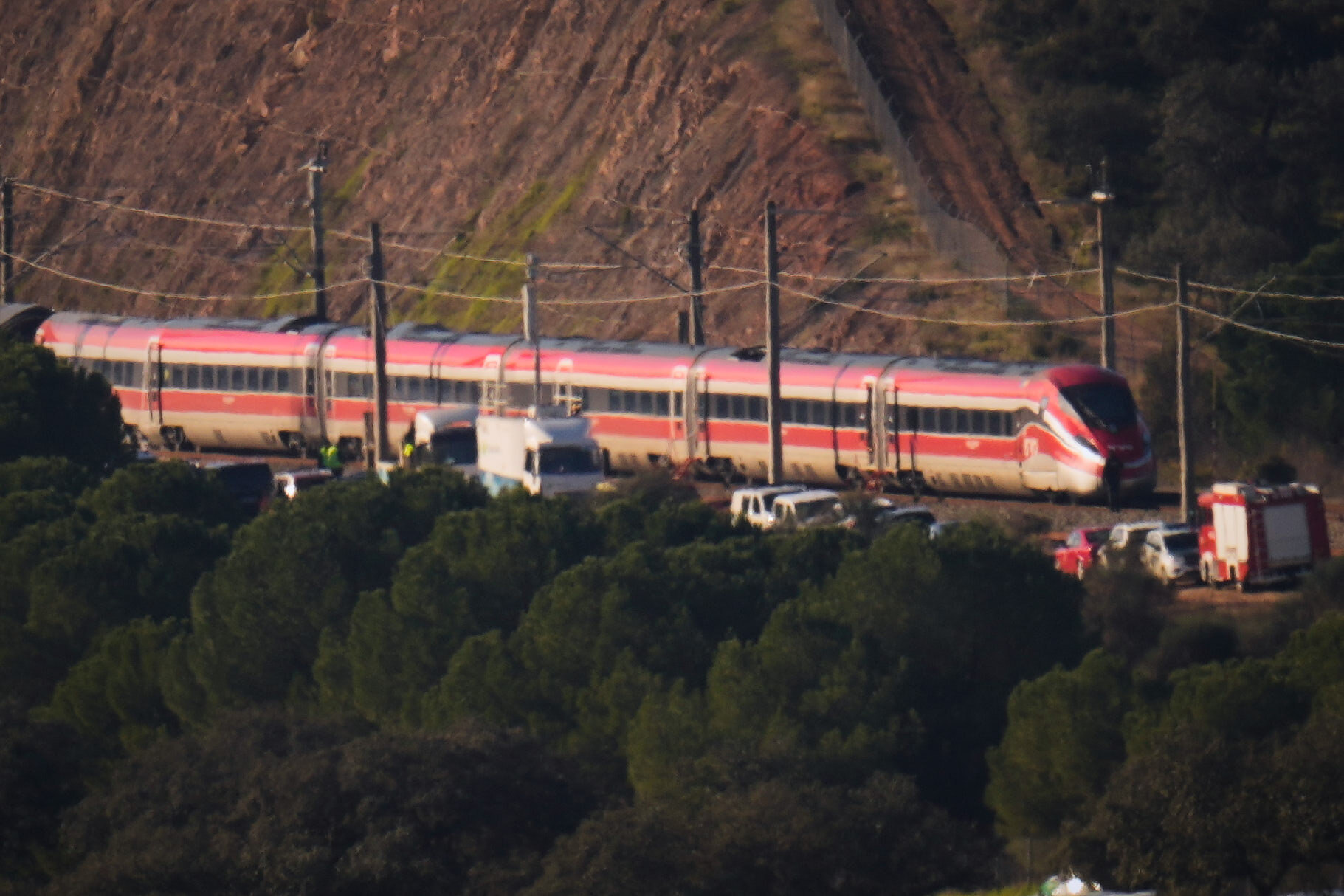
As the days go by, investigators of last Sunday's accident are narrowing down the circle around the rail breakage in Adamuz as the main cause of the tragedy that claimed 43 lives. Yesterday, Minister Óscar Puente confirmed the exclusive report by EL MUNDO which revealed the discovery of notches on the wheels of the first cars of the Iryo, the ones that did not derail. These marks were caused by a welding fault on the rail, which worsened as the Italian company's train passed over it. A growing erosion that eventually led to the complete collapse of a section of over 30 centimeters of the track, causing the rear cars of the Iryo 6189 to derail, invading the opposite track and becoming a deadly obstacle for the RenfeAlvia that, unfortunately, was travelling towards Huelva on the opposite track almost at the same time.
However, the track deterioration did not occur suddenly, but it was already present on the route before the Iryo 6189 passed over it. In fact, after confirming the rail breakage, matching it with the train's metal wheels, and confirming their relation, the technicians from the Commission of Railway Accidents Investigation (CIAF) who will prepare the report on the accident requested access to trains that had previously travelled on the same track. With Ouigo out of the picture after unexpectedly deciding on January 8 to temporarily withdraw its trains from the Madrid-Andalusia corridor, the affected vehicles could only belong to Renfe and Iryo, which keep their vehicles at the Santa Catalina workshops in Madrid.
Although initial reports suggested that the focus of the investigation was on the rail breakage and that this breakage had left marks on the train wheels as evidence of a possible derailment, the Ministry of Transport initially denied this. Minister Óscar Puente, who on Monday stated that the theory put forward by this newspaper was mere "speculation", admitted yesterday in a press conference, three days after the accident, that these marks were also found on trains that had preceded the Iryo 6189 and that it is an "undeniable possibility" that the marks were caused by a rail defect.
Among the trains analysed, investigators discovered that a Talgo train that had travelled on the same section earlier that day also had notches on its wheels, due to rail defects. According to sources familiar with the process, these marks are similar to those seen by CIAF technicians on a previous Iryo before the accident. This verification was carried out live at the Renfe workshops in Puente de Vallecas, Madrid. These are deep abrasions, the size of a 50-cent coin, which have become crucial evidence pointing towards the track as the main reason for the derailment. Two Iryos and a Talgo have them, without ruling out that they may appear on other trains that passed through a point now marked in Spanish transport history.
The investigation increasingly focusing on the poor state of the track, over a possible mechanical failure in the trains or a rail breakage due to the dragging of a piece or obstacle - a possibility that was losing strength yesterday - is causing great concern in the railway world. There is still time to learn the CIAF report, but if confirmed, it will be a blow to the image of Spanish high-speed rail, an infrastructure exported through construction and maintenance contracts by multinational groups.
For now, all stakeholders in the industry are looking to Adif for explanations and safety assurances on the tracks. "Something very dangerous has happened, and we don't know if it could happen again," say industry sources. The question being raised now, with increasing urgency, is whether that rail fault in Adamuz could appear at another point in the Spanish network. Are there more welding faults?
Puente ruled out an audit of the 4,070 kilometers of the network yesterday, although the high-speed limits have been reduced on the Madrid-Barcelona and Valencia corridors since Tuesday while problematic sections, such as Adamuz, are being reviewed. Up to now, the guarantees seemed to be maximum and sufficient, even with four checks at each joint of a new track installed, but this, for now, unexplained breakage is causing fear among train drivers, manufacturers, operators, and users. "Those welds cannot dissolve by magic or by train use. Either they were done incorrectly, or the controls were not rigorous. That's what needs to be investigated now," comment sources from the accident investigation that has so far claimed 43 lives in the Cordoba town.