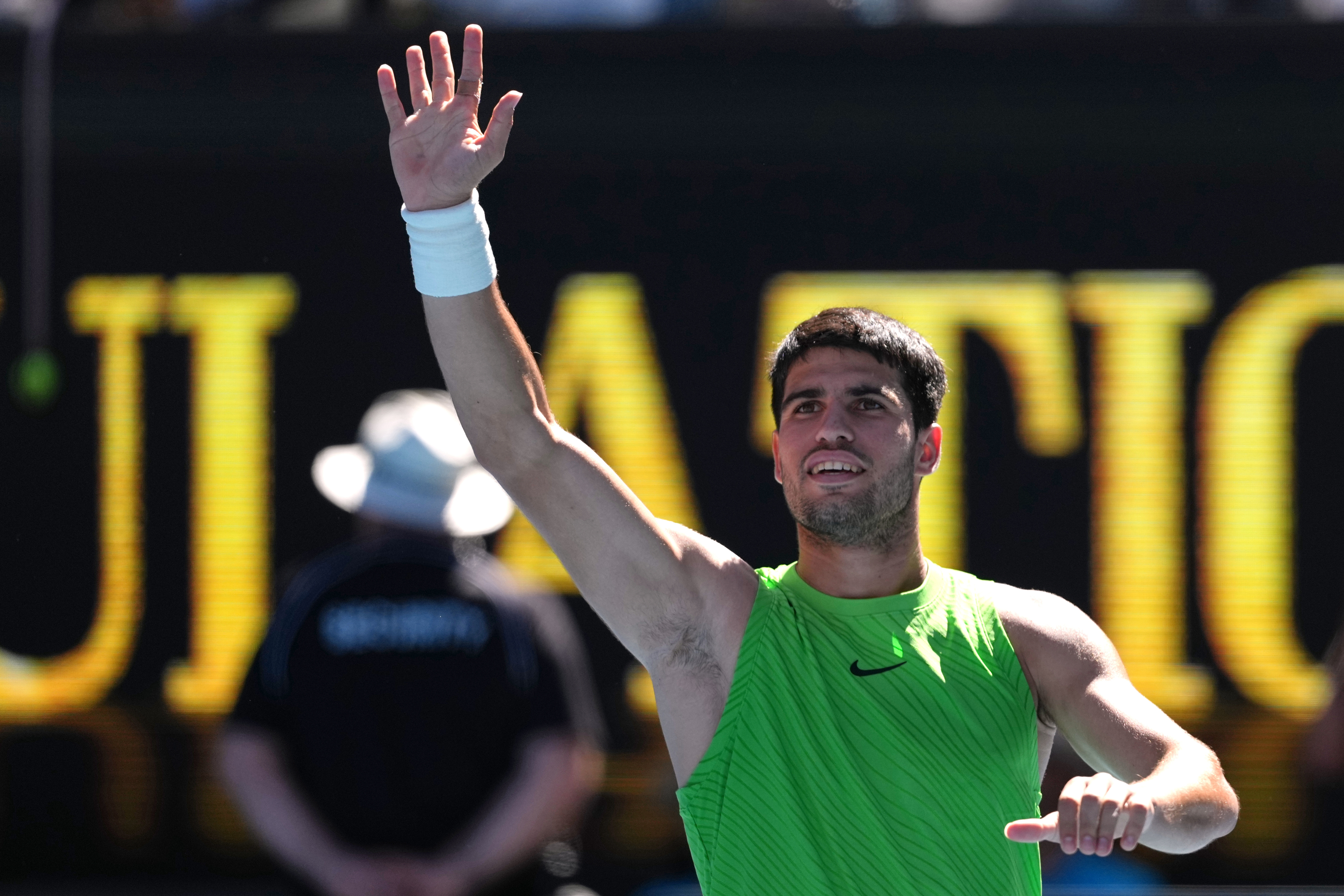
What good is an ovation? In most scenarios, a burst of applause is everything: recognition, success. But in tennis, it's not like that. Tennis is not a place for artists; it's so cruel. After every trick that amazes the audience, you have to win another point, and another, and another, and in the end, the magic is buried by defeat. In tennis, an ovation is worthless.
Corentin Moutet presented himself to Carlos Alcaraz with his palette of trademark shots—his drop shots, lobs, topspins, tweeners, underarm serves—and the fans had a good time, they really did, but the Frenchman had no chance. The score, which ended up reflecting a 6-2, 6-4, and 6-1 in two hours and five minutes of play, condemned his artistry. At times, the third round of the Australian Open turned into an exhibition and was great fun; that will be his consolation. If you missed it, watch the highlights, they will be worth it.
There were multiple exchanges for the show, and the editors of the various TV channels will have plenty to choose from. However, the rest of the points were dominated by Alcaraz. His superiority over Moutet was so evident that you could hear it; you didn't even need to open your eyes. His shots sounded as usual, one detonation after another, while the Frenchman made a different noise, a murmur. If he didn't come up with something new, he lacked strength. Or, rather, he came up with something new because he lacked strength. Occasionally, Moutet unleashed his forehand from the back of the court and seemed dangerous, but he did it so rarely, it was so exceptional, that it didn't pose a real threat. The risk for Alcaraz was in relaxation.
The second set was evidence of this. In the first 45 minutes of the match, everything was settled. The number one also likes to entertain the fans, but his game is based on the power that modern tennis demands, and his forehands found no response on the other side of the court. With 6-2 and 3-0 on the scoreboard, his qualification for the round of 16 was just a matter of time. But then Moutet set a trap for him. Amidst the tension of a Grand Slam, on a crowded court like Rod Laver, he invited him to dance with shots as unusual as a couple of underarm serves, and Alcaraz accepted the challenge.
Amidst the excitement of the crowd, both began to seek the most difficult shots. And suddenly, the Spanish player conceded four consecutive games, two breaks against—from 3-0 to 3-4—and had to get back to work. It didn't take him long to recover, but he will have to learn from what happened. Until the end of the match, he could have fun, yes, but the most important thing was the victory. In the next round, he will face Tommy Paul, which won't be as easygoing.
"It's not easy to play against someone like Corentin, you never know what's coming. The good thing is that it has been fun for everyone, there will be many highlights," commented Alcaraz, joking about the number of drop shots Moutet had played. The Frenchman approached the net 55 times, and in the end, he claimed to be "exhausted": "There was a moment when I told my team that I wasn't going to run after drop shots anymore. Normally, I'm the one using that shot, now I see what it causes."