n the days leading up to the 2024 US Open, Elena Rybakina dismissed her coach, Stefano Vukov, who then proceeded to pursue her in the hallways of her Manhattan hotel, sending her dozens of messages and trying to call her over a hundred times. He was seeking another chance, he claimed. But his harassment forced Rybakina to file a complaint and reveal that during training sessions he would call her "stupid" or "retarded." "He told me that without him, I would still be picking potatoes in Russia," she stated.
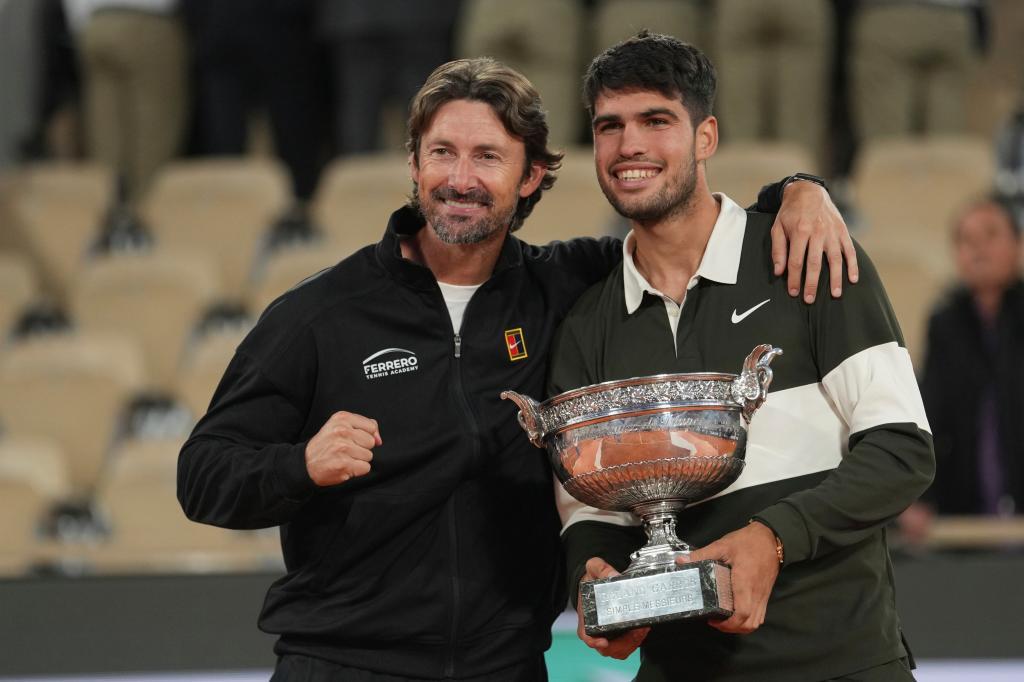
The WTA circuit intervened to disqualify Vukov, but the extreme episode highlighted an evident fact: the relationships between tennis players and their coaches are very, very, very complicated. The split between Carlos Alcaraz and Juan Carlos Ferrero prior to the current Australian Open is just one more within a long tradition of disagreements, amicable separations, and, in extreme cases, traumas. Throughout history, very few players have kept the same coach throughout their career, and it will continue to be so. It is a union that always tends towards divorce.
"These relationships are never easy. You pay someone to tell you what to do. It's a strange situation. In tennis, you experience it from a young age, getting used to it from the private lessons your parents hire, but still, it's odd. It generates conflicts, and the balance is very delicate. If we think about the greats of history, even the relationships of Rafa Nadal with his uncle Toni or Novak Djokovic with Marian Vajda had an end," writes Garbiñe Muguruza in this newspaper, who throughout her career followed a classic pattern of changing coaches: from the one who helped her in her development -Alejo Mancisidor- to the one who accompanied her in her Grand Slam victories -Sam Sumyk-, until reaching the one who kept her at the top -Conchita Martínez-. She needed one thing from one and another from the other. Hence the difficulty for relationships to last.
Each player demands something different, and their requirements evolve: coaches have the impossible task of adapting quickly. The renowned Patrick Mouratoglou shared that when he stopped coaching Serena Williams and started guiding Simona Halep, he realized he couldn't follow the same methodology. Williams wanted to lead, and Halep wanted someone to lead her. For Mouratoglou to understand this, the Romanian had to suffer an anxiety attack during a match at the 2022 Roland Garros.
Ultimately, establishing a connection is essential, and there are two paths to achieve it. There's the player who embraces a coach and keeps them for many years to build that bond, like Aryna Sabalenka with Anton Dubrov. And there's the player who jumps from coach to coach in search of a magic that never seems to arrive, like Emma Raducanu. The British player, winner of the 2021 US Open, has already worked with a dozen coaches - the latest being Francis Roig, a former coach of Rafa Nadal - and her career has yet to take off.
"That can happen, and it's very ungrateful for the coach. For three or four months, you offer all your knowledge to a player, and suddenly, they decide to change. But it's not the norm. Everyone knows that a coach-player relationship requires a minimum time to yield results. Our job is very beautiful but very difficult," defines Marc López, also a former coach of Nadal, who assisted Jasmine Paolini and now advises Marie Bouzková.
"It's a job that also demands many sacrifices, especially in terms of travel," comments López, now a commentator for HBO Max and Eurosport - the platform broadcasting the Australian Open - which is why he doesn't see Nadal on the bench of any player soon: "I find it hard to see, he now wants another life." Although some coaches miss certain tournaments, it's rare for a head coach to only attend Grand Slams and a few more tournaments, as Ferrero proposed. Accompanying the player throughout the season is a basic requirement, although, of course, it is rewarded.
Unlike in football or basketball, in tennis, the base salary is not the most important: the percentage of prize money is crucial. It's common for a coach of a Top 10 player to receive 5% of the prize money, with more modest players giving up to 10%. Many variables can come into play, but it's key to establish all the job conditions in contracts. This is where the relationship between Ferrero and Alcaraz broke down, although it had already been strained before. It is a union that always tends towards divorce.