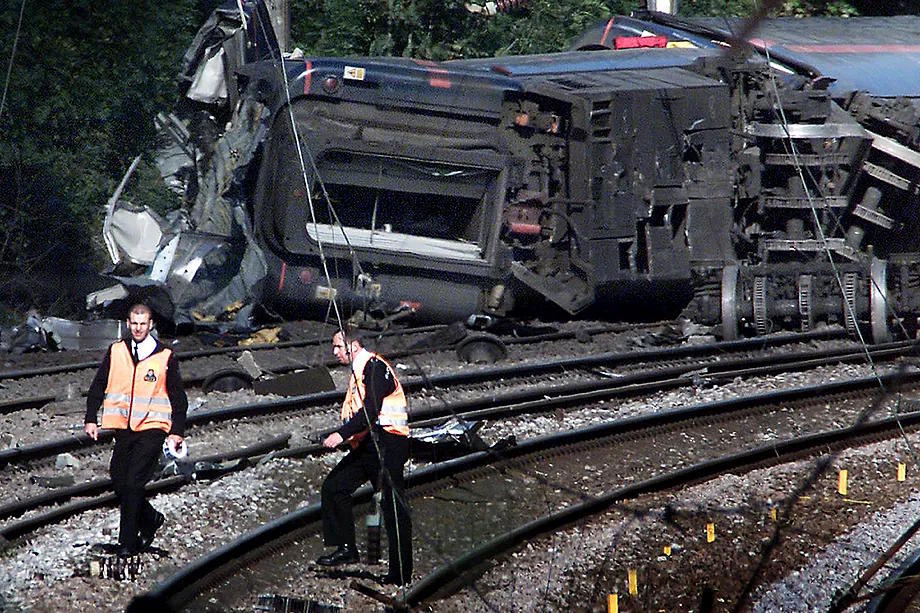
There are sounds a nation never forgets. For the United Kingdom in 2000, that was the sound of steel shattering like porcelain. Although unheard, that noise haunted the British railway industry and changed it forever.
It was October 17, 2000, at 12:23 pm. On that day, an InterCity 225 train - the 'jewel' of high-speed rail in the UK at the time - operated by GNER (Great North Eastern Railway), traveling at 185 kilometers per hour from London to Leeds, turned into an uncontrolled projectile just 800 meters from Hatfield village station, a little over 30 kilometers north of the British capital. Four people died, and 71 others were injured in an accident that marked a turning point in railway safety management in the UK.
The tragedy, although with far fewer victims than Adamuz, shares similar elements to the shocking incident that has shaken Spain. The Hatfield derailment was primarily due to metal fatigue, causing the track to disintegrate "like a sheet of glass," according to the official accident investigation. However, the deeper causes were a disastrously executed privatization handing over railway management to private companies operating under a regulatory system that provided perverse incentives to neglect track maintenance.
The symbol of this disastrous railway safety management was not a victim but the metal itself: rescue services found, next to the disintegrated rail, another rail, completely new, brought there for replacement, which had been left exposed to the elements for five months and 19 days. Today, with the memory of the recent railway accident in Adamuz still fresh, the ghost of Hatfield returns to remind us that engineering also carries a moral responsibility.
Just like in the Spanish accident, everything came as a surprise when suddenly the train started experiencing what survivors would later describe as "a hellish vibration," culminating when, as the restaurant car of the convoy passed, the left rail of the track shattered into over three hundred fragments. The train derailed, with the restaurant car bearing the brunt, violently overturning, hitting an overhead line post that tore through its structure as if it were cardboard. Four passengers - three men and one woman - died instantly. The images of rescue units working among twisted metal in the midst of an English countryside autumn circulated worldwide. But the real tragedy lay in the laboratory analyses of the track.
The technical cause of the tragedy has a name: Rolling Contact Fatigue (RCF). It is a problem where the constant pressure of steel wheels on the rail creates microscopic cracks. If these cracks are not detected and rectified in time, they propagate inward in the metal until the rail, unable to bear the weight, shatters. The experts from the body responsible for railway safety in Britain, the Health and Safety Executive (HSE), concluded in their final report that at Hatfield, the rail was so degraded that it behaved "as if it were made of glass."
In reality, the HSE analysis was more of an autopsy of not just steel failures but of corporate and regulatory negligence. The Hatfield track section had been classified as defective for 21 months. The maintenance company had placed a spare rail next to the track in April. When it shattered, it had not yet been installed.
The reason for this paradox is a warning about a terribly executed privatization. Railtrack, the track owner, operated under a perverse incentive system created by the Railways Act passed during the Conservative government of John Major in 1993, which handed over the entire sector to the private sector without any regulation. The system established contracts between Railtrack and train operators, where if the company had to close a track for maintenance, it had to compensate the operators in case of delays. As noted by the National Audit Office in 2001, this created a dynamic where it was more "cost-effective" to risk infrastructure failure than to face penalties for lack of punctuality. Safety had become a cost that managers, pressured by shareholders, preferred to postpone.
Railtrack had subcontracted maintenance to companies like Balfour Beatty, responsible for the section where the accident occurred. The fragmentation was such that the "track memory" was lost. Engineers familiar with the terrain were replaced by managers. Responsibility was diluted in a tangle of private bureaucracy where, between them, the track was left unattended.
After the accident, panic spread at Railtrack. The fear that thousands of rails were on the brink of failure led to over 1,200 emergency speed restrictions nationwide. The UK experienced the so-called "Great Lockdown," with two-hour journeys extending to up to seven hours. The combined effect of delays and fear of further accidents eroded user confidence in railways.
This chaos, along with massive compensations, pushed Railtrack into administration a year after the tragedy. The Labour government of Tony Blair intervened by effectively dismantling Major's private model to create Network Rail, a non-profit entity that returned maintenance to public control and, most importantly, rehired workers directly to avoid the coordination and commitment issues that subcontracting had caused. Six years after the incident, the Corporate Manslaughter and Corporate Homicide Act 2007 was passed, allowing a company to be criminally prosecuted not for an operative's mistake but for the "culture of negligence" within its leadership.
Hatfield left an uncomfortable lesson: railway safety does not fail suddenly but accumulatively. It is not the steel that decides to break but the system that decides for years not to listen. In Spain, the British mistakes have been avoided. The railway organization is based on two companies —Adif and Renfe— but with a higher state authority prioritizing safety.
However, the Adamuz accident once again raises the same technical challenge: material fatigue on high-speed lines. Modern trains are lighter, but frequencies are higher, and speeds are greater, subjecting steel to continuous and cumulative stress. The lesson from Hatfield is that detection technology —ultrasound, inspection trains— is futile if not accompanied by a political and corporate will to halt service when the metal starts to signal.