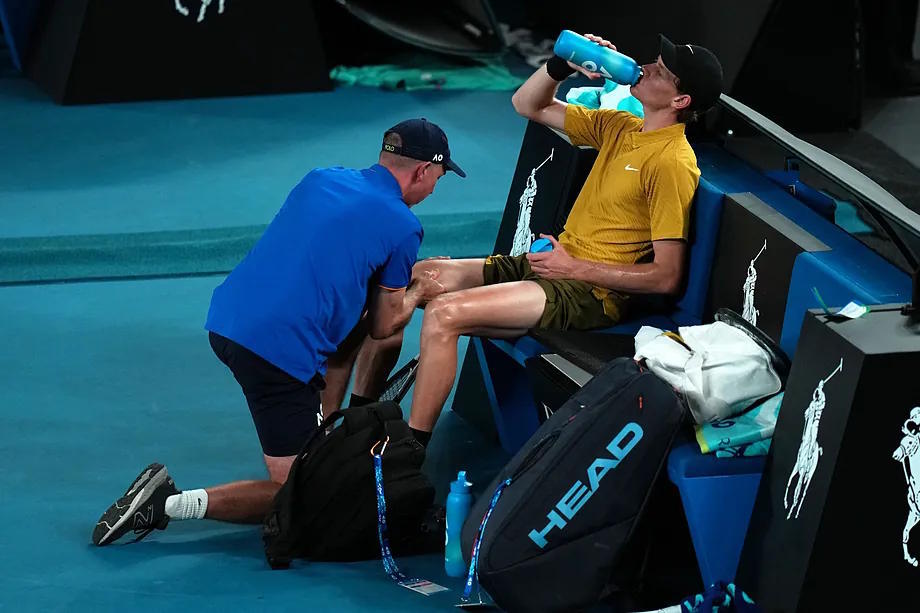
At the 2008 US Open, before his breakthrough, Novak Djokovic seemed like the patient in the Operation game: when his hip didn't hurt, his stomach did; if not, a leg... In the round of 16, against Tommy Robredo, he asked for two medical timeouts, and in the quarterfinals, against Andy Roddick, one more. "What's next? Bird flu? Anthrax? SARS?" Roddick mocked after his defeat, and at that moment, the legend was born: Djokovic, master of the dark arts.
Throughout his successful career —the most successful in tennis history—, the Serbian has used medical timeouts —called MTOs— and bathroom breaks on multiple occasions as another strategic element. "I take advantage of that moment to mentally reconnect and change the environment," he admitted years later at Roland Garros, and in response to the controversy surrounding his case and many others, the ATP circuit toughened the rules in 2022.
Has the controversy ended? Not at all. At this Australian Open, the debate on health, timeouts, and tactics has returned with force thanks to another champion, Jannik Sinner, who yesterday qualified for the quarterfinals by defeating Luciano Darderi 6-1, 6-3, and 7-6(2), in two hours and nine minutes.
Every respectable sport has its tricks, those actions that push the rules to the limit. In football, forwards dive in the box looking for a penalty; in basketball, shooters collide with defenders to draw a foul... In tennis, timeouts are requested to stop matches at convenience.
Since the change made four years ago, ATP rules state that players have the following options: for each ailment they feel, they can request a three-minute break, and in a five-set match, they can go to the bathroom twice. Those visits should last less than three minutes, and if changing clothes, the limit extends to a maximum of five minutes. The regulation is clear: few and short timeouts. But in practice, matches still stop for as long and as many times as the players desire.
"The three minutes of treatment start after our medical assessment, and we have no time limit. We are under pressure to be quick, but we must do our job," comments physiotherapist François Morency, who often works at ATP tournaments. Last year here, at the Australian Open, Sinner felt dizzy in his round of 16 match against Holger Rune, and his medical timeout lasted 12 minutes because it included a cardiac test in the locker room.
MTOs often exceed the three-minute regulatory limit, and there are other exceptions: some claim various ailments to be treated twice or make exaggerated excuses to extend their bathroom visit longer than necessary.
The tactical effect of these tricks is imaginable: they change the course of the match. A study by the University of Manchester concluded that players who are losing request a 55% more timeouts than those who are winning, and an analysis by the Wall Street Journal revealed that Djokovic wins 84% of the sets he plays after breaks —when his usual average is 79%—.
The effectiveness of the strategy is what raises suspicions and is why Sinner is now being singled out. Before his match in Melbourne against Rune, exactly 12 months ago, at Wimbledon 2024, he had already stopped a match twice against Daniil Medvedev, which he would end up losing, and then, in the US Open semifinals last year, a medical timeout halted his opponent's attack, Felix Auger-Aliassime.
In the controversial suspension of his round of 16 match against Eliot Spizzirri last Saturday due to the heat, there were many criticisms of the timing chosen by the organization to stop the game and roof the Rod Laver Arena, but also of the possibility that the Italian could then enjoy a second rest period. It was just what Sinner needed, who already masters the dark arts of tennis like Djokovic.