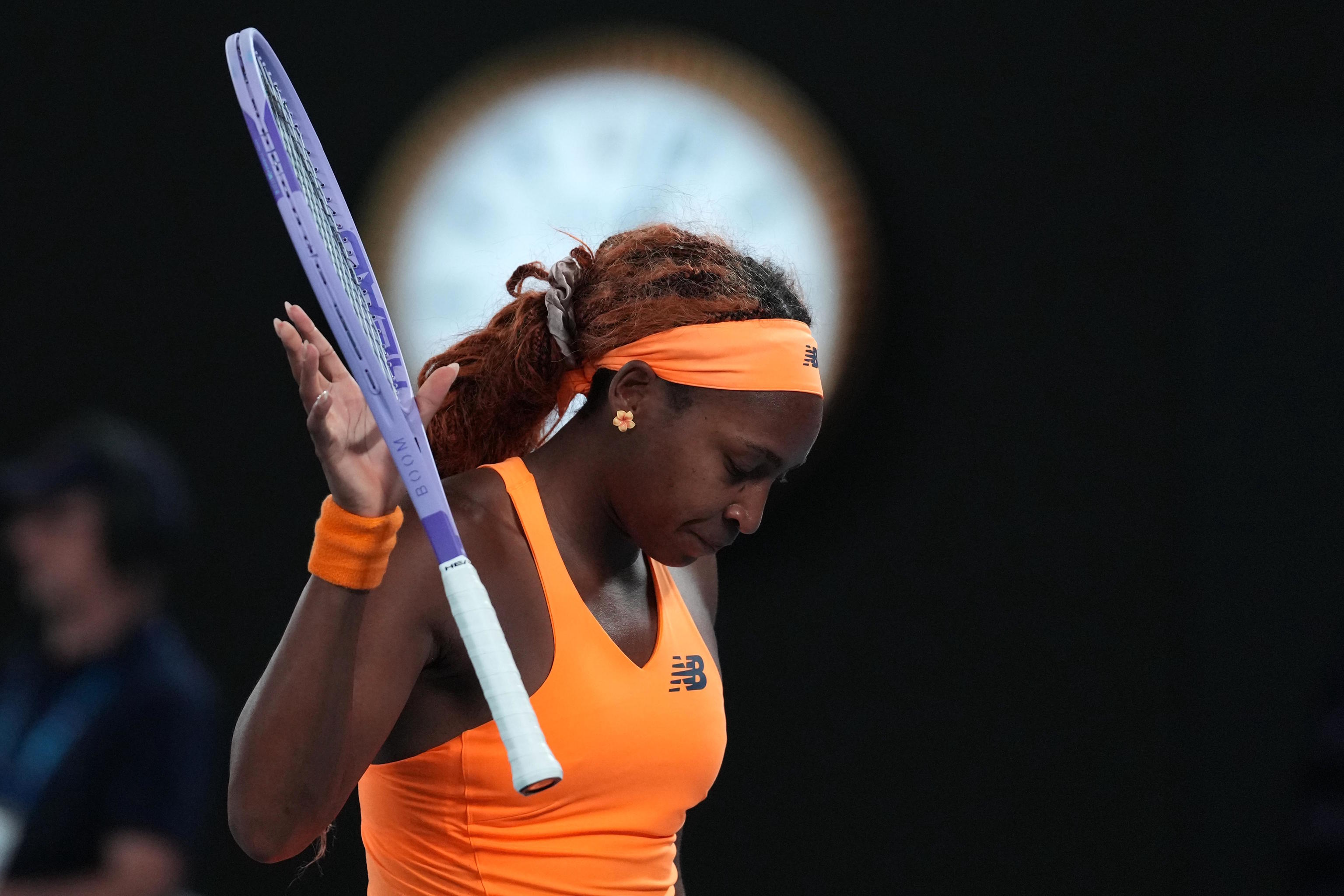
Coco Gauff endures. She has just lost in the quarterfinals of the Australian Open against Elina Svitolina with a painful 6-2, 6-1 defeat, but she endures. She leaves the court, walks down a long corridor, crosses the players' warm-up area, approaches the locker room, and still endures. But there comes a moment when she thinks she is alone. Behind a wall, no one can see her, and there Gauff smashes her racket. Once, twice, thrice, and so on up to seven hits against the ground that destroy the device and allow the American to exorcise all her troubles or, at least, let off some steam. Then she goes to the shower. And when she comes out, she finds out that there was a camera just behind, and her despair has already been broadcasted by ESPN or Eurosport and is going viral on the internet. Bad luck? No. "Lack of privacy."
After the incident, numerous players raised their voices against the live broadcast of all their steps in the Grand Slams and opened a debate: to what extent should athletes participate in the reality show organized around them.
"I don't like people seeing me like that, and I looked for a place where I thought there were no cameras. Unfortunately, that was not the case. I know myself, and I don't want to take it out on my team when I'm angry because they don't deserve it. I try not to smash rackets in public to set a good example for young people, but I needed to let off steam to avoid taking out my irritation on others," confessed Gauff, who herself recalled past incidents.
Over two years ago, at the 2023 US Open, the international broadcast showed how Aryna Sabalenka smashed her racket inside the locker rooms after the final, sparking the same controversy. Back then, there were players who excused the broadcast of her reaction, and Sabalenka received a $20,000 fine from the WTA circuit for giving a bad image. This time, however, perhaps due to the repetition or perhaps due to Gauff's character, the entire community came out to defend the American's privacy.
"Are we tennis players or zoo animals being observed even when we relieve ourselves? People are supposed to watch us on the court and in the press room. That's our job. That's it. Our job is not to provide entertainment all day or become a meme when we forget our accreditation," commented Iga Swiatek, empathizing with Gauff as a mishap of hers was also going viral.
A few days ago, she forgot her accreditation before entering the Rod Laver Arena to play a match, and the entrance guard did not let her in: she had to wait there, motionless, at the stadium entrance until her coach appeared. "Oh, yes, it was very funny," she said ironically. "With these things, people have something to talk about, but it's not pleasant for us. I don't think it's necessary."
Like her, other players also spoke out against broadcasting images from the locker rooms, as did Jannik Sinner and Novak Djokovic. "I empathize with Coco. It's sad that there isn't a single place where you can step aside and be alone with your joy, frustration, or anger. Unfortunately, we live in a society obsessed with content," said the Serbian.
According to a source from the Australian Open to EL MUNDO, the tournament has 45 cameras distributed to broadcast what happens off the court, but there are certain situations considered "out of bounds," such as showing players with their families—especially if there are minors—crying after a defeat, or receiving a message.
"Every year we offer more private spaces for players to relax, focus on their preparation, and work with their teams in private. This includes a players' rest area, strategy rooms, a sleeping room, private locker rooms, medical rooms, health, wellness, and beauty rooms," defended Tennis Australia, stating that they are in contact with the players and that their work "is based on creating a deeper connection between the players and the fans."