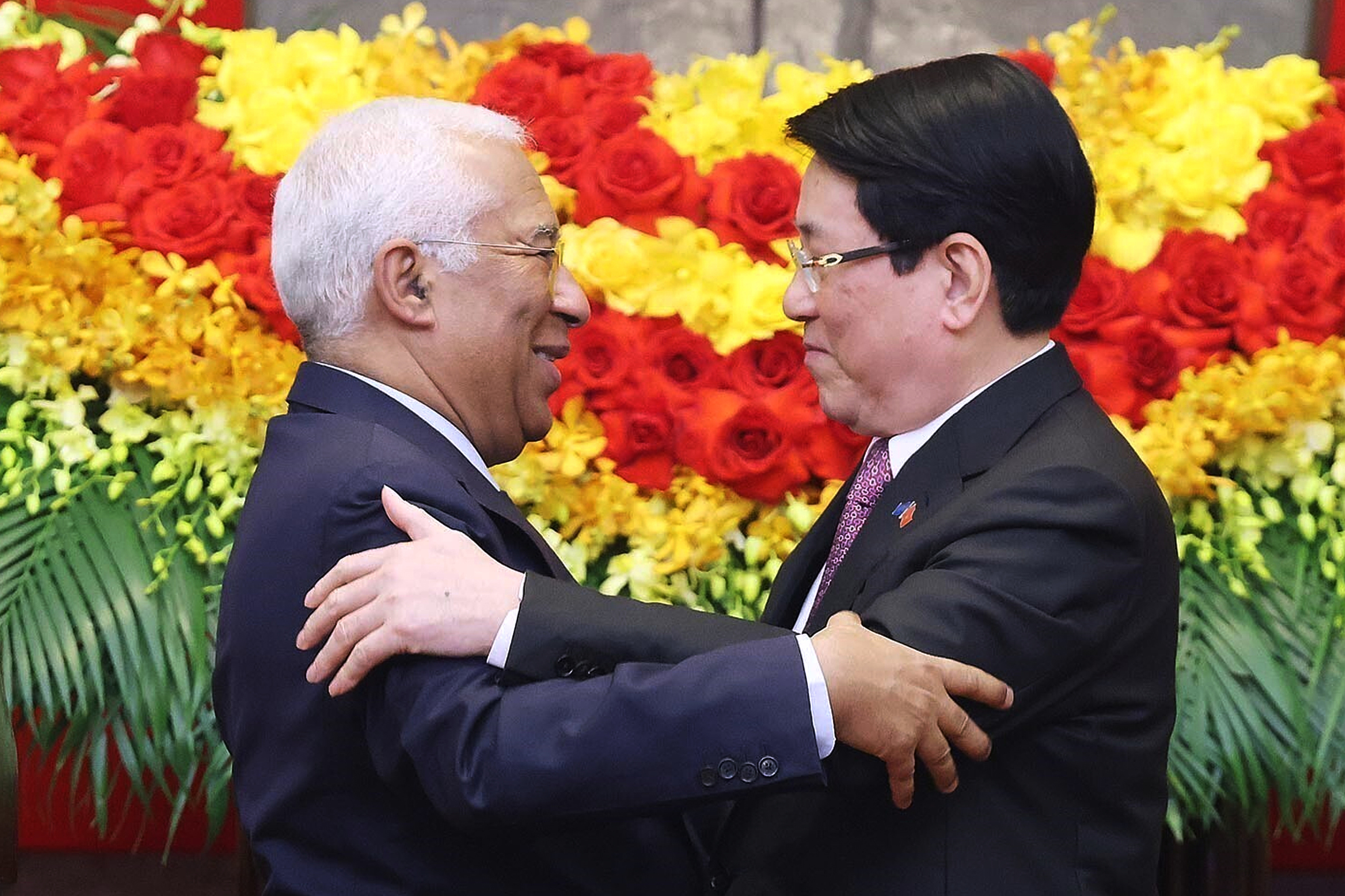
Vietnam and the European Union took a decisive step in their bilateral relations on Thursday by elevating their ties to the category of "comprehensive strategic partnership," the highest diplomatic level reached between foreign partners. The news, announced during the visit to Hanoi by the President of the European Council, António Costa, reflects the urgent recalibration of global trade flows amid pressures from the United States.
Costa landed in Hanoi from New Delhi, where he left elated after India and the EU signed a free trade agreement that had taken almost 20 years to negotiate. Brussels' strategic shift now points towards another of the most promising Asian economies: Vietnam is one of the fastest-growing manufacturing hubs on the continent.
"At a time when the rules-based international order is being threatened from multiple angles, we must stand united as reliable and predictable partners. This is about developing spheres of shared prosperity and projecting stability in a region that is key to the global economy," Costa declared at an event in Hanoi.
Following the mega agreement with India, the EU continues to seek to diversify its supply chains and reduce dependence on China. For Vietnam, now eager for more foreign investment, the elevation of the status of its relationship with Brussels reinforces another diversification strategy in the face of its traditional dependence on the US.
According to official data, in the first 11 months of 2025, bilateral trade reached $66.8 billion, an increase of 6.6% compared to the previous year. The EU is now Vietnam's fourth-largest trading partner, its third export destination, and its fifth import source, while Vietnam consolidates its position as the EU's main partner in Southeast Asia. In 2020, Vietnamese and Europeans already established a free trade agreement laying the groundwork for a deeper relationship.
The internal context in which the new partnership has been sealed is also significant. Last week, the ruling Communist Party of Vietnam (CPV) held its congress to set economic goals for the coming years and strengthen the powers of To Lam, the Party's General Secretary, the country's most influential position. The top leader was re-elected for the next five years.
In this regime, the one-party state has been led in recent decades by the four main members of the CPV's Politburo: the General Secretary, the President, the Prime Minister, and the President of the National Assembly. A system designed to prevent the concentration of all power in a single leader.
Lam, 68, a former police officer and former head of Vietnamese intelligence services, became General Secretary after the death of his predecessor in 2024. His popularity within the party lies in the country's economic strength, with GDP growing around 8% last year.
Lam has spearheaded several significant reforms during his tenure. In administration, he carried out a bureaucratic cleanup by eliminating tens of thousands of middle management positions to streamline decisions and expedite project approvals. He has also led a broad anti-corruption campaign and launched a series of infrastructure projects, winning favor with many foreign investors. A few days ago, the leader delivered a speech during the congress committing to combat corruption and boost annual economic growth to over 10% for the rest of the decade.
But there is another side that Hanoi tries to conceal: that of a dictatorship that allows no opposition, continuing to persecute critics and tighten controls on the media. International human rights organizations document an increasingly widespread use of vague laws, such as Article 331 of the penal code - which punishes "infringement of state interests" - to imprison not only activists and journalists but also ordinary citizens who dare to criticize authorities or raise complaints about public services or police abuses.