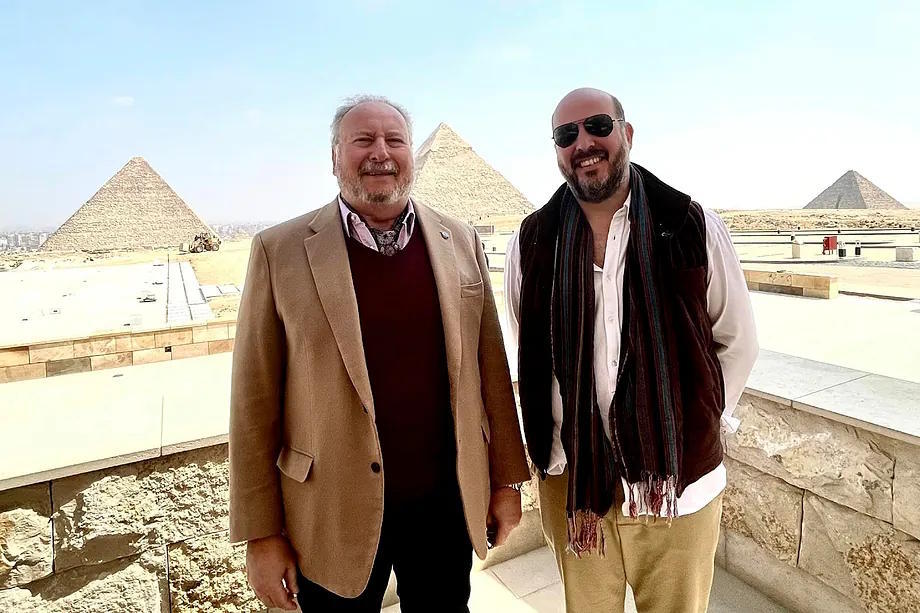
Ahmed Fuad II could hardly have imagined that his discreet celebration for his 74th birthday in a Swiss hotel in the middle of this month would be so widely covered in the Spanish press and in many other European and Arab media. It is not often that someone holding nothing less than the title of king of Egypt and Sudan attracts such media attention. However, the odd coincidence that among the guests at his party was the Kuwaiti sheikh Sheikh Khalid Al-Sabah, who on the same date posted a photo with King Juan Carlos, has brought some attention back to the dethroned monarch.
Fuad II is the son of the last Egyptian sovereign who could reign as such, the extravagant Farouk I, and his second wife, Narriman Sadiq. He was proclaimed king when he was just six months old, after his father abdicated, a few days after the outbreak of the July 1952 revolution, a desperate maneuver by Farouk, who immediately left for Europe, in an attempt to save the Monarchy. In fact, the newborn Fuad II was the de facto head of state during the months when the Regency Council led by Prince Mohamed Abdel Moneim was in effect. However, the revolt, actually a coup d'état led by the Free Officers Movement, soon abolished the throne, and in June 1953, the Republic was proclaimed, with General Muhammad Naguib at its helm.
While King Farouk indulged in nostalgia living the dolce vita in Rome and Monte Carlo, the cities where he resided until his death, his Heir Fuad grew up with a rather spartan education at the exclusive Swiss boarding school Le Rosey, where he shared a desk with many international elite, far from any family affection, as he barely saw his father and even less his mother, who was allowed to settle in Cairo.
Switzerland has long been the host country of the current head of the House of Mehmet Ali, the last royal dynasty that ruled pharaonic Egypt since 1805. Although Fuad II also lived for several decades in Paris, where he worked as a financial advisor and where he also faced significant health problems, including severe depression, which he spoke about at a time when publicly addressing such issues was not as common.
Fuad married the Frenchwoman of Jewish origin Dominique-France Loeb Picard in 1976, who converted to Islam and took on the title of Queen Fadila. The ceremony took place in Monaco, sponsored by Prince Rainier and Princess Grace, who granted Monegasque honorary citizenship to the Egyptian king and his descendants. The marriage produced three children before their divorce in 1996: Prince Muhammad Ali, Princess Fawzia-Latifa, and Prince Fakhruddin.
This royal family not only has a close relationship with the Grimaldi family but has also maintained a strong friendship over time with the Moroccan dynasty and several reigning families in the Middle East, especially the Saudi Arabian one, who apparently also provided economic support to Fuad II during his life in exile. It does not seem that the last Egyptian sovereign has ever lived in excess luxury, despite always being surrounded by the legend of the fortune his father could have taken into exile, something he denies. Farouk was one of the wealthiest monarchs of his time. However, it is true that the vast majority of his assets were confiscated by the revolutionary authorities, who later made a lot of money by auctioning off many valuable items, including all kinds of jewels, from the dynasty.
The current Heir, Muhammad Ali, was born in 1979 in Cairo. This is not insignificant. The deposed king and his family were not allowed to set foot in their homeland. However, with the first pregnancy of Queen Fadila, an intense diplomatic campaign was launched, led by the then King Hassan II of Morocco, to pressure Egyptian President Anwar Sadat, who granted an exception that allowed the consort to travel to Cairo to give birth to the crown prince, all done with great discretion.
Fuad II was unable to set foot in his homeland for the first time until 1991. On that occasion, after being granted a special permit by the Egyptian authorities. However, shortly after, the government of Hosni Mubarak issued him a passport in a semi-official recognition as a former king, which has since allowed him to return to the North African country on numerous occasions.
The prince who has taken a significant symbolic step for the dynasty is Prince Muhammad Ali, who last year decided to settle permanently in Cairo. This comes amidst a new social fervor for the monarchical past, contributed to by television dramas that have shown young Egyptians new angles of their recent history, and also due to a notable improvement in the treatment of the current president Al-Sisi towards the royal dynasty compared to his predecessors.
Muhammad Ali married Princess Noal Zaher in 2013, the granddaughter of the last king of Afghanistan, Mohammad Zaher Shah, uniting two dynasties with many historical ties. The ceremony took place at the Ciragan Palace in Istanbul and was attended by numerous royalty, such as Leka of Albania, Grand Duchess of Russia Maria Vladimirovna and her son George, Lalla Hasna of Morocco, Princess Lea of Belgium, Prince Rudolf of Liechtenstein, or Maria Gabriela of Savoy. The latter, the Italian princess who was the first youthful love of Juan Carlos of Bourbon, completes the circle of this story that also speaks of how endogamous the relationships of the members of the Götha are.