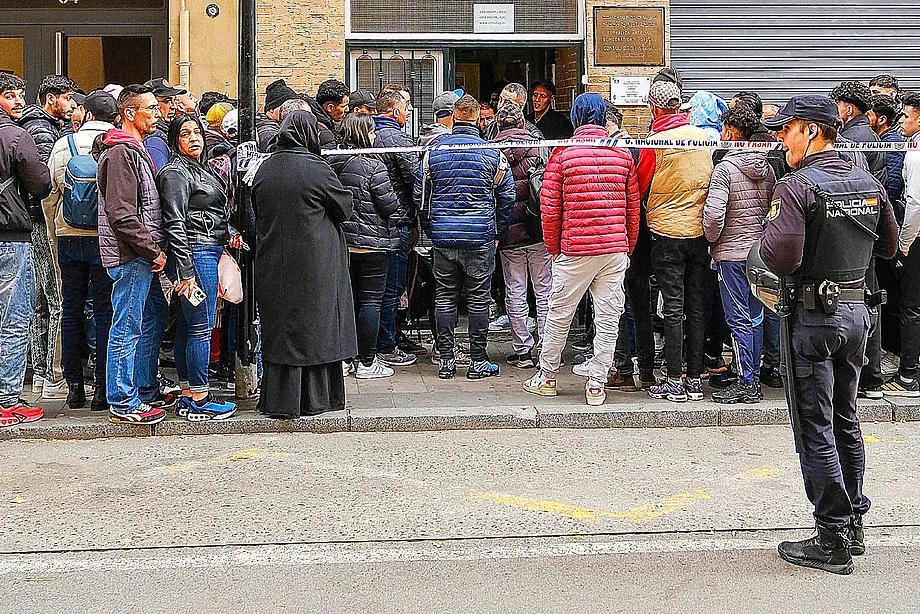
The announcement by the Government of Pedro Sánchez of the extraordinary regularization that will allow more than half a million immigrants to legalize their status in Spain has caused a collapse of administrative services, both in foreigner offices and in consulates and municipal registries. Despite the clarification by the Minister of Inclusion, Social Security, and Migration, Elma Saiz, that the procedures will not start until the month of April, those affected want to gather all the documentation they will be required to provide. They know they will have to prove that they were in Spain before December 31, 2025, for which they need a certificate of registration, and that they will have to demonstrate that they do not have criminal records in their countries of origin, a process they must do at the consulates. With difficulties in managing prior appointments, the only option left is to wait in line.
A crowd has been camped out, day and night, since last week near the Consulate of Algeria in Alicante. It is one of the three points in the country where Algerians, a large community in Spain, can process everything from their passport to visas, and also where they can grant powers of attorney to their relatives so that they can request the criminal record certificate on their behalf in Algeria. Specifically, those residing in the entire Mediterranean region, from Castellón to Cádiz, have to go to Alicante: the entire Valencian Community, Murcia, and Andalusia, as well as Ceuta and Melilla.
The Government's announcement has caused a massive influx, and since last Tuesday, to prevent altercations, the National Police have cordoned off the consulate on Pintor Velázquez Street, next to the Central Market. The goal is to organize the line of people seeking one of the 400 numbers issued daily for these procedures. Prior appointments are only considered for passport renewal or visa applications. The rest have to wait.
Zahari Hallal spent the night in the rain at the door to ensure being one of those attended to. "We have to ensure that our relatives can handle the procedures for us there, in our country," he explains. From Alcossebre, in the province of Castellón, Hamou Karima arrives with the same goal: to make progress towards achieving a regularization that excites him. They live in the Valencian Community, but there are even those who have come from Sevilla after a long journey.
Their situation is understood by neighbors and merchants, but they ask for solutions so that this collapse does not interfere with their daily lives and, above all, does not generate coexistence problems. In the early hours, the presence of people sleeping in doorways and some confrontations between them for not respecting the line were reported. Therefore, the Government sub-delegation plans to meet with the consulate to try to coordinate the operation. Attention has also been focused on ensuring that there are no irregular practices of scams, sale of prior appointments, or document forgery.
In Canary Islands, with strong migratory pressure, it is the consular office of Morocco that is receiving the most requests, while in Barcelona, Algerians are once again the most mobilized along with Pakistanis. Their consulate is the image of endless lines, with waits of up to four hours, even though they have extended their hours and have even opened on weekends to handle the flood of requests. They estimate that around a thousand people per day have passed through the offices. Arman is one of those who came yesterday to claim and "update" his passport. He has been living in Spain for four years, two in Seville and the last two in Barcelona, has two children, and his wife is in the same situation. "It's an opportunity to work, no one expected it," he says about the Government's announcement. Everyone fears that the documents depending on the country of origin will not arrive on time, a bureaucracy that forces many to expedite the procedures.
In Catalonia, the Government estimates that between 120,000 and 150,000 (one-fifth of the total) could benefit from this regularization. Yesterday, the Generalitat, the Government, and social and economic entities organized an institutional summit to address the measure.
In Murcia, where up to 50,000 residence permits and work permits could be granted, the Foreigners units are under pressure due to the flood of information requests. "With the staff we have, it is unmanageable," say police sources.
This uncertainty is denounced by the Independent and Public Service Union (CSIF), which considers it "unprecedented" that the Government has announced this measure without designing a "shock plan" like the one that accompanied the regularization in 2005, under the government of José Luis Rodríguez Zapatero.
"There is a lack of workers and the workload is tremendous. There are no specific information points in our offices anymore, and everything is done online. And meanwhile, the application is experiencing failures due to overload," these sources point out. They indicate that there are people who are going to complain in person about the delays in their requests, and those who want to benefit from the new regularization must be redirected because the period has not yet opened "and they do not know when it will open."
The staff is considering organizing demonstrations and even going on strike, an option that the Ministry has been considering for many years, they argue. What would a week of strike entail? "The halt of around 50,000 cases," estimate these sources, who are determined to "fight" to improve their conditions.
A week after making the agreement with Podemos public, "the cases in the Foreigners' Office have increased by more than 25% and there is already a generalized saturation in documentation units," the union denounced yesterday in a statement urging the Ministry of Territorial Policy to meet with them to refine the multiple aspects that still need to be implemented in this regularization.
If consulates and Foreigner services are overwhelmed, the influx also reaches the municipal registry offices. In Valencia, the third capital of Spain, the long line surrounds the City Hall building, and appointments cannot be requested until next week. The Mayor of Valencia, María José Catalá, asks the Government to step up. "We have not received any official information about the supposed regularization, but we see the uncertainty. False expectations, propaganda, and collapse of public services: Sánchez's playbook," she asserts while municipal sources speak of a "call effect" and redirect applicants to request information at the Government delegation. The opposition has not taken long to criticize the Mayor for the constant lines at the registry in Valencia that she has not been able to address, although a significant portion of those waiting on Wednesday were seeking the certificate justifying their registration before December 31.