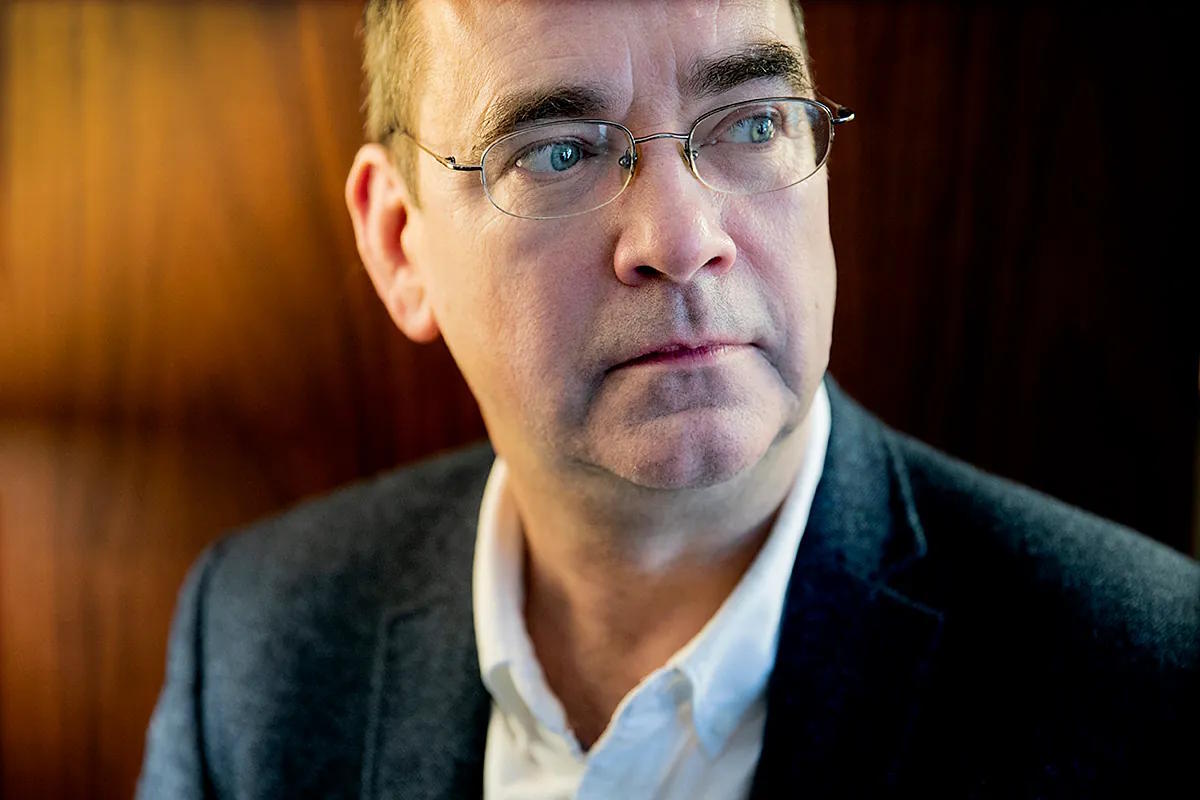
Although it may be hard to believe today, in his early days, Mick Herron (Newcastle upon Tyne, 1963) had several manuscripts rejected. Considered today one of the heavyweights of modern espionage thriller, things changed, he explains, in 2003 when he managed to publish his first novel Down Cemetery Road. "In reality, I finished it much earlier, over 30 years ago, and the truth is that the sales were not good," he admits with a laugh. "It seems like another life, and so many things have changed since then. How can I put it? It's my work, I clearly recognize it. Maybe my voice has changed a bit, but there are phrases I would write today," he states.
"Television is a completely different world, and that TV success, of course, has nothing to do with literary success, it's a different dimension," he jokes. "I don't have much to say about that, you could say I'm just an observer, but it's clear that many more people have watched the series, maybe they don't even know there's a writer behind it. But well, it doesn't matter. I think it's great, I have no complaints. How can I complain? It's amazing. It's great," Herron acknowledges, praising the screen adaptation. "I think they are doing a great job, but it's like a separate entity, because if I got involved there, I couldn't continue with what I do. I think the series has clearly maintained the tone, it's very faithful to the books, and they have nailed the characters."
However, he does point out that audiovisual storytelling does not affect his literature. "No, because when the project was born, I was already writing the eighth book, so I know what I'm doing, I know my relationship with my characters, with my page, I know how to write my books, and I know how to get into the heads of those characters and their minds, so it hasn't affected me," he insists. "As soon as I sit here [in his rather austere office] and close the door, I have a great time. This is my office and when I work, I don't even use the internet, so I don't get distracted. I have a blank page, a blank screen in this case, and I start writing, sentences, paragraphs, and that's how my books come out, as always, from day one. I'm very lucky to have had the success I've had, but that success took a long time to come and it won't change my way of working."
So let's set aside the television world and focus on the books, as Herron has just received the Pepe Carvalho Award at the BCNegra festival. There in Barcelona, he presented his new novel, The Hidden Hours (Salamandra), a standalone novel from his famous series that tells an absorbing and acerbic spy thriller exploring the dark areas of power and the weight of secrets from the past, taking us to post-Berlin Wall Berlin, where the still dangerous embers of the Cold War smoldered.
"I started without knowing what would come out, I only had the first chapter, about an elderly person who had been a spy and who is awakened at midnight in his country house and made to flee. The intention was to take a break from the House of the Swamp and do something different, but...". In the end, he couldn't. Although the book addresses an independent plot that unfolds in two timelines, some characters from the series are hidden within its pages that loyal readers will gradually recognize.
"We live in turbulent times, a kind of Cold War, but with different paths. I look at the young people and wonder what world they will have"
"I wanted not to mention their real names, but the code names they had in the past, so it will be interesting for the reader, I hope, to discover them," he wishes. "In my books, the plot is built as I go along, I focus more on the characters, because I think that's what interests the reader the most. When I come up with the ending, I start to establish the connections and ties, but the truth is that when I write, I have fun. It sounds strange, but I start writing to have a good time, that's the idea," he insists.
Perhaps that's why, Herron confesses, this is the first book in which he had to do research, something he detests. "I never investigate because I usually always focus on the present, but this time I had to actually read about Berlin. Although what interested me especially was how they must have felt at that moment, how the city was experienced," he explains. "Exploring that chaos that surely occurred after reunification because although the world in general celebrated, of course, the fall of the Wall and the end of the Cold War, there were social difficulties and surely it was difficult to live in Berlin at that time," he opines. "Those tensions were what interested me."
That, and portraying, as usual, the complex relationships between the abusive power of high political and economic spheres and the opacity and arrogance of the secret services, who are investigated as revenge by a corrupt and aggrieved Prime Minister. Operation Monochrome, set in the present and aimed at revealing the hidden dirty laundry of MI5, is the plot that adds current relevance to The Hidden Hours. "We are living in turbulent times, a lot of global tension that takes us back to those years of the Cold War: what is happening in the United States is terrible, not to mention Russia. How will it be resolved? Frankly, I don't know," Herron acknowledges.
"Although we are heading in different directions, because financial resources are now private and there is a lot of power in the hands of big tech companies, and there are other serious problems, like the climate. I look at the young people and wonder, I don't know, when they reach my age, what world will they have? What world will I leave them? I don't think it will be an easy or comfortable place to live, to be honest," he ventures. But, as we say, in addition to that leap of three decades that sharpens comparisons, the novel contains a sharp portrayal of contemporary London power and the dealings, pitfalls, and shenanigans that take place in the corridors of Downing Street, Whitehall, and Regent's Park, the respective headquarters in his fiction of the British Government, the Home Office, and the Secret Service.
"We know that many of these organizations in the past had behaved in, well, not very orthodox ways, they did quite badly. But when I sit down to write a book, I know it sounds horrible, but I don't want to moralise or educate, or denounce anything, what I want is to entertain. Literature and any art are based on entertainment. Without it, a good novel is meaningless," Herron argues.
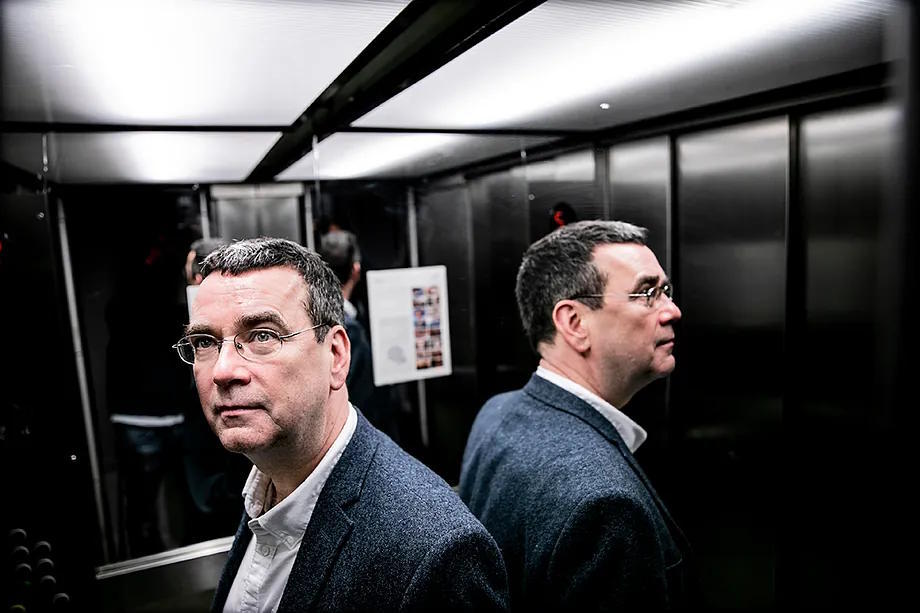
Just as without the irony and sarcasm that are Herron's trademark, which he uses to take aim at all that bureaucracy, corruption, and inefficiency that, although no longer surprising, still angers. "I certainly speak of the terrible things that governments do, especially the people who make up those governments, who come to power, and I use black humor and irony to reflect how cheated we feel," he explains.
"In democracies, we have the right to protest, don't we? And if you don't want to vote for one party, then you support another party, but in the end, the change achieved is minimal. In the UK, we had to change the government not long ago, but it hasn't made any difference, things continue as they were. This new administration is just as corrupt as all the others, and there is no change in our daily lives. And for me, the only way to express my feelings, if you want to put it that way, is through my works, through my writing, and by effectively using humor as a tool that we all have at our disposal. I don't know if it's effective in the long run, but in the short term, it cheers you up a bit, lifts your spirits," he says with a smile.
"When writing, failure has much more interesting elements than success"
Another key in which Herron excels is in exploring ordinary people. His characters, commonly failed and desperate, are not heroes, but become heroes by chance, luck, or obligation. "When writing, failure has much more interesting elements than success. My characters tend to doubt themselves, and by exploring that, I can delve deeper into their consciousness, their personality, their temperament, their character, than if they were very capable, very rational, or very perfect people who could always be at the top level and doing everything right," summarises the writer.
His hope is that, as his book demonstrates and sometimes reality, one cannot escape the past. "We can try to leave it behind and turn the page, ultimately therapy is about that, accepting the past and trying to face your present in the best way you know how," reflects Herron. "But I like to think that the great advances of recent decades are based on individuals and institutions having to account for what was done wrong years or centuries ago. Even if we think otherwise, we are all governed by History, and we must try to emerge successfully from what was done wrong and not repeat the mistakes. I wish everyone thought that way," he concludes.