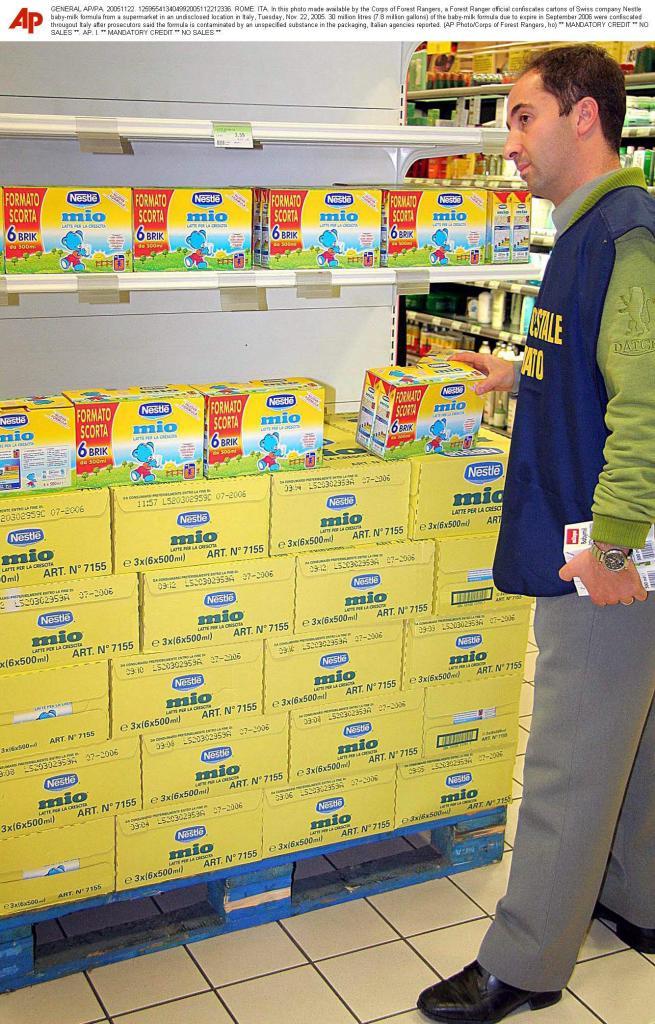
Since December, different brands of infant formula milk have been withdrawn from the market due to the presence of a toxin in their formula. Meanwhile, eight Spanish infants have experienced vomiting and gastrointestinal problems after consuming infant milks whose composition is being investigated for possible contamination with cereulide toxin.
Five of the infants have had to be hospitalized, as reported in the alert bulletin from the European Centre for Disease Prevention and Control (ECDC). In Europe, around 60 cases related in some way to this event have been reported.
Teresa Cenarro, vice president of the Spanish Association of Primary Care Paediatrics (Aepap), makes it clear that linking one thing to the other "is complicated". In fact, the ECDC report points out that in none of the cases has the cause of the vomiting been confirmed through laboratory studies, although the infants had consumed products potentially affected by contamination.
The withdrawal of products that has been carried out in recent months has affected several countries, both within and outside the EU. According to European authorities, "the withdrawn products have had wide distribution in the EU and other countries; therefore, the probability of exposure to a contaminated formula batch is moderate to high for the infants consuming it."
The European Food Safety Authority (EFSA) has conducted an assessment to assist EU risk managers in determining when products should be withdrawn from the market as a precautionary measure for public health.
What does the bacteria responsible for the toxin cause?
Cereulide is a toxin that can cause nausea, vomiting, and stomach pain between 30 minutes and six hours after ingestion. In younger babies, "it can alter the body's salt balance and lead to complications such as dehydration," explains Cenarro. The toxin is produced by the bacterium Bacillus cereus (B. cereus).
The potential negative health effects are considered low to moderate and depend on the age of the infant, although "newborns and infants under six months need to be monitored, as they are at higher risk of serious illnesses due to their still developing immune system," notes the paediatrician.
As the products are being withdrawn and collected in many countries, the AEPap spokesperson assures that the likelihood of further exposure is decreasing.
Bacillus cereus (B. cereus) is a Gram-positive, rod-shaped bacterium, aerobic and facultative anaerobe, known for its ability to form heat-resistant spores. Although there are numerous known species in the genus Bacillus, the one most frequently associated with human diseases is B. cereus, responsible for two types of foodborne illnesses associated with the ingestion of vegetative cells, spores, or toxins produced by the bacterium.
This pathogen is widely distributed in the environment (soil, water, plants, etc.) and is naturally present in a wide variety of raw materials and food products of both animal and plant origin.
What to do if you suspect contamination from contaminated milk?
Cenarro assures that "the symptoms of food poisoning and infant gastrointestinal virus are indistinguishable". She justifies this statement because both processes result in the same symptoms: abdominal pain, vomiting, diarrhea.
The paediatrician, besides calling for calm, states that "monitoring the child will give us clues about their condition". If they start showing any of the mentioned symptoms, it is necessary to monitor their recurrence and duration, "if there are urine problems (if the child urinates regularly, there is no dehydration) or if the baby is fussy-crying because they are not feeling well."
For her, the important thing is to monitor for signs of dehydration, "if it is mild, rehydration solutions will be recommended." If the baby requires specific or more intense care, hospitalization is advised. "When in doubt, it is best to consult a doctor to address the situation appropriately," Cenarro insists.
Where is the problem with milk contamination?
Miguel Ángel Lurueña, a doctor in Food Science and Technology, mentions that according to the information that has emerged, the problem is due to an alteration in an ingredient in formula milks, which has been supplied by the same provider to different brands. This is arachidonic acid, "an important fatty acid for the development of the nervous system, especially in babies." That is why this compound is used as an ingredient in some formula milks as an omega-6 supplement.
As Lurueña clarifies, at an industrial level, "this fatty acid is produced by bacteria in bioreactors through fermentation." In this process, one of the causes of batch contamination could occur, as "undesirable bacteria may have developed during fermentation and produced that toxin that ended up contaminating this fatty acid."
Why has it not been detected before?
In this regard, the food technologist explains that normally risk or hazard analyses are carried out on the most likely risks. "If we talk about sausages, the list of bacteria is analyzed (including Escherichia coli), but, for example, the amount of uranium it contains is not evaluated." Here, unlikely causes are left out, "not everything is analyzed because it would be impossible."
Therefore, in the case at hand, the toxin had not been a problem or a risk until now. "As a very unlikely danger was seen, no analyses were carried out," Lurueña justifies.
EFSA, based on these cases, has established a reference dose ("more indicative than anything else") for companies to consider at what quantity that toxin could be dangerous, the expert details.
Which formula milks have been withdrawn in Spain?
To date, the Spanish Agency for Food Safety and Nutrition (Aesan) has reported the withdrawal of a series of products and batches of infant formulas from Ireland under the Almirón and Bledina brands due to the possible presence of cereulide.
Aesan has expanded the information from January 24, with the decision by the manufacturer (Danone) to carry out a preventive withdrawal of new products and batches.
Specifically, cans of Almirón Advance 1 formula milk have been withdrawn, with an expiration date of November 9, 2026, and a weight of 400 grams, and others from the same brand with expiration dates of July 8, 2026, July 22, 2026, October 30, 2026, and December 3, 2026, in these cases with a weight of 800 grams.
Cans of Almirón Advance 2 (dates 7/13/2026, 8/31/2026, 9/18/2026, 10/27/2026, 10/28/2026, 11/21/2026, and 12/18/2026, 800 grams); Almirón Advance 1 (1.2 kg box with date 12/5/2026); and Almirón Advance 2 (1.2 kg box with dates 8/9/2026, 11/25/2026, and 1/20/2027) have also been withdrawn.
Other affected products are Almirón Profutura 1 (800-gram jars with expiration dates of 12/28/2026, 04/15/2027, 05/14/2027, 06/13/2027, 08/19/2027, and 09/13/2027); Almirón Profutura 2 (800-gram jars with expiration dates of 12/28/2026, 01/11/2027, 05/10/2027, 06/13/2027, and 07/11/2027); Almirón Profutura 2 sachets (with dates 07/12/2026 and 08/21/2026); Almirón AR2 (jar dated 10/3/2026 and 11/2/2026); and Bledina 1 (jar dated 11/3/2026 and 12/9/2026).