I land in Perth (Australia) two planes and 19 hours of flight after taking off from Barajas. The border procedures, compared to the US, are a breeze: a free visa processed online, a simple stamp, a genuine police smile, and a food entry check - better not bring anything edible! To reach the capital of Western Australia, I opt for an Uber. Another young, smiling driver, what they call a "being of light," is behind the wheel. It's Sufyan, a university student learning computer science and English thanks to a visa that allows him to study and work. He is from Bhutan, the supposed country of happiness where young people dream of emigrating to Australia (watch the movie Lunana, a yak in school).
Night falls, and the city proudly rises on the banks of the Swan River. In the center, a handful of office skyscrapers grow, among which the Rio Tinto company stands out. We are in the mining metropolis, the corporate and financial center of those who extract iron, gold, nickel, gas, and lithium. A symbol of a fortunate country. The city's motto is "flourish, prosper." The country's motto: "Advance." Without a doubt, I am in the right destination.
After a much-needed sleep to combat the jet lag and the seven-hour time difference, I run 10 kilometers along the Swan River bike lane, known for its black swans, and stretch with a tai chi session in Langley Park. It's 5 am, the sun is shining, and I keep crossing paths with cyclists, runners, and walkers. Australians are early risers and sports enthusiasts. The run leads me to stumble upon the University of Western Australia (UWA) and its colleges. Canoes glide over the river with students paddling to the beat of the helmsman's drum. It's not Cambridge, it's not Oxford, but it has a similar vibe.
I turn back at the Matilda Bay Reserve and notice the Bayside Kitchen café, which will become my favorite breakfast spot. Specialty coffees, matcha tea, avocado toast, and eggs. The houses, apartments, and green parks look well-maintained and full of birds, Australian shepherd dogs with clear eyes. There are sailing clubs and yachts. Some even dare to swim, but it's worth remembering that hungry sharks hunt upstream, so be careful. On my way back, I observe tourists taking selfies on the boardwalk of the Crawley Edge Boatshed and the firm skyline of Perth.
Perth is a magnificent entry and exit point to Australia if you want to escape the crowds and discover the wild coast. Touristically, it's not Sydney or Melbourne. Just two or three days are enough to recover from the journey and explore its streets filled with international restaurants, discover Elizabeth Quay, or swim at Cottesloe Beach. As a highlight, a trip to Rottnest Island is a must. Crystal clear waters. Magical beaches like The Basin, Longreach Bay, Salmon Bay, or Paterson Beach and zero traffic except for bikes, pedestrians, and a minibus. As for land animals, quokkas, a species resembling a hybrid of a mouse and a kangaroo, delight tourists who sometimes get bitten by those who think they are Disney plush toys.
To explore the Australian southwest and its paradisiacal beaches, it's best to rent a camper or motorhome. I prioritized comfort, safety, and a 4x4. Traveling with my university student daughter, I chose Indie Campers; 2,400 euros for 14 days with full coverage, excluding damage to the underside or kangaroo collision accidents. It's not cheap, like the country, but the destination is so remote and lacking in hotels that this is the smartest option. If you're up for it, compare prices with Go Cheap, Go Camper Hire, WA Experts, Cruisin, Maui, Mighty, or Britz.
Driving is on the British side: right-hand drive and overtaking on the same side. Australians drive well, respect speed limits, and are friendly to tourists. No problem! Our first stop is in Bunbury. The plan is to rest and see dolphins at the Dolphin Discovery Centre. Lacking dolphins, we end up having cappuccino, chai latte, and gluten-free cake at the Benesse café. When I drink water from a jug, my daughter reminds me that Bunbury is known as the meth capital, with its waters teeming with drug residues.
Not even paradise is spared from this scourge, what a shame. We flee from Bunbury to Busselton. Here, the attraction is walking the jetty that extends almost two kilometers into the sea. It's a wooden walkway to stroll on foot (three euros) or by a little train, originally built as a light pier to load and unload cargo offshore. The promenade is dotted with signs reminding that swimming is not without risks as there is no shark net. Despite this, adults fish, and teenagers do somersaults, flirting between dips.
The first night leads us to sleep in the parking lot of a yacht club in Dunsborough. It's evident that we are new to living in a caravan. I thought the police would knock on the door at any moment to send us elsewhere. But nothing happens. There's a lot of flow, and that's appreciated. The camper has a toilet, shower, kitchen, and fridge, but we make use of all the public facilities, which are plentiful and clean, to avoid dirt and intestinal odors.
We wake up in Eagle Bay. The water colors are intense. Clouds travel fast, painting the sky. It rains intermittently, the sun shines, the wind blows. Nature is wild. The chalets facing the sea are few and blend into the greenery. Directions lead us to the Whale trek at Cape Naturaliste Lighthouse. A bench overlooks the infinite ocean, a wooden bench designed for daydreaming, for whale watching when they migrate. The peak months are from September to November or from December to February, and although we are within the calendar, the sea only offers us foam and relaxation. The cetaceans must be busy with underwater fishing. We also don't spot seals. The tranquility is deafening. The beauty, striking.
The camper stops at Yallingup. Kangaroo warning road signs indicate that they cross the road daringly at dawn and dusk. We try a public camping site without light or water in a natural park. Payment is made at a meter, but I fear no foreigner will pay. However, we feel unsatisfied when we discover the recommended and luxurious RAC campgrounds, the Royal Automobile Club of Western Australia. Average price per night and camper: 30 euros. The learning curve shows us that we must book and arrive before 5 pm. Australians are early risers, but after 5 pm, everything shuts down. Everything is closed except for a few restaurants, very few. They are kings of work-life balance.
Near the tourist town of Margaret River, we find the sophisticated White Elephant Cafe beach bar. This is Gnarabup Beach. The signs in the parking lot read: interaction with a 2.5-meter white shark. A video on social media shows us what happened: a local surfer was attacked, but the shark took his board and he reacted with a clean punch, causing the animal to flee. So we have breakfast, contemplate the turquoise blue colors, but don't feel like swimming, just in case...
The journey is made bearable with stops at wineries such as Voyage Estate Winery. Chardonnay and Chenin Blanc at exorbitant prices. Alcohol is so expensive that Australia is the ideal place for a detox. Hamelin Bay is another must-see if you want to see manta rays in their habitat. We are close to Cape Freycinet and Cape Leeuwin, marine sanctuaries worthy of a documentary on La 2. To feed ourselves, we opted for hearty breakfasts and early dinners (6/7 p.m.) based on meat and potatoes, pizza, Chinese or Japanese food. Australians live in Eden, but they don't have a gift for cooking. Their menus are reminiscent of those in the United Kingdom, including fish and chips and pints of beer. You can eat, but the range is very limited, at least in Western Australia.
In Denmark, Greens Pool stands out: turquoise waters, jade green, dotted with giant round granite formations that give rise to Elephant Rocks. Whimsical masses, as if they were a herd of elephants, bathe in an idyllic sea when the sun shines. The water is cold, but not impossible: it's like swimming in the Cantabrian Sea. In Albany, we had breakfast at the historic Dylans (the kitchen closes at 3 pm) and dinner at a delicious Indian restaurant tucked away in a motel, the Royal Turban. We improvised a bed at a wild campsite in Kronkup (East Camp Ground). We found signs warning us to watch out for snakes! and pretended not to notice when we discovered we had to pay at the parking meter.
We continue driving south, devouring miles. We stop at Bremer Bay to see killer whales, but the animals keep eluding us. The beach looks like a mangrove swamp. Capricious lagoons with blue-green waters. In the background, the roar of the sea. On the endless straight roads, we pass dozens of campers made up of couples, families, and groups of friends. There is no shortage of Spaniards: exchange students, digital nomads, and adventurers who will never reach 50. The rest of the traffic consists of a few locals and many truckers with triple vehicles up to 42 meters long, the impressive road trains. Trailers transporting grain and mining products. A lonely job reminiscent of the roads of the American West. Gas stations are scarce: one every 100 kilometers, so we always keep the tank half full.
Lucky Bay
The towns are tiny, prefabricated, and predominantly agricultural. The dispersion of the population gives us much to think about. In local pubs, such as the one in Jerramungup, where we eat mediocre food, signs warn us that we cannot enter wearing work clothes and dirty boots. And that we should not drink outside the premises.
Esperance is the highlight of the trip. The beaches surrounding the capital of southeastern Australia alone take our breath away: West Beach, Fourth Beach, Twilight Beach, Nine Mile Beach. Turquoise waters. Crystal clear. Miles of sand and a real danger of sharks. We swim, but always with our eyes fixed on the horizon. Refreshing, but not relaxing. For swimming laps, the pool is better. My daughter, as if she were a local, uses the Smart Shark WA app, which informs us in real time of the presence of sharks. Sometimes, in the parking lots, a thunderous loudspeaker warns us of the danger posed by the proximity of two white predators, and far from fleeing, we go into Rodríguez de la Fuente mode, hunting for fins. From a distance, of course.
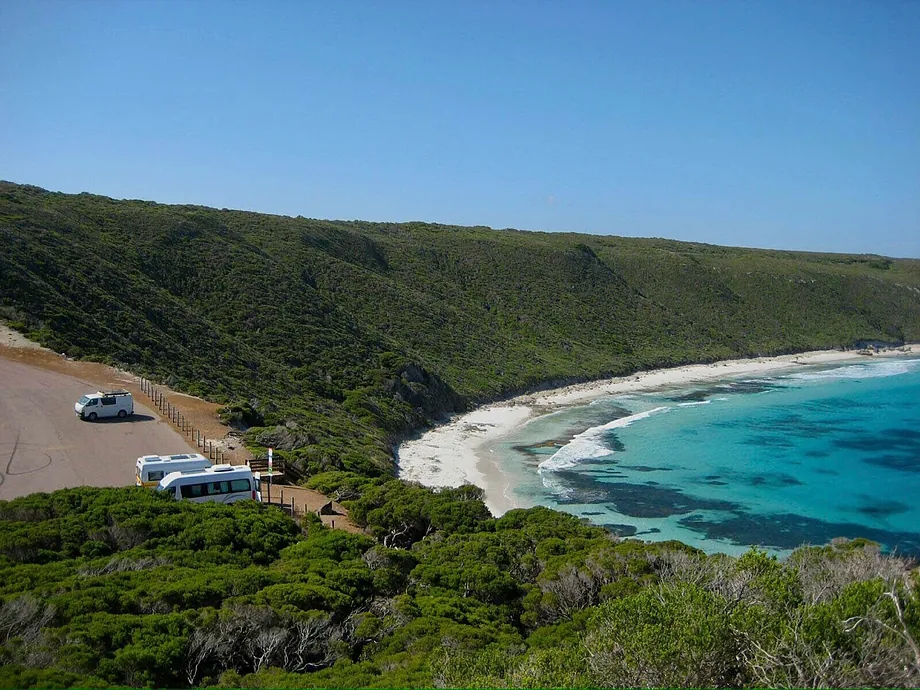
From Esperance, we travel long distances to discover the beaches of Cape Le Grand, which should be classified as a Great Wonder. Lucky Bay is the best known, but it is only the tip of the iceberg. Ranked in 2023 as the "best in the world," it is also a favorite of kangaroos, who sometimes spend the evening on its shore to the delight of visitors. White sand, pool-blue water, and a public campground nestled among the trees that must be reserved months in advance. And here, the law is strict: no overnight stays without a reservation. That rule means we drive between 75 and 93 miles round trip every day, but every meter is worth it.
The cleanliness is incredible. Everything is labeled and explained in detail. The public restrooms are clean, and there are free electric barbecues in the parks. The parking lots are convenient and very well designed. The ecology is superb, so it's surprising that they allow 4x4s to drive on the squeaky sand, which crunches under our feet. Don't venture out with a camper van, and even less so with a motorhome!
In search of more unheard-of beaches, we discovered Hellfire Bay and its smaller counterpart, Little Hellfire Bay. We walked along the cliffs (Whistling Rock) and ventured into the immense sandy areas. But the biggest surprise, the drum roll, goes to Wharton Beach. Make a note of this name. A handful of people. A couple of Australian fishermen casting their rods and drinking beer. A soccer game in the background and wild nature at its best. In Technicolor. In Dolby Surround.
And between beaches, we find a whimsical, almost childlike mountain. It's Frenchman Peak. A 262-meter peak with a hat-shaped hole in the rock that can be climbed in just over two hours. An essential trek in the company of millions of flies, salamanders, and black amphibians, offering a 360-degree view of this maritime paradise.
Before returning to Perth, traveling more than 700 kilometers diagonally inland, we stop at the giant dunes of Wylie Head. We are in Mullet Lake Nature Reserve, 300 meters from the sea, a living desert where the wind draws whimsical ridges and children crunch down the sand. The quick return trip to the airport takes us past the salt flats of Lake King. The white, salty nothingness is crossed by a silent road that takes us back to the financial capital of mining, where locals and foreigners seek their fortune while tourists drive around in vans in search of beach paradise or dream of saving up and becoming boomerangs so they can return soon. Very soon.