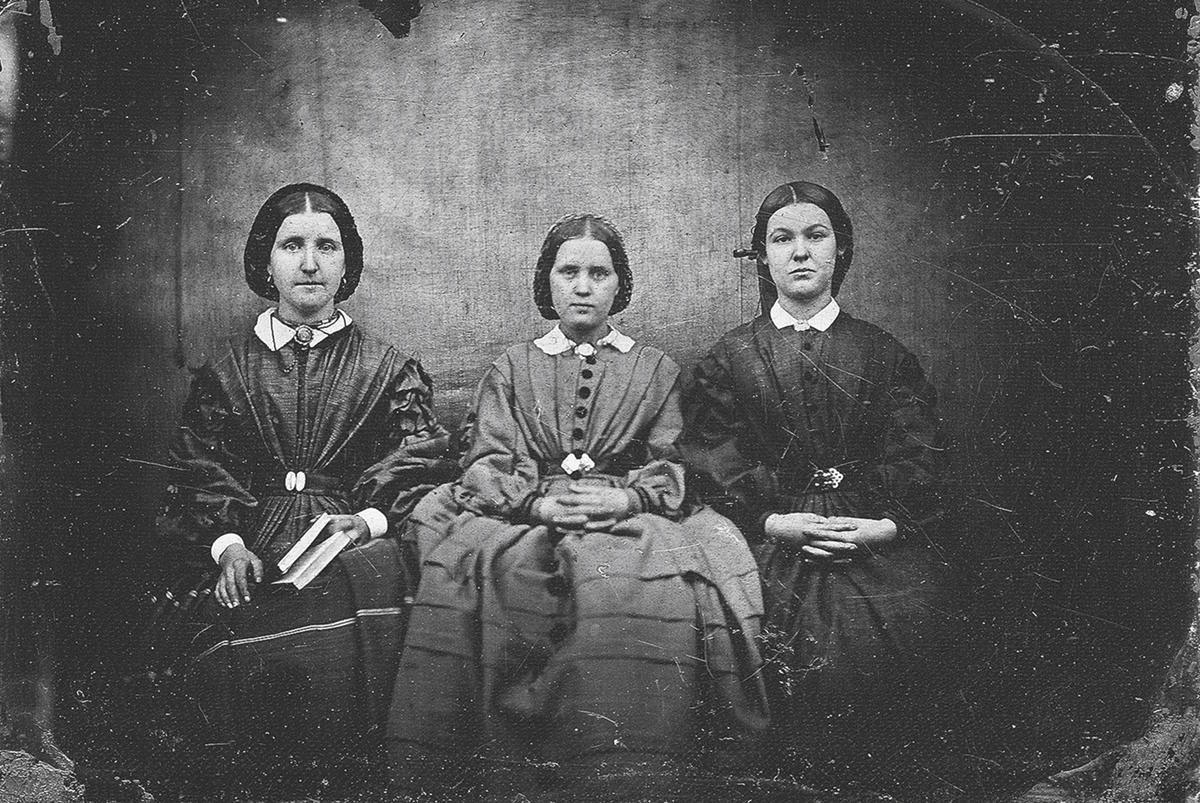
The novel was so scandalous that her sister Charlotte, author of Jane Eyre, had to soften her writing. The other sister, Anne, wrote Agnes Grey.
It was unusual for three sisters to have such talents, but the Brontë sisters were fortunate to be educated by their father, Patrick, a self-taught Anglican pastor and writer with an above-average intelligence quotient.
Emily was the fifth of six children of a humble couple who lived in Thornton, in the county of Yorkshire, in the north of England. Unfortunately, the siblings were between one and six years old when they experienced the loss of their mother, Mary, due to cancer.
During their childhood and adolescence, Emily, Charlotte, and Anne created an imaginary world where they unleashed their emotions. Their three fictional countries were Angria, Gondal, and Glass Town, places where exaggerated fantasy led to passions and unrestrained madness that they later drew upon for their literary works.
According to various studies and biographies, Emily had a personality that was nothing like her literary heroine. Privately, the young woman was quite shy, reserved, with great willpower, at times stubborn, barely socialized, preferred the company of her dog and her sister Anne, and with such sharp intelligence that, at that time, she was sometimes considered somewhat masculine.
When her family moved to the small village of Haworth, in the county of West Yorkshire, Emily found in the moors and the wild nature of the area the ideal environment for writing.
She found happiness in the simple pleasures of life like a sunset, the smell of fresh grass, or the sound of rain. Emily was comfortable with herself and, at most, shared her personal space with Anne, whom she considered almost like her twin.
This independent and practically unsocial way of being meant that she never married or had romantic relationships. Indeed, in popular gossip, the names of Robert Heaton and Louis Parensell appear.
An interesting biographical fact dating back to 1846, a year before the publication of Wuthering Heights, suggests that Charlotte convinced her literary sisters to write a poetic anthology signed with male pseudonyms. And, for this, they came up with the idea of using the initials of their names. Thus, Emily Brontë was Ellis Bell, Charlotte was Currer Bell, and Anne was Acton Bell.
Also, to evade the strict morality and prejudices of the Victorian era and to protect her privacy, Emily chose to publish Wuthering Heights under her pseudonym. Despite being one of the most successful novels today, when it was published, it had little critical and reader success.
Last Friday, a new film adaptation of Wuthering Heights was released starring Margot Robbie as Catherine and Jacob Elordi as Heathcliff.