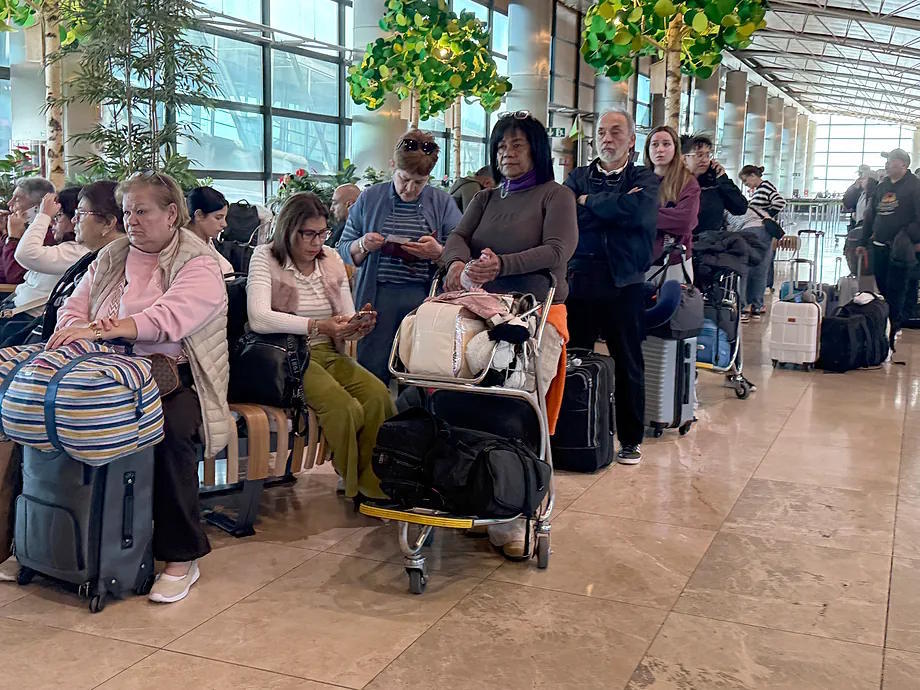
Erwin has two strong reasons not to return permanently to his country. "First, my marriage is not legal there; second, Venezuela lacks many things." That's why, after five years without setting foot in his homeland, he has travelled to reunite with his family in Ciudad Bolívar. But he will return to Spain in a few days. "In the future, if the country recovers, I am the first to say let's go back to Venezuela", intervenes Rafael, his Spanish husband, sitting beside him as they wait for the boarding gate to be announced at Adolfo Suárez Madrid-Barajas airport terminal 1.
Tuesday afternoon, at 16:40, the first plane with a direct destination to Caracas since Maduro's fall took off from Madrid. Thus, Air Europa is the first Spanish company to re-establish the connection with Venezuela since, at the end of November 2025, most airlines suspended their operations to the Caribbean country following security warnings from President Donald Trump and other international authorities due to intense military activity in the region and the subsequent closure of Venezuelan airspace. This period of tension was characterized by a US intervention that led to the capture of Nicolás Maduro.
The joy over the dictator's arrest still lingers, but it is not definitive. Therefore, the image of travellers at the airport is not like the one in the video for Escala en Panamá, a song in which artist Danny Ocean addresses hope for returning to his homeland, where hundreds of Venezuelans pack their bags and run excitedly towards the plane that will take them back to their country. No. Those travelling are not part of the nearly 9 million people forced by Chavismo to leave Venezuela.
Although they celebrate Maduro's fall, hope for change is overshadowed by uncertainty about the interim government led by Chavista Delcy Rodríguez and the transition to a democracy that still seems uncertain. Therefore, those who travel, only go - or return - for a visit.
Erwin (right) and his husband Rafael wait as the boarding gate for their Madrid-Caracas flight is announced.Javier Barbancho
Like Erwin, many are going to their home country with a return ticket to Madrid. One of them is José Agustín, 48 years old. "I want to return, I miss everything, but for now, we are going for a visit, there is still a long way to go before we can return to Venezuela," he confesses alongside his around 10-year-old son Kevin. He has been away from his country for 22 years and is naturalized in Spain. He tries to visit as often as he can, if a pandemic or US restrictions do not prevent him. According to what his fellow countrymen have told him, "things are changing slowly" and he will verify it on this trip.
In front of José A., Somaira also waits in line to board. She came to spend Christmas with one of her sons and one of her grandchildren. She was supposed to return on January 10, but had to wait a month and a week for the route to be re-established. She says she lives in Venezuela thanks to the money her children send her from Spain, Arabia, and the United States, as her pension alone would not be enough to even eat. That's why she is considering the possibility of staying in Spain soon.
"Hey, this is not for the government, right?" Somaira asks hesitantly after talking to EL MUNDO. After being reminded that it is for a journalistic report, she excuses herself: "Okay, okay, you know, one is afraid." "You don't have to be afraid anymore, madam, you have to know that we, at any moment, will be completely free," José Agustín tells her.
Fear is still palpable among the travellers who look distrustfully at the reporter and photographer approaching them to ask about the reason for their trip to Caracas. "We prefer not to talk," they conclude. When asked if they fear reprisals, they respond with a firm "yes."
On the other hand, some are overflowing with enthusiasm. This is the case of Julia, ready to board as the first in line, an hour before the gates open. "Oh, yes, I am very excited," she admits with a smile. She arrived in September to be with her daughter and was supposed to return on November 30. "I had the opportunity to spend more time with her," she highlights as a positive point. She had not seen her for three years. "But I want to be back in my homeland now," she confesses.
Misloi had not seen her daughter for five years. At the end of last year, she travelled to accompany her for the birth of her second child. "I feel bad for leaving them," she says with a half-smile. Like many others, her family is divided. "I have four grandchildren: two in Caracas and two in Madrid," she says. Misloi's husband will take over, and when she arrives in Venezuela, it will be her turn to travel to Spain to meet the new grandchild.
Ana planned to return, like Julia, on November 30. And, like Misloi, she travelled to be present for the birth of her granddaughter. "I am grateful that I had a place to stay, food, and shelter. Thank God I could spend more time with my family," she celebrates.
On the contrary, Ramona did not come to Spain to meet her grandson but to bring him. "I wanted to be with his dad, so I left him with him," she expresses with a hint of sadness. The boy's mother lives in the United States. "It's horrible, the whole family is scattered," Ramona laments. Her three children live in Barcelona. "Sometimes they go to Venezuela, but I don't want to stay here. I love my country," she points out.
"I came on November 8 because my granddaughter turned six on the 15th," says José Méndez, father of three. His wife also lives in Spain, and they are already used to being separated for most of the year. "My children wouldn't return, but I think my wife would. We have a project: to have a little house in Mérida [a city in Venezuela known for its cold climate]." While Ramona, whom he has just met in the queue to board the plane, sighs sadly because he also has his family far away, José M. downplays it: "No, but everything is fine. It's not like we won't see each other for a long time: that's what this is for," he says, pointing to his phone. "My one-year-old granddaughter in Caracas sees me on the screen and laughs, she recognizes me," he assures.
Venezuelans move through the airport corridors in groups with their suitcases. At first glance, they seem to be family herds: they are seen laughing and talking naturally. Surprisingly, when asked if they share any connection, they respond: "No. We just met!" A group of five women accompanies Roberto Castellanos, another 63-year-old Venezuelan. "Among all of us, we found the boarding gate because there was no way," they comment with laughter.
These women speak under the condition of anonymity. "The politicians are destroying the country and us, we no longer have anyone to believe in, and all we can do is entrust ourselves to God and let Him do His will, nothing more," one of them shares. Another, who works in a Venezuelan ministry, is returning to her country after visiting her husband, who emigrated to Italy because he lost his job.