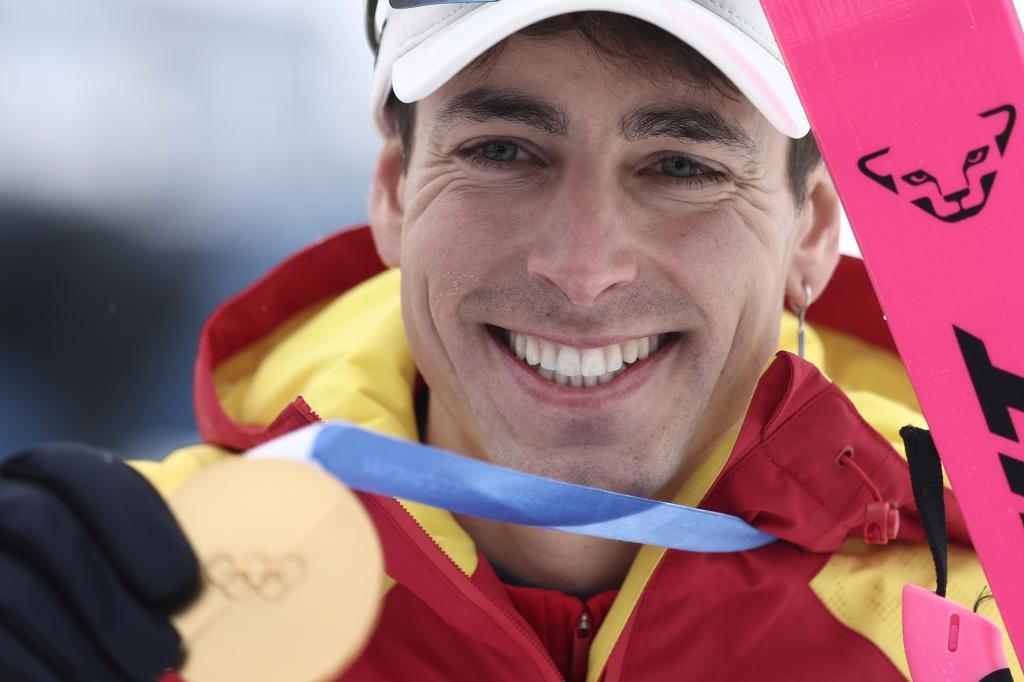
He would have loved to embrace Oriol Cardona. The photo would have been priceless. Paquito Fernández Ochoa would have turned 76 next Wednesday. It took 54 years for another Spaniard to become Olympic champion at a Winter Games. A long time, too long, and also, to have the cooperation of a new discipline in the program. Otherwise, impossible. Oriol Cardona is now another of our distinguished pioneers. And he is so in a double sense: for finishing first in a novel discipline among us and because this discipline is, like him, debuting at the Games. Oriol has also become an international pioneer.
He started from scratch. Or from a world unknown to the general public. Most likely, to the public in general. Before Paquito, people were not unaware, or not completely, of skiing's presence in the national sports scene. Those interested knew of its existence. Even the indifferent, because they were not entirely ignorant of the fact that skiing occupied a space in the news.
Paquito had some predecessors in Spain who paved a path that our champion in 1972 completed to surpass them and make history. Before Paquito and with Paquito, who made his Olympic debut in Grenoble68 before winning in Sapporo72, all these names represented Spain at the Winter Games, from those held in Saint Moritz in 1948: José and Luis Arias, Thomas Moravitz, José Vila, Juan Armiñán, Juan Poll, Ramón Blanco, Francisco Viladomat, Luis Moliné, Jaime Talens, Manuel García Morán, Luis Sánchez, Luis Viu, Juan Garriga, Javier Masana, Jorge Rodríguez, Francisco Prat, Aurelio García, Luciano del Cacho, Antonio Campaña and Carlos Adsera.
Oriol did not have anyone to look up to at such heights, although there is a certain tradition of this sport in Catalonia. Unlike Paquito, he was a favourite due to his world champion status. Paquito was a surprise. The surprise, in Oriol's case, would have been if he had not won. If there are miracles in Spanish sports, this is one of them. And not because Oriol is the result of an unexpected and favourable chain of joyfully unforeseen circumstances, but quite the opposite: because he has not needed "divine help", inexplicable or illogical factors to reach the top. His gold is not the product of alchemy, of manipulating disparate elements. It is nature's doing. There is no counterfeit chemistry in the carats. There is pure physics, without the mystifying processes of test tubes and alembics.
His medal, of the highest value, should be linked, alongside Paquito's also supreme one, to the silver of Queralt Castellet in halfpipe, in Beijing2022. And to the bronze medals of Blanca Fernández Ochoa, in the same event as her brother, in slalom, in Albertville1992, Javier Fernández in figure skating and Regino Hernández in snowboard, both in Pyeongchang2018. And now, Ana Alonso in, also, ski mountaineering.
After Paquito, Spanish alpine skiing was not left without names in, apart from the Games, the World Cup. All female. Blanca won four events (three slaloms and one giant slalom). María José Rienda, six giant slaloms. And Carolina Ruiz, one downhill. Those were good times.
We do not know what will happen among us from now on with ski mountaineering and, by affinity, with other winter disciplines. It is hoped that all this promotional popularity born from the gold will generate interest among young people that leads to an increase in practitioners. Hopefully, this gold is solid and does not melt away, like snow, when summer arrives.