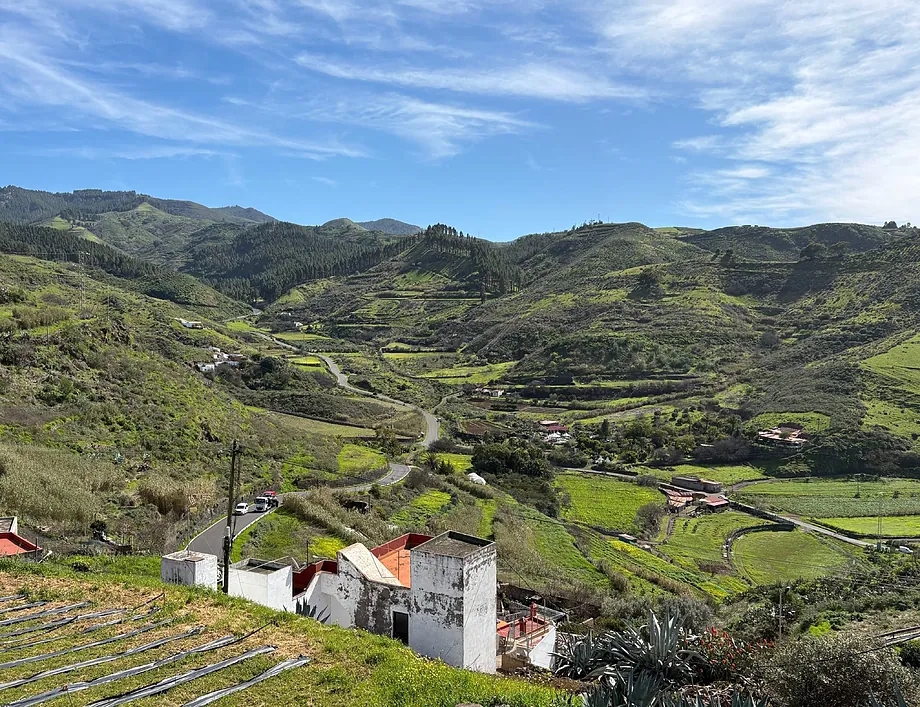
A space traveller received a beautiful lesson that for decades has adorned diaries, folders, and now Instagram profiles: "what is essential is invisible to the eye." That extraterrestrial (Saint-Exupéry's, not Spielberg's) comes to mind when travelling to Gran Canaria at this time and observing the minor sin committed by thousands of tourists on the island: focusing on the coastal attractions, be it Maspalomas or the capital, and not taking advantage of the unique, unusual, even historical explosion of green and flowery tones with which the interior has dressed itself with the persistent rains of this winter. Storm after storm has covered the ravines like Guayadeque, very close to the airport, and also old volcanoes and tired peaks.
One must seize the surprising fervour of nature that has transformed the interior of Gran Canaria into scenes reminiscent of the Cantabrian Mountains and dare to take the car, choose a good playlist (from Sabandeños to Quevedo, each to their own) and drive to climb and descend ravines. The reward, the views, in plural.
It's not about making a ranking of places to visit, but about driving with more eagerness to discover than planning. From Las Palmas, not far away is the Bandama Caldera, a retired volcanic cone now covered with vegetation among which paths descend to the base, where until a few years ago there was a small building occupied by a goatherd.
The road and common sense will lead to the Cruz de Tejeda, a pass from where a good part of the island's interior can be observed, such as the summit of Pozo de las Nieves, which reaches almost 2,000 meters. Here is the Parador Nacional, where guests swim in the outdoor heated pool overlooking immense ravines, Roque Nublo, and Roque Bentayga; visitors enjoy the views from the terrace, and hikers start their route to Tejeda, recognized as one of the Pueblos más bonitos de España, with low whitewashed houses, always facing the valley's vertigo, with impossible orchards on some terraces, Canarian pines, and almond trees.
If these two towns have more tourists than our spirit craving for calm needs, a good option is to move a few kilometers away and stop in Artenara. There, leaning out from the viewpoint to accompany Mr. Miguel de Unamuno in contemplating the horizon. A sculpture of the writer looking at Roque Bentayga, by the local artist Manolo González, recalls his excursion around the island in the early 1910s. Perhaps, in this early spring, the thinker would see landscape similarities with his native Vizcaya.
The time will come to stop for a meal, to discover flavors, which is essentially the same. Even at the table, one must remain curious. The restaurant-shop Antonio Pinocha (Fagajesto) is one of the unavoidable eateries in the interior. Cornmeal, avocados, and sweets are sold on shelves; through the window, the pine trees descending towards the valley can be seen, and next to the sidewalk, the metallic clicks of Harley Davidson motorcycles ridden by bikers taking a break can be heard. Both locals and foreigners immerse themselves in Gran Canaria's gastronomy, from gofio to goat, cheese to chickpea stew, fried lamb, all accompanied by aniseed bread.
With a full stomach, everything rolls downhill. One must make the most of the day to take a stroll through what could be considered the tourist capital of the interior, Teror, with its colonial air, facades painted in shades of indigo, egg yolk... adorned with exposed stone and elaborately crafted wooden balconies... At times, it's not easy to tell if one is in the Canary Islands or in some city of colonial America. Even a corner holds a statue of Simón Bolívar. The town's landmark is the slender church of Nuestra Señora del Pino, a pilgrimage center, with an impressive Norfolk Island pine at its feet. And around, on weekends, artisan products, honey, cheese can be bought...
For those who miss the beach, from the interior, head to Fataga, a small and picturesque village known for its whitewashed houses, gathered tightly together in an environment of ravines, palm groves, and prickly pears. The road southward resembles the landscapes of Hollywood road movies. And for a sunset view, a stop at the circular platform of Degollada de las Yeguas, from where one can contemplate lava flows from over 11 million years ago now speckled with vegetation. To the south, the dunes of Maspalomas. But that's another story.