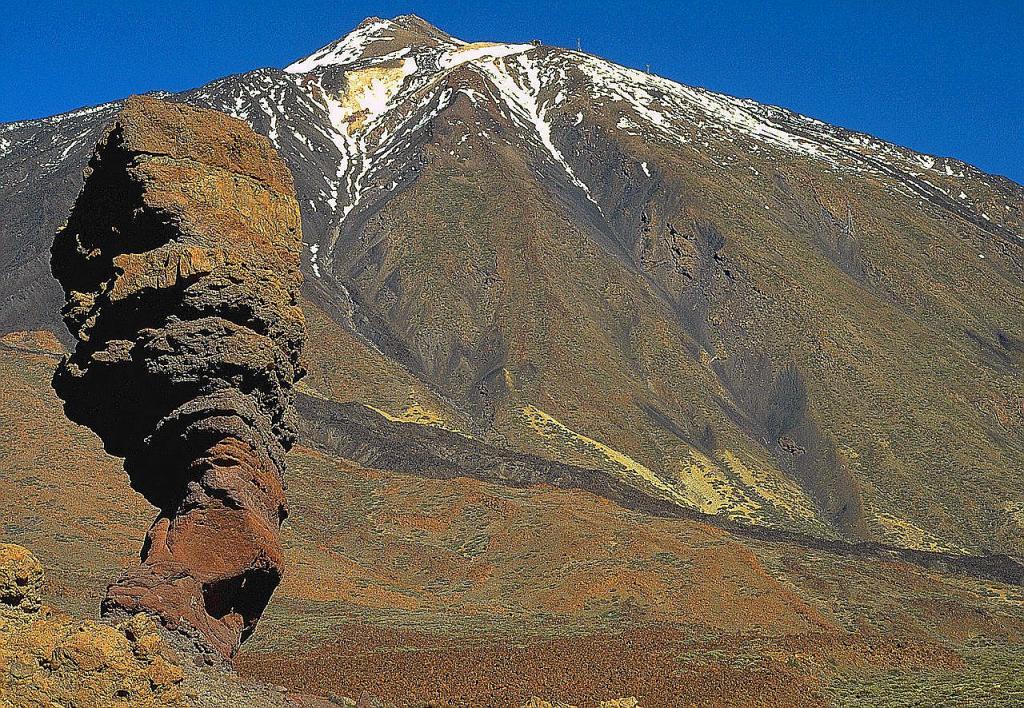
"Through the Echeyde crater, Guayota emitted smoke, burning rocks, slabs, and boulders, clots of burns. It also spewed out tongues of lava and streams of scoria, sulphur, ashes, and burning embers." In Guanche mythology, Teide was Echeyde and Guayota the evil one, whom only Achamán, the supreme being, could defeat. Although not definitively. According to the tradition collected by Sabas Martín in Ritos y leyendas guanches, Guayota, captive since then, "lurks and threatens" in the volcanoes of Tenerife. This week, the island experienced its seventh seismic swarm of February, a number exceeding those recorded in the last nine years. Thousands of small-magnitude earthquakes were located west of Las Cañadas del Teide, at a depth of between 7 and 9 km.
Today, there is no Achamán, but authorities are calling for "calm and serenity," stating that Teide is "the most monitored volcano in the world." The National Geographic Institute (IGN) speaks of a possible "new normality" that concerns José Manuel Marrero. "From a social point of view, it is not correct to speak of normality. We are in a complicated situation that requires preparation. When you are prepared, then you can relax. But if you have things to do, you cannot talk about normality," explains this Geography Ph.D. from the University of La Laguna with research experience in Mexico, Ecuador, and the Caribbean island of Montserrat, focused on volcanic crisis management and evacuation planning.
In fact, his doctoral thesis developed a variable-scale assessment model to be used as a tool in the event of an eruption. He applies it to the Mexican volcanoes Popocatépetl and Chichón... And to Teide on his native island. "Its system has been saying 'I have woken up' since 2004. It is doing normal things within an activation process, which means that the probability of an eruption is significant. That's why the big dilemma would be when to evacuate. And Tenerife is particularly complicated because it has a more complex volcanic system and is densely populated, increasing the risk."
According to Marrero, the island's population has a distorted historical memory regarding volcanic activity. The last eruption occurred in 1909, with the Chinyero volcano, mainly affecting the municipality of Santiago del Teide, which had a population of 1,585 inhabitants at the time. Today, it is home to over 12,000 residents. Hence, the significant impact of the Tajogaite volcano eruption in La Palma (2021). "The high volcanic risk of the Canary Islands and especially Tenerife does not stem from changes in expected activity, but from the increase in territorial occupation since the 20th century," asserts the researcher, who believes that the perception of danger is higher among residents of potentially more exposed municipalities, but there are still many misinterpretations.
"In Tenerife, you can have a monogenetic eruption like the one in La Palma, where you don't know where it will come out: you have uncertainty about the location, but you have a better idea of what it could be like. It depends on the location and duration. But then you have the central system of the Teide-Pico Viejo complex, with different characteristics and chambers that alter the magma's chemistry, filling it with gases. There, the type of activity expands the range of scenarios: from a small to a very large eruption. And unlike other stratovolcanoes, the eruption does not have to come out through the central cone. It can come out from many points around."
Almost all the island's eruptions in the last 20,000 years have been located in the volcanic complex formed by Teide and the Northwest Ridge. In the Northeast Ridge, the most recent eruptions are over 30,000 years old, and in the South Ridge, over 90,000 years. "We live on a 100% volcanic island. There are no areas with zero risk. And it is not the fault of people for building here or there. It's like saying the blame is for living in the Canary Islands," emphasizes Marrero
From a scientific perspective, the 31 municipalities of Tenerife are playing the lottery of a hypothetical eruption in their territories, but some have many tickets, and others have considerably fewer. Garachico, El Tanque, Santiago del Teide, and Guía de Isora have a very high volcanic risk. Icod de los Vinos, San Juan de la Rambla, and La Guancha have a high risk. And large areas of Puerto de la Cruz and La Orotava have a moderate risk. But the expert argues that it is not good to differentiate "if that makes the population and authorities lower their guard, as the probability between them is not so different."
"If you have an outlet, a crater, that comes out within Las Cañadas, it would have to be a very large eruption to affect inhabited areas. But if it comes out on the north side, towards Icod, then it's already outside," the researcher points out. The mention of Icod is not coincidental. The municipality is located on a territory where a moderate-intensity eruption could generate severe impacts without needing to reach large magnitudes. Marrero uses it as an example in his thesis and explains that evacuation would be the only effective measure, as phenomena like rapid flows, massive ash fall, gases, or pyroclastic flows could affect it in a short time, nullifying any reactive response.
His research dismantles the idea that evacuation simply involves "getting people out on roads." His model demonstrates that the evacuation of Icod is a systemic problem: high population density (over 24,000 inhabitants in 95.91 km2), limited road network, dispersed nuclei, dependence on roads that may become unusable, and unpredictable social behavior under stress.
The thesis introduces a variable-scale evacuation, integrated into a geographic information system, simulating different eruptive scenarios and evaluating real departure times, bottlenecks, and infrastructure collapses. It was done in 2009, and what it reflects has worsened since then.
"Although the municipality of Icod has several kilometers of coastline, it only has a small beach, San Marcos, where landing boats could operate if sea conditions allow. In the north, the sea state during much of the year hinders arrival and departure from the coast, which is cliffy, rocky, and difficult to access," he details. Additionally, airports must close due to ashfall, ruling them out in the critical phase. His conclusion is clear: without prior planning and early decisions, a late evacuation in Icod would turn a statistically low-lethality volcanic eruption into a human catastrophe caused not by the volcano but by poor emergency management. The total evacuation time would vary between two and 20 hours.
Marrero has collaborated with the CSIC in the deployment and maintenance of volcanic surveillance networks and participated in monitoring the volcanic crises of 2004 in Tenerife and 2011 in El Hierro. That's why he emphasizes that "waiting to see or waiting to see how the eruption will be to make decisions is playing with fire." "If the eruption is significant, it can have pyroclastic flows, fiery clouds descending in minutes and sweeping an area. It's no longer lava that you see coming and evacuate people," he highlights. "The logistics to deal with it are more complex, and decision-making is very delicate. These are scenarios that must be prepared in advance, in collaboration with the population. And if it doesn't need to be put into practice, great."
The researcher from Tenerife believes that no new signals beyond the swarms are needed. "The system is already active; that's justification enough." On La Palma, it was thought that the process would be like on El Hierro, where it took two months for the eruption to occur. But its internal structure was weaker, and the magma reached the surface in three weeks. Hundreds of residents of La Palma lost their homes, and the affected residents' association, Tierra Bonita, has demanded transparency from the authorities to avoid repeating the serious management errors at Tajogaite in Tenerife. They point out that there was a lack of information, with the maintenance of an inconsistent alert level: the eruptive process began without the population being evacuated beforehand.
For the moment, there is a consensus among scientists that volcanic activity in Tenerife has entered a new phase with the swarms, although the eight institutions (Spanish and Canary Islands Governments, Involcan, CSIC, etc.) that make up PEVOLCA conclude that there is no probability of an eruption in the short to medium term. However, the director of the IGN in the Canary Islands, Itahiza Domínguez, clarifies that "zero probability does not exist." Marrero points out that "you can't just say 'when the alert level is yellow, we'll get everything ready,'" because that might be too short a timeframe, given that the magma, after 22 years of reactivation, could only need three or four weeks to reach the surface. He notes that current plans have several problems. "Those at the higher administrative levels focus on organization: alert levels and who's in charge. None of them design evacuation plans. That problem is passed on to the town councils. But these are phenomena that transcend the municipality: an eruption can affect several towns. On islands with physical boundaries, you need an island-wide perspective for planning, not 31 conflicting plans."
Establishing an evacuation protocol with clear messages is a priority. "People aren't stupid. They understand that science doesn't know everything. But if you tell them there could be an eruption, they ask themselves: 'What do I do now?' And they're not getting answers. That was the main complaint on La Palma. The authorities are preparing the plans and don't yet have a clear answer to give, so they're putting in front of the scientists. And their speech is always the same, related to their field, but that doesn't address the kind of information the public needs."
Aside from the evacuation kit—ID, health insurance cards, family book, driver's licenses, copies of property deeds and insurance policies, cash—Marrero believes those affected need to know clearly whether they will have to leave their homes or stay; and if they have to leave, what the process would be. They should even register on a public portal, if necessary, to indicate where they are evacuating.
Volcanic alert system in question
In this respect, Marrero is very critical of the management of the PEVOLCA volcanic alert system. "It was designed to explain the alert level to the public in a simple way." But that objective was distorted when it was implemented in the emergency plan. "The alert system was written in a single table that linked each color to alert phases and actions. And that's where the problem begins." If the scientist raises the level of volcanic activity, the system forces a change in color. And when Doing so activates a chain of decisions that, perhaps, are not yet the right time to make.
"It's a rigid mechanism that generates perverse effects on the dynamics of emergency management. It puts pressure on the scientific community because they know that if they say one thing or another, it triggers immediate consequences, without any political leeway. It's as if they were making the decisions. You nullify the decision-making capacity of the politician, who is the one who should assume that role."
But it's not all negative. Since the reactivation of the Teide monitoring system in 2004, there have been numerous technological advances. "Scientific monitoring was minimal then, and now it's extremely advanced, with a more experienced research staff. Any change in the system is detected. The deficient part is management. The Civil Protection system we have in Spain is still outdated in many aspects." He believes that there are some types of natural hazards that, due to their magnitude, require a top-down approach. "They need coordination among all levels of government from the outset, not this kind of 'I'll wash my hands of it and when you're in dire straits, you'll change the level and...'" "Flames." Fragmentation must be avoided. Everyone knows this, but no one has made the courageous decision to change it."
The expert participates in the "La Laguna, Naturally Safe" project of the Canary Islands Volcanoes Association, which he co-founded. In it, he explains how, although the World Heritage city has a low risk of eruption, it could suffer multiple problems: ashfall, airport closures, cessation of economic activity... "You have to be prepared even if your municipality has a lower probability of an eruption, because the islands aren't so big that nothing can affect you," he reiterates.
Although society demands information, he believes that "the current pace of life means that a large majority don't want to hear negative things." "They tell you they want to know, but when what you tell them isn't what they want to hear, which is 'nothing's happening here,' they don't like it so much anymore. Working honestly and telling things as they need to be told to an adult audience, without mincing words, is incredibly complicated, exhausting, and sometimes thankless," he concludes.