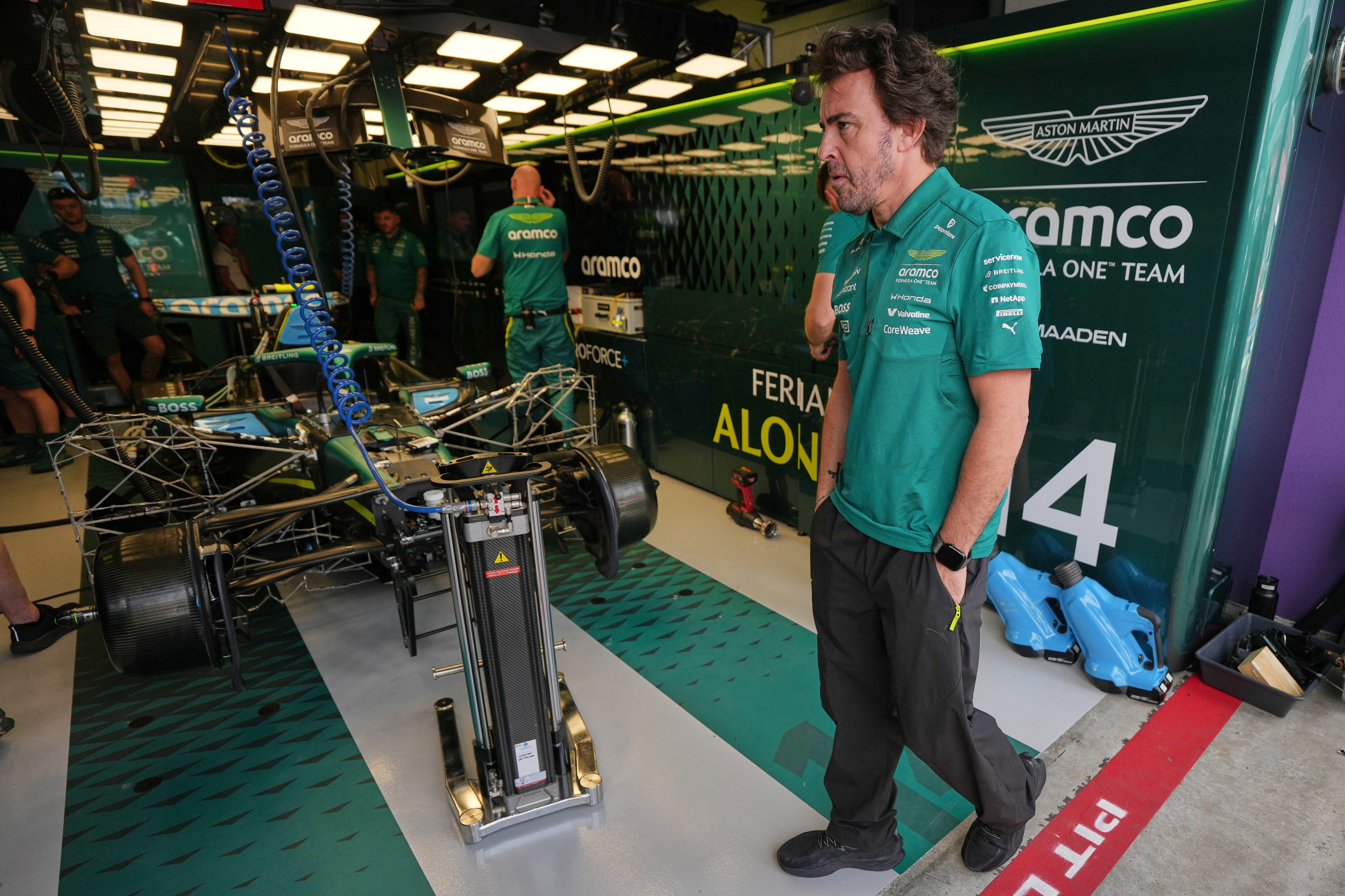
After a long preseason, with nine days of testing, several certainties have settled in the Albert Park paddock, where the 2026 World Championship kicks off today. Mercedes, for example, has the best combustion engine, while Red Bull excels in electric batteries. McLaren, the reigning champion, is facing overweight issues, and Alpine, the last in 2025, is emerging as a force in the midfield. However, none of these statements is as categorical as the one placing Aston Martin as the worst team on the grid. The crisis is so pressing that just completing the 58 laps of the Australian GP seems like a true feat.
It is not unreasonable to think that the AMR26 could be excluded from the race due to the 107% rule, designed to ensure that all cars are fast enough to compete safely. We have to go back to 2012 to witness the last case of a team disqualified for this reason. It was Hispania Racing Team, also in Melbourne. So Fernando Alonso's priority will be to set a time tomorrow that does not exceed 107% of the first-place time in Q1. Considering what happened in 2025 when Lando Norris led with 1:15.912, the threshold would now be at 5.31 seconds. Mistakes are prohibited, as Alonso's best lap in Bahrain was 4.54 seconds slower than Charles Leclerc's.
Two races hang by a thread, with over 200 million dollars at stake
It is hard to imagine a more subdued celebration for Alonso's silver anniversary in F1. A full 25 years since his debut with Minardi in Melbourne, on a Sunday where Kimi Raikkonen and Juan Pablo Montoya also made their debuts. However, the most ominous memories date back to 2015 when an accident in Montmeló's tests thwarted his trip to Australia. The prelude to three years of nightmare with McLaren-Honda. Among the countless misfortunes, the 2015 Mexican GP, where he couldn't even complete a lap due to an electrical failure, or the 2017 Russian GP, where a mishap on the formation lap prevented him from starting.
Today, the exchange of reproaches between Honda and Aston Martin brings back memories of that cursed alliance. The regulations mandate the freezing of engines until the seventh race, so there will be no updates until late May in Canada. Even considering the six-month delay at the Sakura factory, which had lost 40% of its most qualified staff, it is embarrassing to see them losing ground to debutant engine suppliers like Audi or Red Bull Powertrains-Ford.
Throughout the preseason, the AMR26 has averaged 55.7 laps per day, fewer than what awaits them on Sunday. During the tests in Sakhir, 14 drivers completed more laps than the entire Lawrence Stroll team, unable to simulate a race. Alonso's longest stint was 26 laps before his car got stranded on the track. The cause of the Honda engine failure leading to the disconnection of the electric battery is still unknown.
The behavior of the AMR26 at the start is also unknown since their drivers couldn't even practice a single start from the grid. The gearbox, manufactured for the first time at the Silverstone factory, poses another headache. The result is an unstable, unbalanced car with no solid foundation to support a radical and extreme aerodynamics, typical of Adrian Newey.
The genius, with his mere presence, cannot perform miracles, as admitted on Thursday in Albert Park. "The chassis vibrations are causing some reliability issues, but the most significant problem is that they are affecting the driver's fingers. Fernando believes he cannot complete more than 25 consecutive laps without risking permanent nerve damage in his hands," revealed the team principal.
A few minutes later, journalists demanded a more detailed explanation from Lance Stroll. "I don't know what you could compare it to. I guess getting electrocuted in a chair or something like that, not far off," the Canadian concluded. "If we continue with the same issues from Bahrain, it will be difficult to complete more than 10 or 15 laps," he added, to the general astonishment.
For opposite but equally serious reasons, the horizon also looks bleak for Carlos Sainz at Williams. The British team had a relatively straightforward task of building a competitive car thanks to their alliance with Mercedes, the reference engine supplier from the start. Since the summer of 2025, the team principalJames Vowles had focused all efforts on finding solutions for the new regulations. However, no breakthroughs have emerged from the Grove factory.
The FW48 is a reliable car, yes, but lacking in performance, far from the level of the car that brought Sainz three podiums in 2025. Delays in passing the crash test prevented Williams from attending the Montmeló tests, and things started to unravel from there. Although Vowles has always been discreet in providing details, it is estimated that the blue car is 25 kg overweight, more than double that of its rivals. Such a burden can translate to almost a second per lap.
"The top four teams are incredibly fast, the midfield has fallen far behind, and now we have to figure out how to regain ground. At the beginning of this year, we will pay closer attention to Q1," Sainz acknowledged during his press conference at Albert Park. The Spaniard needs to tame an overly nervous car, as he experienced in the braking zones of turns 1 and 10 in Sakhir. Williams' traditional struggles with spare parts complete a truly bleak picture.