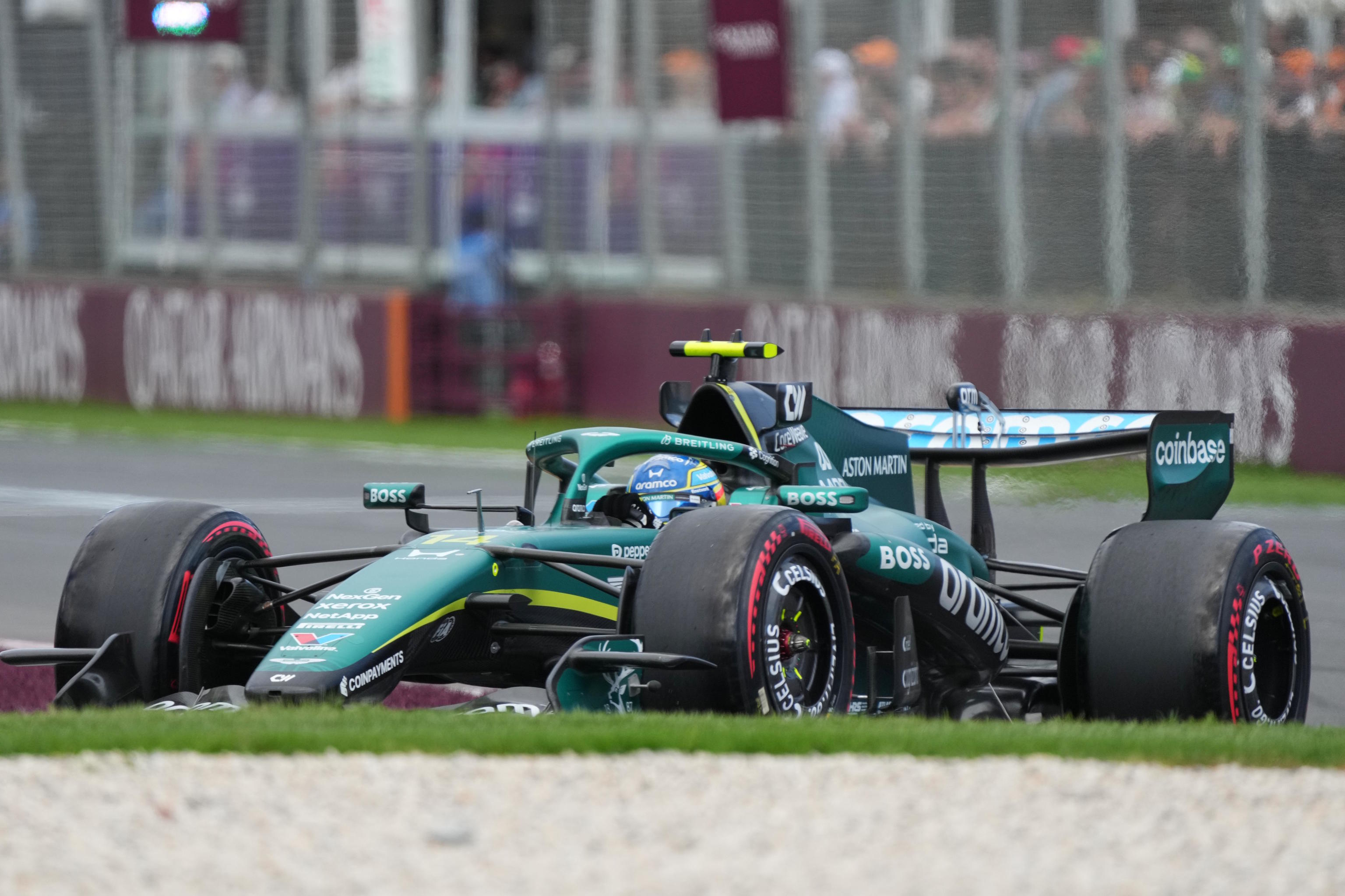
The scale of the disaster is proportional to the ambition of the project, one of the most dazzling in modern F1. Aston Martin has surpassed the limits of ridicule at the Australian GP and now holds the dubious honor of being the biggest disappointment of the century at the pinnacle of motorsport. Not even the cases of Toyota, BAR Honda, and Jaguar from a couple of decades ago can compare to the disaster of the Silverstone team.
A couple of years ago, Fernando Alonso described Aston Martin as "the team of the future," captivated by the colossal investment of Lawrence Stroll. Since his arrival in 2020, the Canadian magnate has invested nearly 500 million euros in state-of-the-art infrastructure and qualified personnel. A technological campus for over 1,000 employees, a futuristic wind tunnel, and a simulator with the potential to change the game. All at the service of Adrian Newey, Enrico Cardile, Dan Fallows, or Andy Cowell, hired, with a hefty paycheck, following their successes at Red Bull, Ferrari, and Mercedes.
The brightest minds in the paddock had set their sights on the 2026 World Championship, when the regulatory revolution would come into effect. In the spring of 2024, Alonso extended his contract. He was 42 years old. It was a unique opportunity, so everything was subordinated to it. The disappointing seventh place in 2025, two positions below the previous season, was seen as mere learning towards a specific place and date: March 8, 2026, at Albert Park.
At the end of January, the prediction market Polymarket placed Alonso as the third favorite to become world champion, behind George Russell and Max Verstappen. Three weeks later, Aston Martin only completed six laps on the final official test day in Bahrain, where the two-time champion couldn't even hit the track. The continuous engine failures from Honda thwarted any attempt to build a solid foundation. The power unit vibrated so much that it caused damage to the batteries.
The situation looked so bleak that there were even considerations of not traveling to Melbourne to focus on work at the Sakura and Silverstone factories. However, Aston Martin chose to respect the Concord Agreement, which imposes hefty fines on teams that decide to skip a race. At Albert Park, the only priority would be to comply with the 107% rule and avoid a monumental embarrassment. They didn't have spare parts for the electric batteries, there was no possibility of completing the 58 laps on Sunday, and the health of the drivers couldn't even be guaranteed, as according to Lance Stroll, the AMR26 resembled an electric chair.
Aston Martin's botch would be unacceptable even for a newcomer like Cadillac, without facilities or human capital at the level, forced to build its project in less than a year and entrust it to two veterans like Valtteri Bottas and Sergio Pérez. Last Thursday, the Finn didn't hesitate to joke about the chaos surrounding his friend Alonso: "If I had to guess the next world champion, I would say Lance and Fernando." Just an hour later, in that same press room, Newey had to get more serious.
Although the role of spokesperson and team principal is still quite uncomfortable for him, the design guru didn't hesitate in front of the microphones. Inside the hospitality, alongside Koji Watanabe, president of Honda Racing Corporation, the Briton defended his work and shifted the blame for the failure to the Japanese brand. A crossfire of accusations reminiscent of the worst episodes of the McLaren - Honda alliance (2015 - 2017). A decade has passed since Alonso's "GP2 engine!" moment, and the image of the Japanese engine manufacturer is once again tarnished.
It's not about always going back to the glory days of the late 80s with Ayrton Senna or Alain Prost. Nor is it about dwelling on the misfortunes of their last factory team era (2006-2008), which ended with just one victory and the sale to Ross Brawn for the symbolic price of one pound. No one could have suspected then that Jenson Button would become champion in 2009. Such a fiasco could only be compared to that of their historic competitor.
Between 2004 and 2007, Toyota established itself as the biggest budget in F1, but their expenditures didn't even yield a single victory. There was genuine ambition in their plans, but Ralf Schumacher and Jarno Trulli were never able to make the leap in quality. The expenses at the Cologne factory and on the German driver's salary eventually took their toll on a team without pedigree.
Today, two decades later, some of those Toyota sins are resurfacing in Aston Martin. If, as Newey claims, Honda concealed their weakness after losing their top F1 engineers, why did it take them almost two years to closely monitor the work in Sakura? If their wind tunnel was at the cutting edge, as the owner boasted, why did it need recalibration to start four months late? If the 2024 and 2025 Championships at least served to gather valuable data for the future, where are the results now?
These are just a few of the countless questions hovering over Silverstone. Just a few months ago, Aston Martin was fantasizing about signing Charles Leclerc or Verstappen to pair with Alonso from 2027 onwards. Now, their only lifeline lies in hoping that the Spaniard doesn't hastily abandon the project.