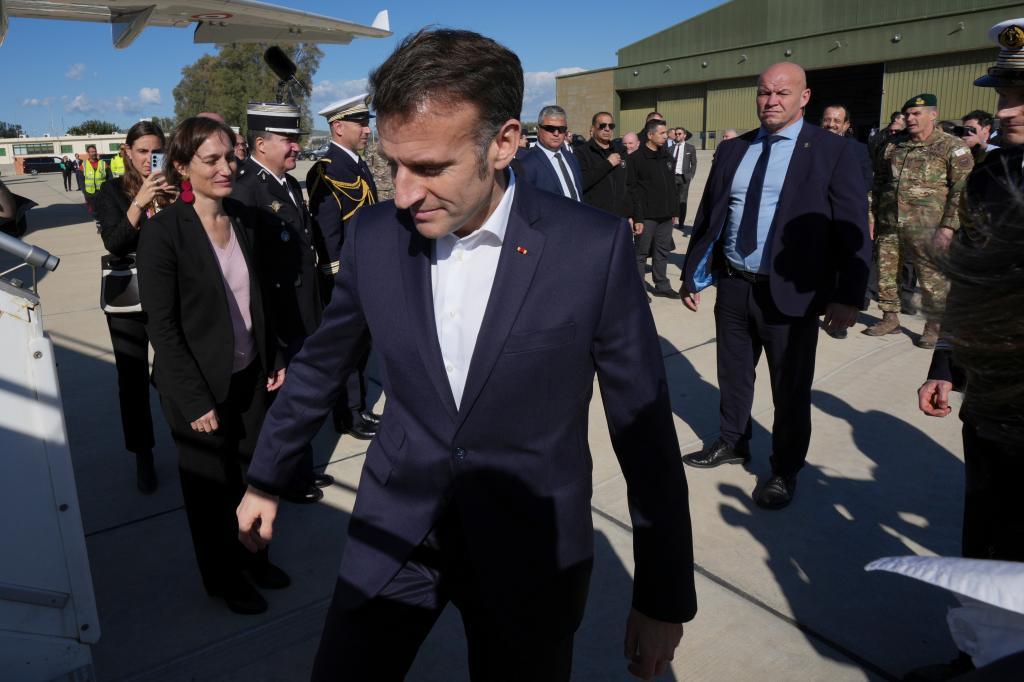
"When Cyprus is attacked, Europe is attacked," declared Emmanuel Macron upon setting foot on the island after the Iranian drone attacks. The French president arrived in Nicosia with the aim of strengthening security in the eastern Mediterranean and visiting the aircraft carrier Charles de Gaulle, anchored off the coast of Crete. Macron landed in the Cypriot capital in the early afternoon and later met in Paphos with the President of Cyprus, Nikos Christodoulides, and with the Greek Prime Minister, Kyriakos Mitsotakis. Macron also announced "an unprecedented mobilisation of our Navy" in an operation aimed at allowing maritime traffic in the area, including eight frigates, two helicopter carriers, and our aircraft carrier."
The visit holds significant symbolic value just a week after the Iranian drone attack on the British base at Akrotiri. In contrast to the criticism received by the British Prime Minister, Keir Starmer, for his delayed response, Macron took a step forward by announcing the dispatch of the frigate Languedoc and the deployment of the Charles de Gaulle, aimed at reinforcing French military presence in the Middle East.
During his stay in Cyprus, the French president emphasized that France's military missions are "purely defensive" and aim to ensure the security of his country, the approximately 400,000 French citizens residing in the region, and allies such as Qatar, Kuwait, the United Arab Emirates, Saudi Arabia, Jordan, or Iraq, "countries that have been attacked or destabilised and to which we provide our support."
Macron was scheduled to meet in the afternoon with the 1,900 sailors aboard the Charles de Gaulle and with the naval unit accompanying it, consisting of two frigates, a tanker, a submarine, and around 40 aircraft, including Rafale fighters. The deployment of the aircraft carrier, which arrived from the North Atlantic, aims to "reinforce the military resources already present in the region, ensure freedom of navigation from the Red Sea to the Strait of Hormuz, and contribute to de-escalation," according to the French president. The flagship of the French Navy will also join the European operation Aspides, coordinated from Greece.
The trip by the French president has been criticised in France by former Prime Minister Dominique de Villepin, who strongly opposed the Iraq war. "If there is one place where the president should be, it is the Élysée, coordinating actions," said Villepin, who warned of the risk of France being "dragged" into the conflict and of military operations "being further expanded."
"The main objective of this trip is to demonstrate our full solidarity with Cyprus," Macron insisted. "France is coordinating efforts to ensure the security of European citizens in the region. And our third objective is to reinforce the security of our partners."
En route to Cyprus, Macron spoke on the phone with Israeli Prime Minister Benjamin Netanyahu to express his concern about the bombings in Lebanon, which have resulted in more than 400 deaths and half a million displaced. On Sunday, the French president also spoke with Iranian President Masoud Pezeshkian, urging "an immediate cessation of attacks against the countries in the region" and respect for "freedom of navigation in the Strait of Hormuz."
One of the main missions of the Charles de Gaulle will be to join the European Union's maritime operation Aspides to ensure the security of maritime traffic from the Red Sea to the Strait of Hormuz, according to the Élysée statement.
The French naval group, with its detachment of ready-to-launch Rafale fighters, also aims to ensure the security of European citizens in the region and support possible evacuation operations. Last week, an Air France plane had to turn back due to the risk of being hit by missiles.