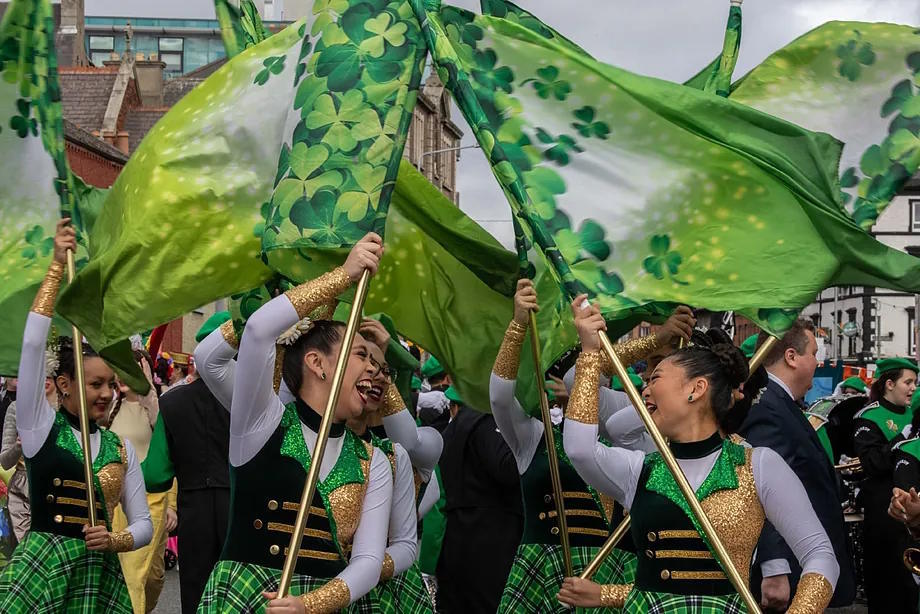
To begin with, he was neither a saint nor Irish nor was his name Patrick. These are three of the lies turned into legend about the famous patron of Ireland. The deception hasn't mattered much when it comes to celebrating his day, the 17th of March, in style across the globe. Or the whole planet, as the festivities take place from a week before in Dublin, the official birthplace, New York, Madrid, La Coruña, Chicago, Tokyo, Rio de Janeiro, or the Caribbean.
As we mentioned, Saint Patrick was not actually called that, but Maewyn Succat, a missionary born in Wales or Scotland (not Ireland) who decided to change his name to Patricius when he was ordained a priest. However, he was never canonized by the Catholic Church, so he cannot be considered an official saint, although he is credited with numerous miracles, which is why the Irish people themselves consider him a virtuous figure. Among his feats are, for example, the expulsion of snakes from Ireland (hence the symbol) or the resurrection of a prince.
Be that as it may, it is believed that Mr. Succat was kidnapped at the age of 16 by pirates, who took him to Ireland. During his time as a slave, he learned the national customs. Finally, he managed to escape to France, where he became a priest, returning to Ireland years later to carry out evangelistic work by building monasteries, churches, and schools throughout the country. Oh, his color was not green either, but he was known to wear blue robes. However, he did use green shamrocks to preach, as he used them to refer to the mystery of the Holy Trinity: Father, Son, and Holy Spirit.
St. Patrick's Cathedral in Dublin is the starting point of the religious route across the island, as it is assumed that right there was a well where he baptized pagans who converted to Christianity. However, the cathedral was not such until the year 1200, as before there was only a modest wooden church from the 15th century. The priest died on the 17th of March 461 in Saul, in County Down (Northern Ireland), so he is buried on Down Hill, one of the main pilgrimage sites related to the saint and where the first church in his honor was erected.
The one who fought for that date to become a national holiday was Luke Wadding, an Irish Franciscan friar. In fact, the first St. Patrick's parade in the country was in 1903 in his hometown, Waterford. In Dublin, it would not be celebrated until 1931. Today, it is the country's main festivity, with a festival lasting from the 14th to the 17th of March offering activities of music, dance, theater, literature, and gastronomy. The parade on the 17th brings together more than 3,000 people from noon. Festivals are repeated in cities like Armagh, Sligo, and Belfast, in Northern Ireland, where they even organize a sort of St. Patrick's Day race where runners dress in green. The motto of the celebration in Cork is Marsh, Myth & Magic, while in Waterford, the atmosphere is lively from the 13th.
The Spanish origins of the celebrations in honor of St. Patrick date back to the colonial times in San Agustín de la Florida, back then under the Iberian crown. The first parade took place in 1601 by an Irish priest who wanted to ask the saint for a good corn harvest. The Celtic connections of our country also have a strong link with the celebration. This will be the fourth year that the Tourism Office of the Emerald Isle in our country organizes the Ireland Week in Madrid from the 10th to the 17th of March.
Among the activities carried out are performances of traditional music and dance, Irish film screenings, gastronomic tastings, talks, sports exhibitions, and a few more surprises that aim to bring the culture and heritage of the Emerald Isle closer. The main day will be Saturday the 14th, when the grand parade will fill Gran Vía with bagpipes and Celtic folklore (from the Metropolis building to Plaza de España) with over 600 musicians and 1,200 participants. On the other hand, Cibeles will be lit up in green on the 17th of March, St. Patrick's Day. That will be the color of the churros offered that morning at the famous San Ginés chocolate shop.
The rest of Spain also joins the celebration, with parades and festivities that will take place in Granada, Barcelona, Pamplona, Santander, Cáceres, Barcelona, or Cabo Roig, in Orihuela (Alicante). In Albuñol (Granada), Benidorm, or Santa Cruz de la Palma, on the homonymous Canary Island, for example, they parade the saint. In the latter town, they also pay tribute to the figure of the merchant Dionisio O'Daly, born in Cork, who in 1773 contributed to La Palma having the first town hall in Spain elected by popular vote.
In Pontevedra, they also go all out, as from the 18th to the 22nd of March, the 14th edition of the Galaico-Irish Festival of St. Patrick will be celebrated, highlighting the ties that unite Celtic culture through gastronomy, culture, and tourism. The same goes for Tortosa, in Tarragona, where their traditional Tortosa Irish English Festival Opens will take place from the 13th to the 21st of March, an event with Irish culture that is conducted in English and is now in its 13th edition.
From Tokyo to the Caribbean or New York
We continue the journey around the world, as the celebrations touch places as diverse as Tokyo, Chicago, Montreal, Rio de Janeiro, or Sydney following the trail of Irish immigrants. It is estimated that more than 80 million people have roots from this country. Therefore, it is not surprising that St. Patrick's Day is one of the reference festivals worldwide.
We start in the United States, where it is a well-established celebration. In fact, in New York, the parades started as we know them today, as the numerous displaced from the European island wanted to pay tribute to their patron saint in their host country. Thus, in 1762, the Fifth Avenue held the first parade with over 250,000 spectators. This March 17, therefore, will host its 265th edition, with countless legendary monuments illuminated in green.
The number of parades across the country exceeds a hundred, with other iconic locations like Boston, Washington, Tampa, San Francisco, or Chicago, where even the river is dyed green. It is worth noting that the tradition in the city dates back to 1843 when the first parade took place. In these places, it is also common to eat corned beef and cabbage and the classic Irish stew during these days.
In the Japanese capital, on the other hand, all kinds of events take place where shamrocks, green caps, red-haired beards, and pints of beer are the protagonists. The big day is Sunday the 15th when a grand parade will take place along Omotesando Avenue, with similar repetitions across the country.
March 17 is also a national holiday on the Caribbean island of Montserrat, south of Puerto Rico. A curiosity: in this small paradise, they stamp your passport with a green shamrock. This commemorates the strong links with Ireland, as this British protectorate served as a refuge for the Catholics from the European country. As evidence, a census from 1678 certifies that over half of the population was of Irish origin. Hence, surnames like Allen or Lynch are common, and there are towns like Harris Village, Potato Hill, or Cork. During these days, the entire island dresses in green with parades, masquerade dances, concerts, and a special dinner on the 17th called Heritage Feast.