Red Paris voted socialist on May 15, Blue Paris took a turn to the right, and Incendiary Paris confirmed its status as rebellious with the conquest of the emblematic Saint-Denis. The 25 years of socialist reign have given way to a city almost as polarized as the rest of the country, with the far-right also taking advantage of the general anxiety.
From the French Revolution to May '68, through the experience of self-managed socialism of La Commune, which was ahead of its time, Paris carries the label of a left-wing city. For over a century (1871-1977), the city was administered by the French State, and when Parisians could vote again, they curiously chose a right-wing mayor, Jacques Chirac, who used Paris as a catapult to the Presidency.
Chirac's successor, Jean Tiberi, did not measure up, and the socialist Bertrand Delanoë began a prolonged mandate in 2001, continued over the last decade by his natural successor, Anne Hidalgo, who has had the support of half of the citizens for the "ecological transition" and has predisposed the other half against her with issues of citizen insecurity, cleanliness, and debt.
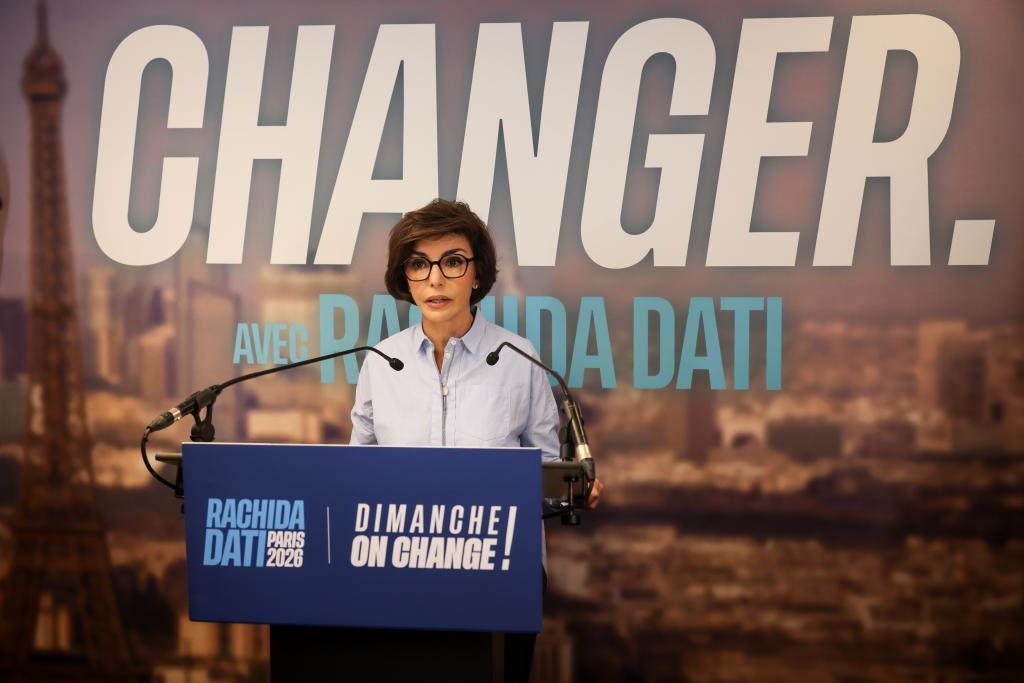
Her former deputy Emmanuel Grégoire is running in these elections strategically distancing himself from his mentor, promising to continue with urban transformations but trying not to polarize the electorate. His 12-point lead over the candidate from The Republicans, Rachida Dati (37% to 25%), may suggest a vote for continuity, but nothing is guaranteed in this two-round system that could bring surprising results on May 22.
The merger of Rachida Dati with the centrist candidate Pierre-Yves Bournazel, who obtained 11% in the first round, could be enough to narrow the gap. Dati's move has also forced the withdrawal of the Reconquista candidate, the far-right Sarah Knafo, completely clearing the way for the right's call for a "useful vote".
In fact, Dati received an extra boost last Sunday by being re-elected as president of the 7th district of Paris with 58% of the votes. From her stronghold around the Eiffel Tower (with the controversial proposal to fence off the Champ de Mars), the candidate from The Republicans aims to continue painting the neighbouring arrondissements blue, already counting on the 6th, 8th, 15th, 16th, and 17th.
In the 16th, the most conservative district of Paris, lives her political godfather, Nicolas Sarkozy, whose shadow is once again looming over her these days due to the trial on appeal for the Libyan connection. Dati also has her own appointment with justice on September 16 for alleged corruption and influence peddling when she was a Member of the European Parliament and for her links with Carlos Ghosn, the former CEO of Renault.
Meanwhile, the socialist Grégoire is heading to the second round without reinforcements, refusing to reach out to Jean-Luc Mélenchon's Unsubmissive France and their candidate Sophia Chikirou, who garnered 11.7% of the votes in the first round. "I am aware that many left-wing voters are somewhat lost today," declared Grégoire, who admits feeling caught "between those insisting on the merger to protect Paris from the right and those urging me not to merge in the name of values and principles."
Grégoire has so far yielded to the latter and has pointed out how the Unsubmissive France candidate "has spent the entire campaign attacking us". An alliance with the far-left could also blow up the fragile coalition supporting him, including The Ecologists, the Communist Party, and Plaza Pública.
"Grégoire is playing an incomprehensible game," warned Chikirou. "I am still waiting for him to call me; he hasn't even wanted to start a dialogue. I was ready to consider a merger proposal to confront Rachida Dati and put an end to the possibility of her becoming the Mayor of Paris."
Meanwhile, in Saint-Denis, in the city outside the walls, Unsubmissive France has prevailed with 50.7% of the votes obtained by their candidate Bally Bagayoko, confirming the pull of the far-left in the suburbs of Paris. Jean-Luc Mélenchon's party has capitalized on its success in the banlieues as a challenge to the marginalization suffered at the hands of the left and as a show of strength for the 2027 presidential elections.
"The victory of Unsubmissive France in Saint-Denis demonstrates that the city's sociology is receptive to the 'new France' concept advocated by Mélenchon," stated Jean-Yves Dormagen, head of the Cluster17 institute, to Le Monde. "The city is a mix of the 'unsubmissive' vote: young graduates, teachers, researchers, journalists, executives from the social economy - what I call the 'intellectual proletariat' - and the population of children and grandchildren of immigrants, mostly of Muslim faith."