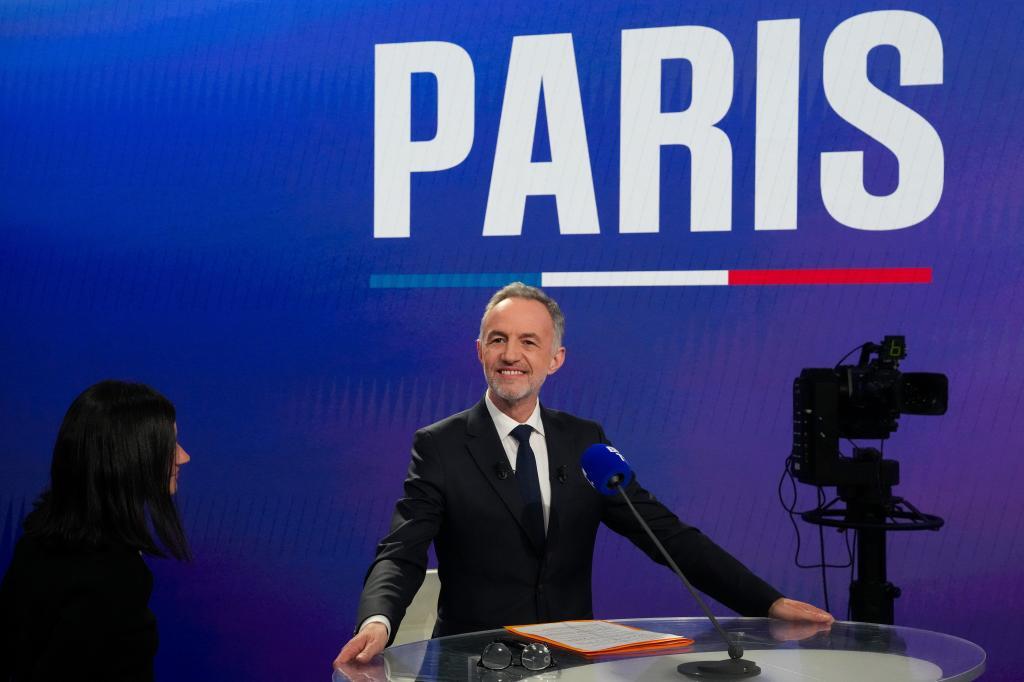
The Socialist Party has resisted the right-wing advance in Paris and has extended its reign of 25 years in the French capital, according to initial estimates. Emmanuel Grégoire will succeed Anne Hidalgo after winning the second round of the local elections against The Republicans' candidate Rachida Dati by 53% to 38% of the votes, despite her alliance with the centrist Pierre-Yves a Bournazel and the withdrawal of the far-right candidate Sarah Kanafo from the Reconquista party.
In his victory speech, Grégoire stated that "Paris has decided to remain faithful to its history" and thanked the voters who "chose the unity of the left and the ecologists." "Paris will be the heart of resistance against this right-wing alliance that wants to take away from us what we value most and what is most fragile: the simple joy of living together," he added. "Paris is this promise, and I commit to fulfilling it over the next six years," he said.
Grégoire assured that he welcomed Rachida Dati. "My office will always be open to the opposition."
Grégoire won by 12 points in the first round last week, but his final victory was compromised by a series of vicissitudes in the campaign, from the direct accusation against President Macron for intervening in favor of his rival to the scandal of sexual abuse in preschool centers that tarnished Hidalgo's last days in office.
The socialist candidate ran in the election with the same coalition as his predecessor (The Ecologists, Communist Party, and Public Square), but faced rivalry from the left with the candidate from La France Insumisa, Sophia Chikirou, with whom he refused to form an alliance.
His victory is seen as a gesture of "resistance" from the Socialist Party against the advance of the far right and the far left in the local elections. The local presence and personal appeal of the candidates have cushioned the fall of the old parties, which, however, are in a weak position for the 2027 presidential elections.
Emmanuel Grégoire persistently sought to discredit Rachida Dati, a protégée of Nicolas Sarkozy and a representative of the hardline faction of The Republicans, labeling her as a representative of "the far-right" and recalling how Marine Le Pen and Jordan Bardella, co-leaders of National Rally, had endorsed her (following the failure in Paris of their own candidate, the former Sarkozy minister Thierry Mariani).
Grégoire also accused Emmanuel Macron of favouritism towards his former Culture Minister and blamed him for paving the way by forcing the withdrawal of the candidate Sarah Knafo, a representative of the far-right party Reconquista, which surpassed the 10% threshold in the first round.
"Given the international and economic situation, it is somewhat incongruous that the president can devote himself to these issues, given all the burden he carries," warned Grégoire, who held Macron responsible for the "moral and political collapse the country is experiencing." The Élysée tenant responded forcefully, accusing him of spreading "indecent and slanderous lies" against him.
Another significant factor in the final stretch of the campaign was the scandal of sexual abuse in the preschool centers of Paris, reignited by the arrest of three men, two of them monitors, and the continued protests of parents at the Town Hall. Rachida Dati used the new revelations to criticize Grégoire for his role as deputy mayor with Anne Hidalgo, accused of "inaction" in the face of the wave of cases (up to 52 animators were suspended in three years).
During his campaign, Grégoire maintained a calculated distance from his predecessor, although he committed to continue with the ecological transition and urban transformation of Paris in the last decade. Security, cleanliness, and debt were the three subjects he pledged to address as the socialist mayoral candidate, with a commitment to a more inclusive and less polarizing mandate.
Like the previous week, the earliest to vote was Rachida Dati, who already had the confidence of being re-elected as president of the municipal council of district 7, where the Eiffel Tower is located. In the name of security, which was the flagship of her campaign, Dati distanced herself with the controversial proposal of fencing off the Champ de Mars and closing it at night.
Socialist candidate Emmanuel Grégoire was photographed coming out of the polling booth with a crumpled ballot paper of his "unsubmissive" rival Sophia Chikirou, sparking a wave of reactions on social media. During the campaign, the tension between the moderate left and the far left candidates was very evident, which may have also influenced the final decision of the voters.
Former Prime Minister Edouard Philippe has been the first winner of the French local elections with 47% of the votes in Le Havre, positioning him as the favourite candidate of the political centre for the 2027 presidential elections. Philippe, who already comfortably won in the first round against his perennial rival, the communist Jean-Paul Lecoq, also left behind the National Rally candidate Franck Keller, as a warm-up for the real contest against Marine Le Pen or Jordan Bardella in next year's presidential elections.
Benoît Payan has been re-elected mayor of Marseille, according to estimates by Elabe for Le Figaro. The candidate of the left-wing coalition ("Marseille Spring") won with 56.3% of the votes, against 39.1% of Franck Allisio (National Rally). Payan narrowly won in the first round, but the withdrawal of the La France Insumisa candidate, Sébastien Delogu, allowed him to garner the useful left-wing vote (while the continued presence of Martine Vasal, from The Republicans, seriously harmed his opponent).
In Toulon, the National Rally candidate Laure Lavalette also lost her personal battle against the mayor Josée Massi, from the moderate right-wing DVD group. The defeat of the far-right candidate, a historic ally of Marine Le Pen, is seen as a resounding failure of the National Rally in its attempt to seize strongholds on the Mediterranean coast after retaining the mayorship of Perpignan last week.
Around 16 million French citizens were called to vote in the 1,526 municipalities where the second round was necessary, including major cities like Paris, Marseille, Lyon, Nice, or Toulouse. Jordan Bardella voted in Garches, a village of 15,000 inhabitants in the southern outskirts of Paris. His party did not present any candidates there, so the National Rally co-leader had to choose between the candidate from The Republicans Jeanne Bécart or the independent right-wing candidate Yves Menel.
The absence of an RN candidate in his electoral district and the significant setback of the Paris mayoral candidate highlighted the "gaps" of the far-right party in the capital and other major cities, beyond their strongholds in the north and the Mediterranean coast.
By midday on Sunday, the voter turnout in the local elections in 1,526 municipalities was 20.3%, slightly higher than the previous week. By five o'clock in the afternoon, it exceeded 47%, and by the end of the day, a participation rate of 57% was expected, with a lower level of abstention than the previous week.
The most notable events of election day were the deaths of a voter and a poll worker at a polling station. In Annecy, at 9:30 a.m., an 81-year-old man died of a heart attack just after casting his vote. Paramedics attempted to resuscitate him, but his death was virtually instantaneous.
In Saint-Étienne, an advisor to National Rally candidate Corentin Jousserand died at noon on Sunday, also apparently from a heart attack. The news was released in a press statement by Dino Cinieri, the Republican Union of the Right candidate.