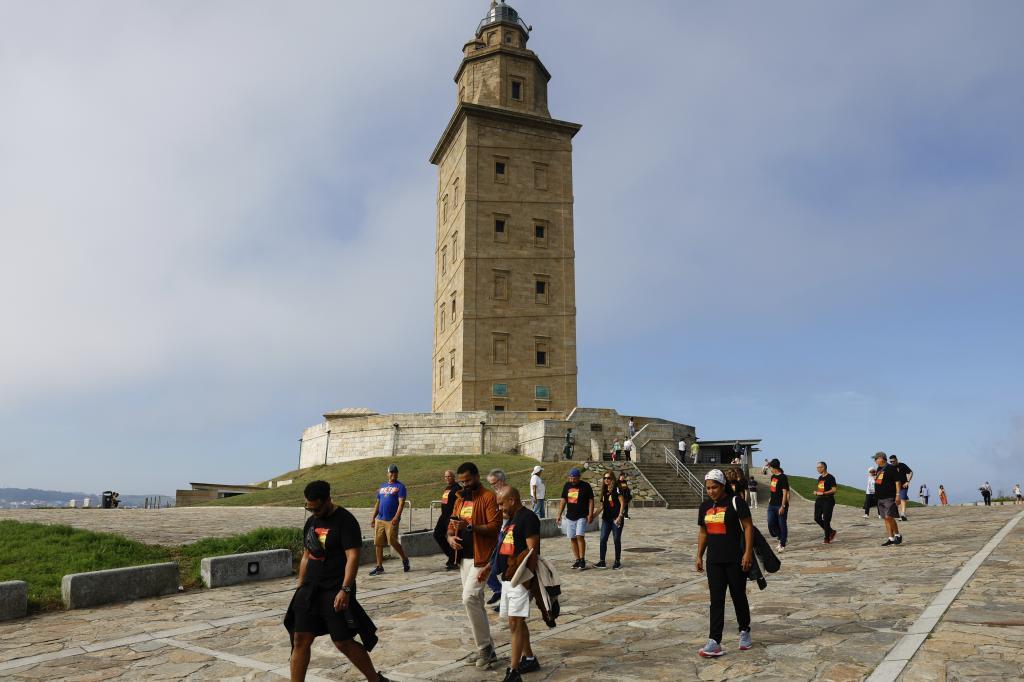
Long before modern navigation systems existed, lighthouses were essential to guide sailors in treacherous waters. In Spain stands the oldest one built by the Romans, an extraordinary example of this architecture.
What is the oldest Roman lighthouse in the world?
On the northwest coast of Spain, in the city of A Coruña, stands the oldest Roman lighthouse in the world, the Tower of Hercules. Not only has it survived the centuries, but it continues to operate. It is a unique gem where history, engineering, and myth come together facing the Atlantic Ocean.
The Tower of Hercules, over 2,000 years watching over the Atlantic
Built towards the late 1st or early 2nd century, during the Roman Empire, its original purpose was to guide sailors navigating these waters. "Its builder was Gaius Sevius Lupus, an architect from the city of Aeminium (modern-day Coimbra in Portugal)," as explained on the Galicia tourism portal.
In the late 18th century, the lighthouse was restored under the direction of engineer Eustaquio Giannini, who respected the Roman base and gave it the neoclassical appearance we know today. The original interior and a Latin inscription engraved on rock and protected by a small building are still preserved.
Its current structure reaches a height of 55 meters. It is the third tallest lighthouse in Spain behind those of Chipiona (62 meters) and Maspalomas (60 meters).
In 2009, the Tower of Hercules was declared a World Heritage Site by UNESCO, thus recognizing its exceptional universal value. Today, in addition to its function as a lighthouse, it is one of the main tourist attractions in Galicia. It is surrounded by a sculpture park and offers spectacular views of the Atlantic.
The mythological legend about the Tower of Hercules
Beyond its historical significance, the lighthouse is wrapped in a fascinating mythological legend. According to tradition, the hero Hercules arrived in these lands to confront the giant Geryon, a fearsome tyrant oppressing the local population.
After defeating him in battle, Hercules buried the giant's head and ordered the construction of a tower in that very place as a symbol of his victory. Over time, a city would emerge around it, which would eventually become present-day A Coruña.
Although this story belongs to the realm of mythology, it has been part of the collective imagination for centuries and remains one of the most popular narratives linked to the lighthouse and the city. In fact, in the coat of arms of A Coruña, alongside the Tower of Hercules, the skull of Geryon appears.