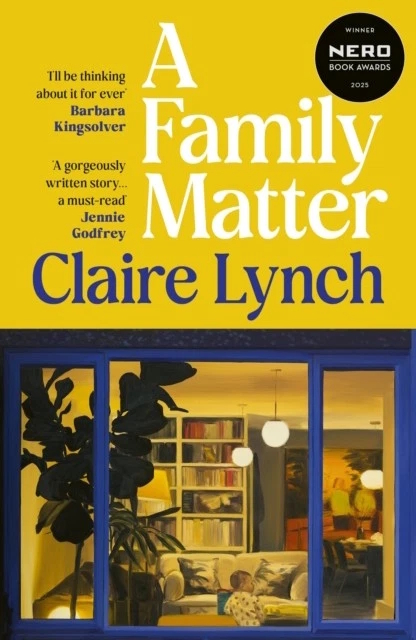
Heron, an elderly man deeply devoted to rules and routine, receives a terminal cancer diagnosis, but instead of sharing it with his daughter Maggie, he chooses to remain silent. This stark scene marks the beginning of A Family Matter (Random House), the acclaimed narrative debut of Claire Lynch (Dartford, 1981), which recently became the first debut novel to win the Nero Gold Prize.
Empathetic and poignant, the novel is much more than a dissection of a peculiar father-daughter relationship. As we discover that Heron raised Maggie alone, it becomes clear that this impulse to protect her from harm is a recurring theme. However, initially, there is no mention of the mother, only that Heron divorced several decades ago. It is only when Lynch takes us back forty years, to 1982, that the true story is revealed.
"I started writing with the idea of narrating the relationship between a father and a daughter, a story that is not very common," explains the author, also a professor at Brunel University, "but soon I realized that the missing piece was the mother. I thought about where she could have been and invented many different reasons to explain her absence." That initial, seemingly simple question led her to a much broader story. As she imagined the past of that absent character, Lynch began talking to women from previous generations and reading real court cases documenting custody disputes when a mother was in a relationship with another woman.
Those stories, not so long ago, revealed a social climate in which female homosexuality, although no longer always prosecuted by the law [the famous Sexual Offences Act of 1967 only decriminalized private male homosexual acts], could be used as sufficient grounds to strip a mother of custody of her children. "Dawn was going to be a minor character in the novel, but when I discovered all these real cases, I felt that I had to make sure her story was told."
Thus, Dawn, the absent mother, grew to become the moral center of the novel. What begins as a family story unfolds as a reflection on how society regulates bodies and the narratives about them, and her disappearance becomes a silence that extends for decades and gradually reveals the social violence exerted on certain private lives in 1980s England.
Because, as the author recalls, the issue was not so much about legality but moral suspicion. "Sometimes I have to explain to people that it wasn't illegal to be homosexual at that time," she points out, "but being homosexual was still so morally questionable, especially as a woman, to that narrow morality, that it seemed impossible to also be a mother."
As the novel suggests, there was some room for a "marginal or eccentric" life in big cities, but not for a family life that challenged the norm in rural England in the 1980s. "You could imagine someone as a kind of free spirit in a big city, but having a lesbian relationship and being a mother in a small town was impossible," Lynch emphasizes. However, 'A Family Matter' does not take on the tone of a strict historical denunciation. Its ambition is more literary than documentary. To reconstruct that world, the author worked with a mix of official sources and personal testimonies.
"I tried to look at the story from both sides," she explains. "On one side were the official documents, what the government or lawyers said in court, which had a very restrictive perspective." In fact, the trial reproduced in the book, based on real records, is chilling. "And on the other side were the personal stories, mostly terrible, of women who had experienced it."
But Lynch also turned to something more intimate to write, her own memory. "I was a child at the time of Maggie," she recalls, "so if I had doubts about any detail, I tried to think of very specific things from my childhood: what food my mother would have given me, what the house was like, what we played with." This deliberately domestic approach allowed her to avoid a too abstract reconstruction of the time. "It's very tempting to talk about politics or pop music when you write about the past, but a three or four-year-old child doesn't care who the prime minister is. They care about what cartoons they have on their pajamas or what toy they want for Christmas."
"You could imagine someone as a free spirit in a big city, but having a lesbian relationship and being a mother in a small town was impossible"
This attention to the everyday is at the heart of the book. Although the historical background is crucial, the novel is primarily interested in how the grand story infiltrates small lives. "When we look at the past, we tend to think of the big political or social narratives," reflects Lynch, "but it is much more beautiful and revealing to ask what was happening around the kitchen table."
In that domestic space, another obsession of the book unfolds, the family as an emotional structure and also as a mechanism of control. Far from presenting it as a purely oppressive institution, the author describes it as a formative force that accompanies the characters even as they try to escape it. "The family is like the soundtrack of a movie," she says with an eloquent image. "It's the background music that shapes you. Sometimes you accept it, and sometimes you want to change it."
The novel moves, as we say, between two times separated by decades. In the present, Maggie revisits the family's past with a mix of compassion and bewilderment. What she discovers forces a reconsideration not only of her parents' decisions but also of the era that made them possible. "I think for many of us, the distance between childhood and adulthood works like this," the author explains. "When you are a child, you don't know what the rules of the world are. And then, when you look back, you think: how was it possible that that was considered acceptable?".
One of the most striking features of the novel is its restrained tone. Lynch avoids explicit drama even when addressing situations of significant social violence. This restraint is not accidental. "I like to write a very messy version of the text and then start removing things," she confesses. "And as a reader, I also like to feel that the writer trusts me. If you tell the reader exactly what emotion to feel, it can be too overwhelming."
"When looking at the past, we always think of the big political or social narratives, but never about what was happening around the kitchen table"
This emotional minimalism has an important consequence: many of the tensions in the book are expressed through silence. For decades, the characters live with a truth that no one dares to name. "Perhaps that's what makes it a very British novel," Lynch jokes. "Many of the problems in the book, and in life, would be solved if we all had the emotional intelligence to talk to each other."
However, silence also has an ambiguous dignity. It can be a form of protection and at the same time a betrayal. In the relationship between Heron and Maggie, a father and a daughter who talk on the phone every day but never discuss the important things, that silence almost becomes the emotional architecture of the book. "Their love is in the everyday," the author explains. "In the little things they do for each other. But it's also a way to cover up what they can't say, for example, that he drove out her mother because he couldn't accept that she loved a woman and not him."
Like many family novels, Shoplifters ultimately poses an uncomfortable question: to what extent is it possible to live authentically when doing so involves severing the most basic bonds? Lynch offers no easy answers. "There's a lot of sacrifice in the book. People have to lose a lot to live according to what they believe is right." However, there is also a certain hope in the characters' patience, in their ability to endure until the world changes enough to catch up with them. "Perhaps it's sad that sometimes you have to wait forty years to uncover such a secret, but in the end I feel that, somehow, the truth eventually catches up with everyone."