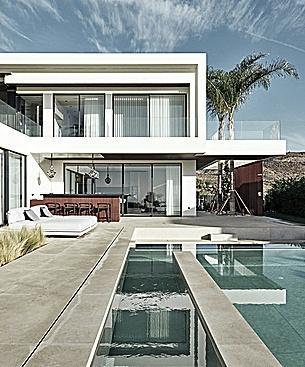
Dream villas, avant-garde shopping centers, luxury resorts, exclusive beach clubs, top restaurants... Álvaro Estuñiga and his partner Chema Sobrado have become the architects and designers of the moment. Based in Marbella, their studio Archidom set up in Madrid in January of last year to bring their characteristic brutalist style to the capital.
Their personal touch has been seen in venues like Rhudo - which closed its doors at the beginning of 2026 - or Sixtyone, the exclusive and secret restaurant, where the entire Real Madrid team dined, merging art, gastronomy, and music.
With a semi-clandestine entrance, this space from the Mosh Group transforms into a club with a DJ at night and has become the new place to be in the capital, where actors like Arón Piper and Ester Expósito, footballers like Vinicius Jr or Mbappé, singers like Ozuna, or entrepreneurs like Alejandro Agag have passed through.
"At Sixtyone, we wanted to recreate an artist's gallery. The front part is like a living room at home, and when you enter through the passageway, you immerse yourself in the secret area of the gallery. We have used materials like mortars and concretes combined with metals and glasses, which light up when the lights are turned on," explains Álvaro, while showing us the dining room decoration, which has a three-month waiting list.
Undoubtedly, the best thing about the restaurant is the atmosphere that surrounds the tables, illuminated by candlelight, as Archidom's strong point is creating environments. That's why they have built famous beach clubs and nightclubs like Playa Padre in Marbella, Ocean Club in Puerto Banús, or Um in Mallorca.
A native of Madrid, Álvaro studied Architecture at CEU, but right after finishing his degree, he went to work in the UK and then to China, where he was employed for five years. There, he gained experience in an Australian company, where he carried out avant-garde projects until he decided to return to Madrid and study an MBA in Real Estate, specializing in real estate management and investment: "I decided to complete my studies because you can be a very good designer and know nothing about business," he states.
While studying the master's degree, his friends from China introduced him to his current partner Chema Sobrado, who lived between Marbella and Madrid. They started a couple of apartment projects in the capital until Chema said to him: "Do you want to build a nightclub in Marbella?"
That's how in 2017 their story began working in the back of a kitchen store in the Andalusian town to design their first projects: "It was a warehouse of Chema's family business, and we slept at his parents' house; it's a Californian story, but in an Andalusian way," he narrates.
After creating Momento - one of the most iconic electronic music nightclubs in Spain - came La Reserva, a luxury beach club in Sotogrande, whose project they had to present in three days.
From there, they moved on to Nido, another club from the Mosh Group - a leader in catering in Marbella - which led Álvaro to eventually move to the Andalusian municipality: "We did three projects in a row. From the beginning, we had exponential growth and worked non-stop until 1 in the morning."
After the nightclubs, they ventured into luxury mansions - one of their specialties - many of them built in the town of Benahavís, where they have authentic architectural gems like Villa Serena or Villa Puente. In just eight years, they have designed over 100 villas located in 10 countries, and in Madrid, they are currently building villas in the La Moraleja and Las Lomas developments and in the Conde de Orgaz neighborhood.
Their international expansion is unstoppable, with projects spread across the world: from Dubai through China and Abu Dhabi, Indonesia or the Dominican Republic.
"We are very brutalist and very Mediterranean. We love sensations, materials, textures, and the constructive sincerity of brutalism. Although we can adapt to any place in the world, we do like to feel very inspired by our Mediterranean roots. Whenever we go to other countries, we try to find what the essence of that place is to try to adapt and create a mix of modernity and roots," concludes Sobrado.