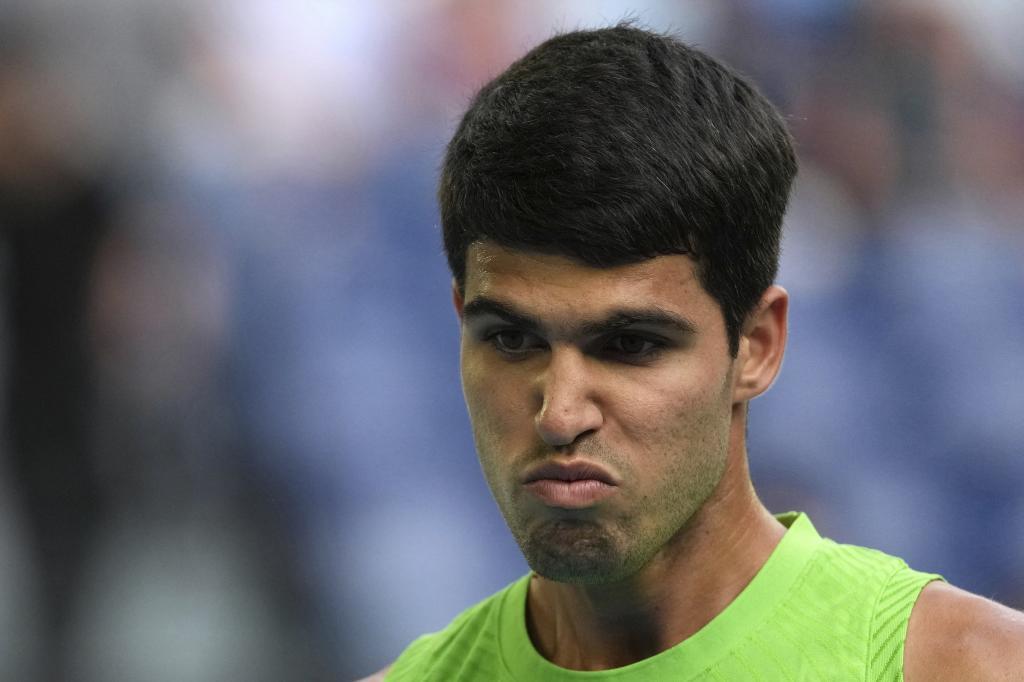
It was at Christmas when Carlos Alcaraz believed he had found balance. For three weeks, he trained on the courts of his childhood at the Real Club de Campo de Murcia and was happy surrounded by family and friends, happier than ever. At the top of the tennis world, everything finally fit together. Without the obligation to travel to Valencia to be with his former coach Juan Carlos Ferrero, his physical and mental aspects connected, life was wonderful, as demonstrated at the Australian Open. But it wasn't that easy. That jubilation is now a memory, and all that remains is the last match. Alcaraz, eliminated in the third round of the Miami Masters 1000, angry with himself and the world.
"Today I can't take it anymore! It's non-stop! I want to go home now! I can't take it anymore! I can't take it anymore, man! I can't take it anymore!" he shouted before confirming his defeat. Inner peace, shattered. What had changed? In reality, nothing. The desperation against Sebastian Korda is just a warning that, no matter how well things are going, weariness will always be lurking.
Tennis is exhausting, there's no remedy. Since the beginning of the year, Alcaraz has barely spent a couple of weeks in Murcia between tournaments and commitments. From South Korea, where he played an exhibition match with Jannik Sinner, to the Australian Open; from there to Bahrain to attend the Formula 1 pre-season and to Qatar for the ATP 500 in Doha, and from there to the two Masters 1000 in the United States. When he was home, he took the opportunity to see his family and meet up with friends to go karting, but little else. Tennis, tennis, and more tennis. In the end, it had to happen.
"We tend to attribute supernatural powers to athletes, but they are humans like everyone else. Carlos has been accumulating too much for many weeks, and there was a moment when he emotionally overflowed. He has suffered a psychological injury, just as he could suffer a physical injury. Perhaps he lacked more prevention, or taking better care of breaks, or working more on his sources of well-being. That's what he can do now," explains psychologist Josefina Cutillas, who worked with the number one until he was 15 and emphasizes a maxim: "What has happened to him is not so rare or so serious."
"Carlos is transparent, and from my point of view, that enhances him. With him, we can see how difficult it is to be a tennis star. Before, champions tended to hide these situations, but I am sure they experienced them the same way," Cutillas says. The Spanish public got used to the prodigious self-control of Rafa Nadal, but the rest of the great legends experienced moments of frustration on the court. All of them. Even Roger Federer smashed a racket - one of them precisely in Miami.
Perhaps the biggest difference with Alcaraz and his predecessors lies in the type of matches in which he explodes, as it has practically never happened to him in a Grand Slam or in semifinals or finals of Masters 1000. The cup always fills up in the initial rounds, and that also has an explanation. "Since he was little, the engine of his motivation has always been challenges, and he enjoys in that context. In a situation of maximum pressure, he thrives. But that doesn't mean he isn't experiencing it. Then, when the decompression comes, problems arise. For example, I don't know to what extent he has managed the emotions of winning in Australia," analyzes Cutillas, who knows what the solution is.
In the coming days, Alcaraz will be able to be with his loved ones and regain the lost balance since Christmas. After his defeat, he already returned to El Palmar, and this same week, he will return to training at the Real Club de Campo de Murcia, but the important thing will not be what he does with the racket. It will be what he does off the court. Mental recovery is essential to face what lies ahead.
If he decides to maintain his schedule, by the middle of next week, he should already travel to the Monte Carlo Masters 1000 to then continue with the Barcelona Open Banc Sabadell, the Mutua Madrid Open, and the Rome Masters 1000. Logic dictates that he should give up one of his competitions, but tennis is exhausting, there's no remedy. If Sinner wins in Miami, the Spaniard will have to defend his number one ATP ranking tooth and nail until reaching Roland Garros, which starts on May 24.