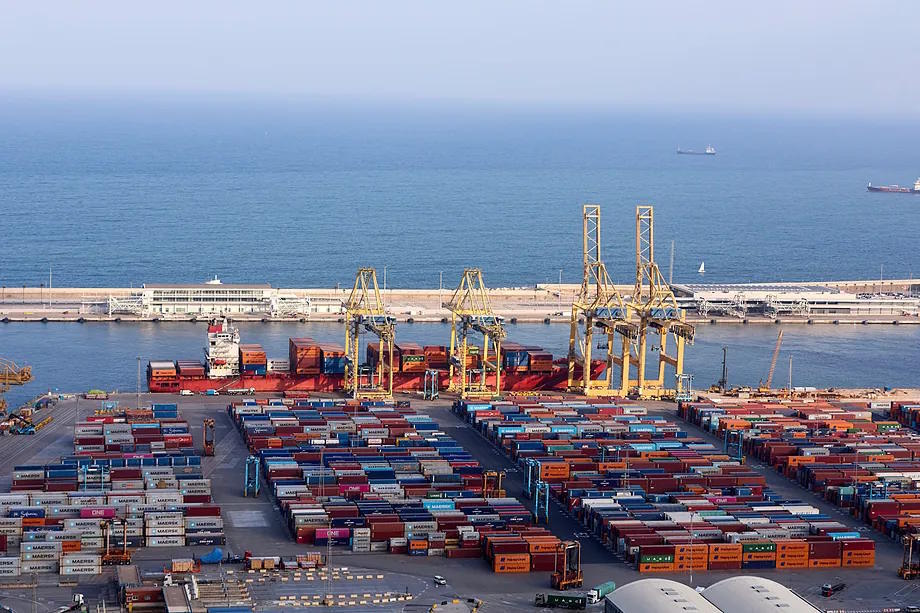
The open war in the Middle East and the almost total closure of the Straits of Hormuz have put global logistics transportation in check. Panic has been spreading for days because the situation is critical: trade in the Persian Gulf is further strained, where shipping companies have been avoiding the Suez Canal for years due to the Houthi siege. Options are becoming increasingly limited due to the crossfire attacks and Iran's threats to sink any ship crossing the strait if deemed a threat.
In this complex and ever-evolving situation, there are two options: wait or change transport routes. And here lie good opportunities, as experts assess in the case of Spain. In their favour: the geographical advantage of being a gateway to both the Atlantic and the Mediterranean, with direct connection to North Africa.
"Entry into the Mediterranean is made through the Suez Canal (Egypt) for all goods coming from Asia," explains Gonzalo Pérez-Maura, CEO of the global logistics company Pérez y Cía. However, the canal has been off-limits since 2024, and coupled with the current crisis in Ormuz, most traffic is now diverted towards South Africa, around the Cape of Good Hope, along the African coast and passing in front of the Spanish shores. "We are the gateway to the Mediterranean, the first European port. Many of the largest scales have to pass through us," he adds. "And here, the major competitor we have is Morocco, equally strategic and beneficial."
Also, it is more cost-effective. The environmental tax in Europe diminishes competitiveness against the Arab country because it raises the costs of docking in Spain, and "we have seen shipowners prefer not to operate here and go to non-European Mediterranean countries solely due to this tax," Pérez-Maura explains.
Ships stopping at Spanish ports incur fees for their use, somewhat like a toll for docking and operating. Since 2024, the payment of the ETS - European emissions tax created by the European Commission to reduce CO2 emissions - has been added, and since 2025, the Fuel EUMaritime, another environmental tax. All these add several thousand euros in expenses per ship.
As an example, port sources explain: a ship travelling from India to New York, if it stops at a European port and operates, must bear a bill of around 250,000 euros for that single stop.
And another example of the outcome: according to the EU-ETS Observatory data from Ports of the State, the activity share of the main European ports dropped from 67% in 2023 to 56% in 2025 in favour of non-EU ports like Egypt or Morocco.
To be precise, in terms of emission fees, a port like Rotterdam, one of the main ones in the Old Continent, faces the same issue as Spain. However, there is something that the Netherlands doesn't have: direct competition with the Tanger Med port. "With that alternative, yes, traffic will indeed be diverted. And the worst part is that once diverted, it is difficult to regain it," assesses Nuria Lacaci, Secretary-General of the Shippers Association of Spain (ACE).
Logistical challenges within Spain
In terms of goods, the amount that the Iberian country receives from the Middle East, and therefore risks due to the Ormuz conflict, is not very significant: it accounts for 4.51% of its total volume imported, according to the latest data from Ports of the State. Out of the 556.6 million tons in 2025, the main recipients were the port of Cartagena (4.1 million tons), Barcelona (over three million), Valencia (over two million), Algeciras (1.7 million), and Bilbao (close to one million).
And what arrived? Mainly crude oil cargoes from Iraq and Saudi Arabia, natural gas from Qatar, coal from Kazakhstan, chemicals and fertilizers from Israel... with the map of importing hubs being extensive. It even extends to Vigo and its metallurgical materials from Bahrain, or Castellón with cement from Saudi Arabia.
"There won't be shortages," assures Lacaci from ACE. However, she foresees the next problem for Spanish logistics: serious congestion is already being reported in various Eastern ports due to accumulated ships, such as in the United Arab Emirates or Singapore. When the bans are lifted, all these ships will be released with an average delay of 20 days in their scheduled journeys. "The [Gulf] ships have not arrived yet. We will face a last impact when the usual vessels overlap with the new ones that have joined the route around the Cape of Good Hope halfway through," Lacaci anticipates. "There will be issues in a week at Spanish ports," she specifies before adding that "Barcelona has an additional problem, as the Rubí Tunnel is currently closed. So, the route to Europe is very complex. If ships are diverted to Valencia or Algeciras, there will likely be congestion there."
The ongoing railway crisis continues to strain the freight transport network. The Port of Barcelona insists that the situation is under control and "the railway network is operational. We have no incidents." However, train drivers operating in different companies in the region disagree: while travel to Madrid and Valencia from Catalonia is possible, reaching France and the rest of Europe is "practically impossible" due to the closure of the mentioned Rubí Tunnel, which will last for weeks. The solution proposed by Adif, exchanging the original route of almost three hours for a detour of nearly seven, seems unrealistic in terms of timing and "nonsensical" to the train drivers.
The national scenario is complex: the railway service connecting the port of Algeciras with Madrid has been suspended since February 4 (due to storms). Opting to rely on other ports and using road transport for the rest of the national scope is an option. However, in this context, transport companies have been demanding more support for days to weather the rise in fuel prices threatening their viability.
When asked about the current situation of connections from Catalan and Andalusian ports for freight traffic, Adif does not respond to this medium.
However, based on previous crises, such as the halt in activity caused by Covid-19, port sources insist on maintaining calm: there is a plan for temporary interruptions - although the duration of the current Middle East war is uncertain - and shipping companies were already prepared. Essentially, because this has been a gradual evolution: the routes were already heavily disrupted since the start of the Gaza war. "The logistics chain of bypassing Africa is well-oiled," assure sources from Spanish ports.
The battle for Spanish operators
Meanwhile, the Ormuz crisis continues, and uncertainty is very high. Although at Pérez y Cía, with a significant business volume in the Persian Gulf, they are considering new perspectives: "We halted the operations of our ships working in the Persian Gulf [Gas & Oil infrastructures in Qatar] three weeks ago. And we have received information from the state authorities to resume operations." However, they emphasize that, despite gradually reactivating their services, everything depends on the course of the conflict. And instability is very high.
The closure of Ormuz has become part of the logistical routine for the 50 major Spanish companies encompassed by ACE. Since the outbreak of the war, they have opted for maritime routes for departure and access in western ports of Saudi Arabia and southern Oman, increasing passage around the Cape of Good Hope, as long as it is not perishable goods requiring the speed of air travel (and facing airspace closures). They have also expanded departures through roads in countries like Jordan.