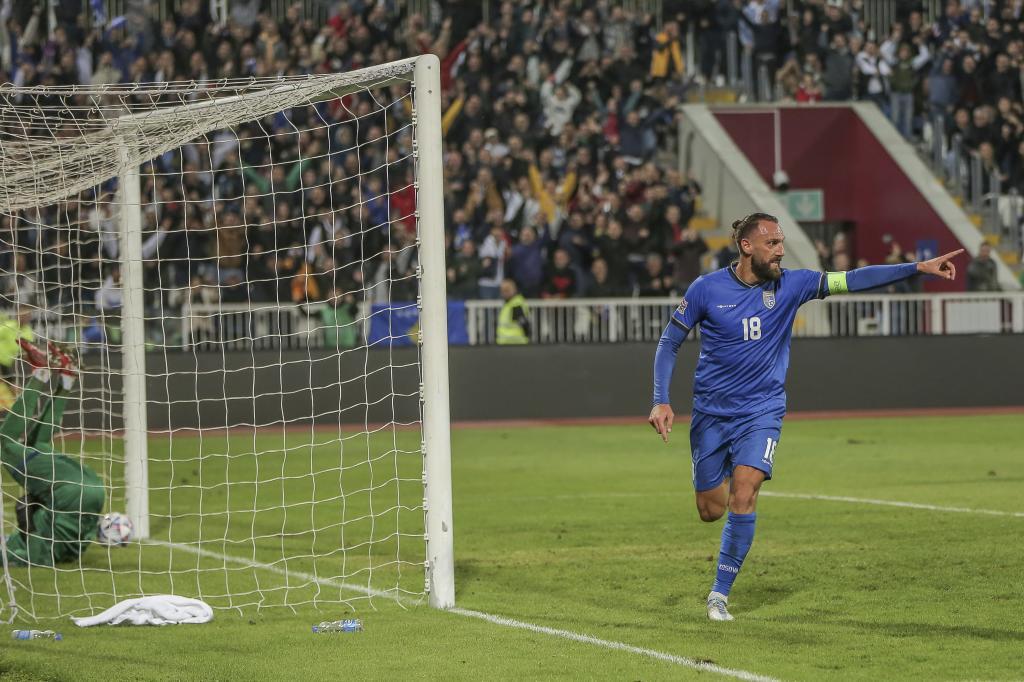
At the Fadil Vokrri Stadium in Pristina, there is room for 14,000 spectators, but this Tuesday "100,000 would enter if possible," admits German Franco Foda, coach of the Republic of Kosovo, a country that meets history today at 20:45. The Kosovar team, in UEFA competition for just over a decade, faces Turkey for a spot in the upcoming World Cup. A unique event for a young team that has never played in a World Cup and for a country that is working, also through football, to be universally accepted by international organizations.
Much of the UN and NATO recognize Kosovo's independence, declared in 2008 after years of war, but Serbia, Russia, China, and five EU members, including Spain, do not, maintaining their "no" alongside Greece, Romania, Slovakia, and Cyprus.
"We are close to making history. It's just one game, but we are up against a great rival with great individual talents. And we have fans who are too emotional; we must be careful not to let that lead us to make mistakes. The only path to success is to stay calm," Foda declares to calm the spirits of a constantly ecstatic crowd since they defeated Slovakia in the semifinals, precisely one of the countries that does not recognize Kosovo.
Turkey does, but the atmosphere in Pristina will be filled with maximum emotion, a battle with warlike overtones encouraged by the country's leaders. "The Dardanian Gladiators have shown that Kosovo never gives up," stated Agim Ademi, president of the Football Federation of Kosovo. The Dardanians were a tribe that lived in Dardania, a country that occupied southern Serbia, present-day Kosovo, northern Macedonia, and part of Albania.
For Kosovo, football is a way to showcase itself to the world. "We are one step away from history. Thanks to all the fans who were present at the stadium, in Kosovo, and in the diaspora," added Ademi.
He was not alone. The Minister of Economy, Hekuram Murati, announced that the Government, at the request of Prime Minister Albin Kurti, will allocate 500,000 euros to the national team after their victory and announced a higher amount if they manage to beat Turkey.
"We have one small step left to reach the World Cup and make history. This way, we can bring joy to all of Kosovo," stated Vedat Muriqi, forward for Mallorca and a key player for the Kosovo national team.
The winner of the final between Kosovo and Turkey will fly to Group A of the World Cup, alongside Australia, Paraguay, and the United States. All of that seems distant now in Pristina, where there is a spirit of national assertion. UEFA and FIFA acknowledged their place in continental and international football in 2016, and each qualifying match has become a historic claim for the Kosovar people, with football as the main connection to the diaspora.
For years, young people of Kosovar origin grew up in European academies and ended up representing other national teams, like Switzerland in the case of Granit Xhaka or Xherdan Shaqiri, but the international recognition of the country in 2008 and its entry into UEFA and FIFA a decade later has allowed the building of a talented team that has improved over the years.
Muriqi, Milot Rashica, Edon Zhegrova, or Florent Muslija are key players of a generation that combines local roots and European training, and the arrival of Franco Foda has changed their fortunes, while the expansion of the World Cup to 48 teams has allowed them to dream of the impossible.
Kosovo started the qualifying phase with a 4-0 loss in Switzerland, and the World Cup wasn't even on the horizon. "Our goal was to qualify for Euro 2028," admits Foda. But something clicked. They beat Sweden twice, Slovenia once, and secured several draws to earn a spot in the playoffs. Additionally, they have been promoted to League B in the Nations League.
An example of the footballing reconstruction of a country still trying to carve out a place on the international stage.