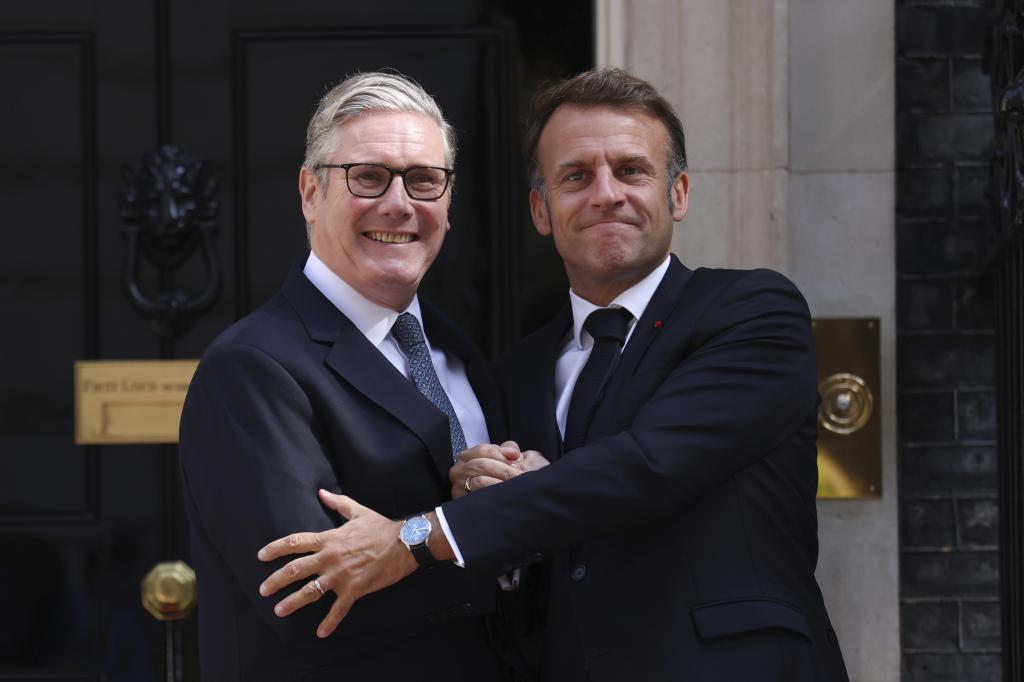
French President Emmanuel Macron and British Prime Minister Keir Starmer have called for a conference of "non-belligerent countries" willing to contribute to "a multilateral and purely defensive mission in the Strait of Hormuz," according to a statement from the Elysee Palace.
The two leaders agreed on the convening during a phone call over the weekend, before the United States announced its decision to impose a blockade in the Strait of Hormuz following the failure of peace talks with Iran. Starmer has publicly expressed his opposition to the blockade, although Macron has not yet commented.
In the official statement, however, the French Presidency distances itself from the U.S. position and warns that the hypothetical multilateral mission will aim to "restore freedom of navigation in the Strait of Hormuz as soon as security conditions allow."
The Spanish government has not yet confirmed whether it will participate in the conference of "non-belligerent countries" or not. Spain sent the frigate Cristóbal Colón to the Eastern Mediterranean, integrated into the naval group of the French aircraft carrier Charles de Gaulle, along with other NATO ships in response to drone attacks launched by Iran against a British base in Cyprus. However, the Cristóbal Colón returned to its base in Ferrol after completing its mission.
Italian Prime Minister Giorgia Meloni stated on Tuesday that "it is necessary to advance in peace talks between the United States and Iran to stabilize the situation in the region." Meloni emphasized the importance of "reopening the Strait of Hormuz, not only for fuel supply but also for fertilizers."
Iranian President Masoud Pezeshkian denounced, in the phone call held on Sunday with Emmanuel Macron, "the lack of goodwill and the maximalist positions of the United States that prevented the conclusion of an agreement in Islamabad," as revealed by Le Figaro.