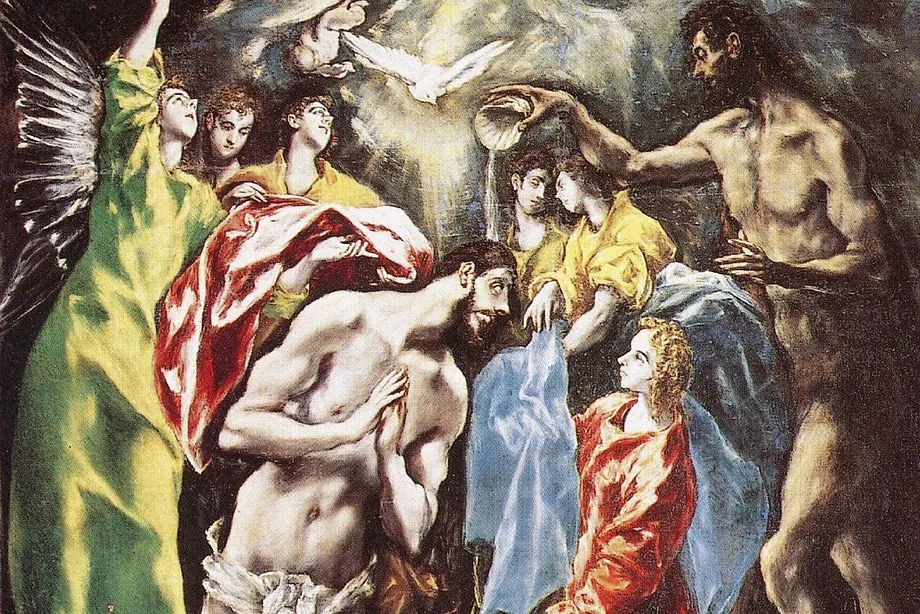
They say he arrived as a foreigner and stayed as a legend. In Venice and Rome, he practiced his first strokes, but it was in Toledo where his brush finally found the freedom of an open canvas. Doménikos Theotokópoulos settled in the city guarded by the Tagus River in 1577 to become, simply, El Greco. Almost 450 years later, his legacy lives on among the walls where he signed one of the works that today rekindles curiosity, sparks debate, and raises questions.
In 1608, Pedro Salazar de Mendoza, a friend and patron of El Greco, commissioned the painter for the heart of the chapel of the Hospital de Tavera, dedicated to Saint John the Baptist. That project not only confirmed the Cretan's mastery but also left a piece that, centuries later, remains shrouded in mystery: who truly completed The Baptism of Christ?
An enigma that does not escape artificial intelligence either. The article PATCH: A deep learning method to assess heterogeneity of artistic practice in historical paintings questions whether Jorge Manuel, the artist's son, finished the work, in a time when workshops operated as spaces of collective creation: authorship was diluted among apprentices and assistants, while prestige was reserved for the master.
However, the research published in the journal Science Advances suggests that the technical variations initially detected do not necessarily result from the intervention of different hands, but from changes in the painter's motor precision. The analysis of his self-portraits, supported by historical documents, indicates that El Greco survived two strokes. The visible consequences, both in his face and physical dexterity, would have influenced his artistic evolution towards the end of his life.
"It is very complex to determine whether it was El Greco who completed the work or if it was his son. Some authors argue that in 1608 he suffered a stroke that prevented him from carrying out his activity with the same intensity. In any case, we can affirm that the workshop's draftsmen had an increasing participation. There were specialized tasks carried out by assistants and apprentices, but there is no way to know specifically what each one did," explains José María Riello, professor of History and Art Theory at the Autonomous University of Madrid.
The protagonist of the study is PATCH (Pairwise Assignment Training for Classifying Heterogeneity), a machine learning system that analyzes paintings on a microscopic scale. To achieve this, it uses optical profilometry, a 3D metrology technique that uses light to scan the surface of the artwork and extract precise data about its relief, roughness, and thickness.
"It is too early for this technology to distinguish between the master's hand and that of his collaborators. However, it emerges as a promising and rigorous tool, more effective as a complement to historians' analysis, especially for what the human eye cannot perceive and which can help formulate new questions," adds Riello.
The question remains open, as the 1614 inventory of assets, after the death of Doménikos Theotokópoulos, indicated that the paintings in the chapel and the two canvases destined for the altarpiece finials were still in progress: "Even the work was not delivered until later due to legal issues," points out the UAM professor, a statement supported by archives: in 1622 a lawsuit arose between the hospital and the workshop, which had already received over 8,600 ducats, when the commission was valued at 7,000.