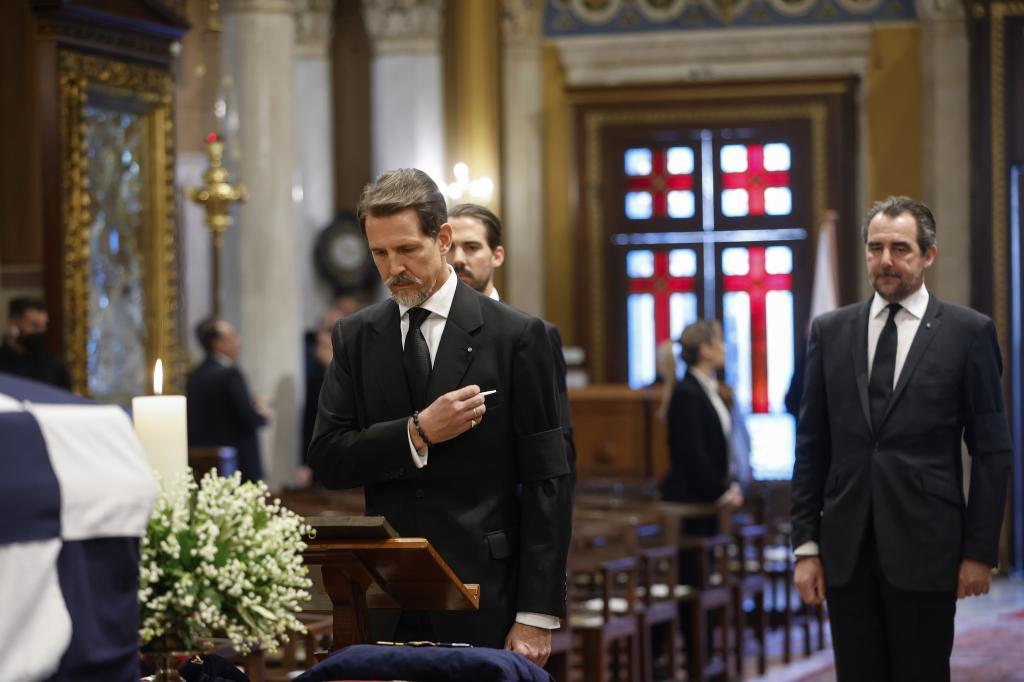
It is worth noting that since then, members of the dynasty have lived in a truly exceptional situation, holding Danish passports granted by the Kingdom that recognizes their princely status, as Queen Anne-Marie of Greece - now the widow of Doña Sofía's brother - is the daughter of the former King Frederick IX - sovereign between 1947 and 1972.
However, beyond the personal satisfaction and peace that winning this battle represents for Pavlos and his siblings, with this outcome, it can be said that the royal dynasty of Greece is practically extinct, with only the aforementioned Queen Anne-Marie remaining today, who has not requested that citizenship. Because the others have had to comply with the express renunciation of their titles and any future claim to the throne, as required by Greek national law, but above all, for the first time, they will have a surname, De Gres, which is mistakenly translated as De Grecia in international media, when in reality, in Greek script, it is a patronymic, invented in this case, that does not mean anything at all.
This means that there is no longer "Greece" among the members of their extinct royal family; all are suddenly De Gres, an essential condition for regaining citizenship. A very bitter issue for any dynasty that values the significance of its historical representation, reminiscent in part of the surname modifications that many members of the Götha in Germany and Austria had to undergo following the abolition of noble titles after the Great War.
It was at the end of 2024 when it was revealed that Constantine's eldest son, Prince Pavlos, and nine other members of his family - his four siblings: Alexia, Nikolaos, Theodora, and Philip; as well as the five offspring of the marriage between Pavlos and Marie-Chantal - had received approval to obtain citizenship from the country's Minister of the Interior, Athanasios Balerpas, after complex and lengthy negotiations. They all signed a declaration recognizing the legitimacy of the republican regime, one of the requirements to become Greek. "A historically pending issue is being resolved. Now we can look forward as a nation," emphasized Balerpas, highlighting the significance for Greek institutions of ending a dispute of such nature.
However, while the procedures that were then taken for granted were being finalized, Panagiotis Lazaratos, a professor at the Faculty of Law of the National University of Athens, filed a lawsuit questioning the constitutionality of the decision. Among other arguments, he denounced that granting that surname was contrary to the precept of the Fundamental Law which establishes that in Greece "no titles of nobility or distinction are granted or recognized to Greek citizens." And now the Council of State emphasizes that, although De Grece clearly plays with a double meaning, as we mentioned, it absolutely does not mean anything, thus endorsing its complete constitutionality.
It is important to note that De Gres was an invented surname in 2004 by Miguel of Greece -great-uncle of Constantine II, Irene, and Doña Sofía, who passed away in the summer of 2024- when he became the first member of the dynasty to initiate the process of obtaining Greek nationality. What he did was take the French surname De Grece -pronounced De Gres- and adapt it to the Greek alphabet. And it worked then. Just as it has worked now.
Pavlos and his family have had to comply with the requirements of the so-called Venizelos Law, which required them to swear allegiance to the Republic, assume a surname, and renounce any claim to the Greek State, including any confiscated assets following the abolition of the Monarchy that were still in dispute.
All requirements that Constantine II never accepted. The last sovereign of the Mediterranean nation died without becoming Greek. Because the Republic kept him until his death deprived of his original nationality and passport. This was since 1994 when Pasok passed a law that was clearly contrary to human rights. The socialists, then in power in the Hellenic Government, coerced the deposed monarch to renounce his royal aspirations and accept the surname Glücksburg - from the Danish dynasty from which the Greek royal family descends. But Doña Sofía's brother refused to accept the imposition of Glücksburg, which is not a real surname.
Since George I, crowned King of the Hellenes on October 31, 1863, the dynasty has never had a surname, and its members simply added "Greece" to their names. Queen Sofía herself has mentioned that, already married to King Juan Carlos and settled in Spain, she only had Greece as a surname - mandated by law - and that it is false that she is known by the endless string of Schleswig-Holstein-Sonderburg-Glücksburg... as many biographies still claim.
Today, Queen Anne-Marie, who resides in Athens, is the only one remaining steadfast in the stance on this issue that her husband Constantine demonstrated in his lifetime.
The De Gres family will now enjoy all the prerogatives of their fellow citizens, including the right to vote and to stand for election, fundamental political rights enshrined in Article 51 of the Constitution.
Prince Pavlos is spending more and more time in Greece, although he balances this with stays in London and New York, where his businesses are based. Paradoxically, while renouncing his titles and even the name of his dynasty, he is increasingly taking steps forward as a custodian of the historical legacy symbolically represented by the Crown.
One notable event was his attendance, for the first time, at the Military Parade for Independence Day on March 25. After the parade, he spoke with some soldiers. "We have a strong homeland, what I saw ignites the soul," he declared to the media. When asked if his sons would serve in the military, he replied, "Logically, they could all go, but Constantine wants to go first, so logically, he will also come." Obtaining citizenship also means that Pavlos and Marie-Chantal's sons will be eligible for military service.
Another historic moment in which King Constantine's eldest son has recently taken centre stage was his three-day visit to Mount Athos. At this site, which is so sacred to the Orthodox, he was received with honours by its governor, Alkiviadis Stefanis. Regarded as the most inaccessible place in Europe, Athos, the Holy Mountain, is an autonomous peninsula in the rugged north of Greece, home to 20 Orthodox monasteries and some 2,000 monks. Its spiritual influence is extraordinary. And it has always been closely linked to the Greek royal family, as for this community King Constantine continued to represent the heritage and line of continuity of the Byzantine emperors.