It took just 15 minutes for almost the entire city to become a wasteland under the bombs. It happened at 13:20 on May 14, 1940, a date etched in the collective imagination of the inhabitants of Rotterdam, the Dutch city on the banks of the New Meuse River that did not allow itself to mourn after the fierce attack, carried out on a scale never seen before, resulting in 814 dead and 24,000 destroyed buildings. Quite the opposite.
It preferred to rise from its ashes like a phoenix, the most associated nickname with this amphibious metropolis of 635,000 souls —the second most populous in the country after the capital, Amsterdam, and its port, the largest in Europe— which, four days after the offensive, began to rebuild. Or rather, to build, "as the authorities decided to demolish what little remained of the historic center, leaving some buildings: the City Hall, the Stock Exchange, Post Office (now a luxury hotel), and the church of St. Lawrence, whose damages prevented it from reopening until 1968," explains Ferrie Weeda, guide of the new thematic routes (on art, architecture, street sculptures, gastronomy...) that start from the Tramhuis, the former "tram house" that served as a waiting room for passengers, now converted into a tourist information point.
The guide continues his explanation next to the statue of the local philosopher Erasmus of Rotterdam —yes, the Erasmus scholarships refer to him—, the oldest bronze work in the Netherlands. "It was erected in 1622 and survived the bombs, quite a miracle," he points out, highlighting the worldwide fame of the humanist, whose name is given to bars, restaurants, a hospital, the Erasmus Bridge, called "the white swan" for its stylized shape and color. The other iconic one is the William Bridge, in passionate red.
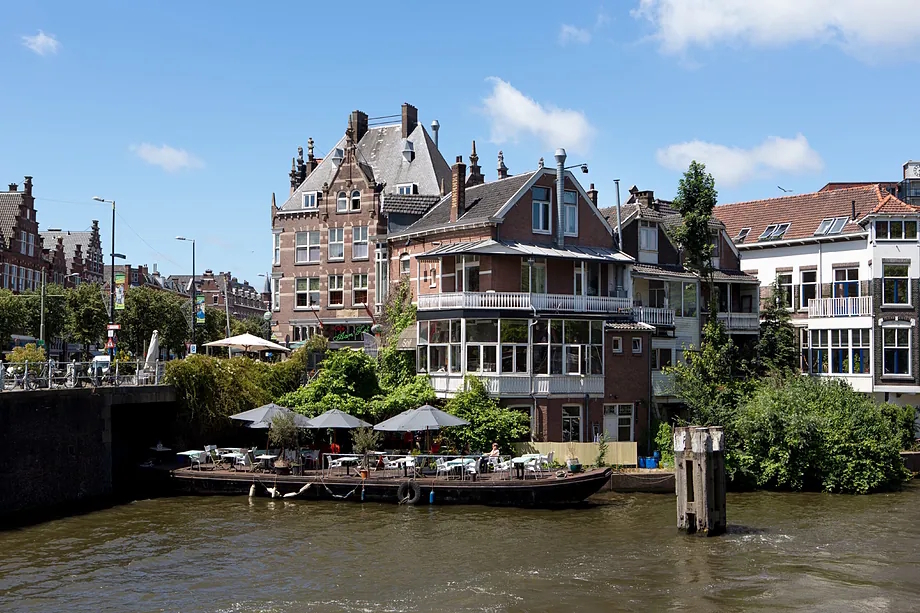
A walk through the Old Port (Oude Haven), where the fishing village that gave rise to the city was located, is necessary to complete the route through the most remote past before the conflict. It is one of the few areas that can evoke the typical Dutch image of canals and bridges. Look no further. Here is also the Witte Huis (White House), in Art Nouveau style, which at 43 meters high and 10 floors was Europe's first skyscraper (1898). A sign that the metropolis was already showing signs of its passion for design and for breaking away from established models, confirmed by movements like De Stijl, a paradigm of total art, with works like De Unie café, and Dutch modern architecture, linked to the Bauhaus and prioritizing functionality, use of light and space, simple forms, and materials like steel.
An example is the Van Delle factory, which in the late 1920s dared not to use brick or rely on load-bearing walls (it has been a UNESCO World Heritage Site since 2014). When Le Corbusier visited it in 1932, he already predicted that in Rotterdam one could see what life would be like in the future. His prediction came true after the war, when it was decided to shape a new city where pedestrians were the protagonists, playing with light, aesthetics, and even water. It is worth noting that its water surface is 114 km2 compared to the 206 km2 of land.
Looking to the future
Thus emerged an urban laboratory where rules were meant to be broken. The center was filled with wide avenues with gardens, benches, sculptures, and showcases like the Lijnbaan (1953), which went from housing a rope factory to being the first pedestrian shopping street in the Old Continent and a model to imitate for many others around the world.
Today, it is full of shopping malls, shops, bars, and legendary venues like Bram Ladage, always with a queue thanks to its gourmet fries seasoned with a variety of sauces (the favorite being peanut sauce). "You have to try them," Weeda insists. Just like the apple pie at Dudok café, with raisins and cinnamon. There are several branches, but the pioneer is on Meent Street. Also from that era of reinvention are the old Central Station (1957), near Chinatown; the De Bijenkorf department store (1957), and the Euromast observation tower (1958), with 185 meters in height and a brasserie at the top.
Then came the famous Cube Houses, the residential complex that architect Piet Blom started building in the 1970s to revive the city center. The 45-degree inclination of the 39 white and yellow polyhedral houses supported on pillars —one of them can be visited as a museum— still attracts the attention of experts and tourists, resembling an abstract forest. The first floor reproduces a triangle, while the ground floor houses shops, a bar, and even a beauty salon.
The design route continues with the Central Library, resembling the Pompidou Centre in Paris, and the Markthal, the first covered market in the Netherlands, combining apartments, offices, and food stalls under a colorful vaulted digital mural, The Horn of Plenty, described as a sort of Sistine Chapel made by a computer. It is considered the largest painting in the world, measuring 11,000 m2.
The building is signed by MVRDV, the prestigious architecture studio that also created the Portlantis exhibition center, in the form of a rotating box, and the Depot, a storage facility for the art collection of the Boijmans Van Beuningen Museum, currently under renovation. "It is the first public warehouse of its kind in the world, as museum collections are usually hidden. And what is exhibited is no more than 10% of what a museum owns," says Ina Klaasen, Depot's director.
The result is an original structure resembling a gigantic glass planter 40 meters high (with 1,644 panels) reflecting the city. The interior is a constant flow of engravings, drawings, sculptures, ceramics, or furniture (up to 151,000 items) from medieval to modern art spread over six floors, topped by a rooftop with a creative cuisine restaurant, Renilde, and a garden with pines and birches overlooking the Museum Park where it is located.
New Artistic Attractions
Also located there are the emblematic Chabot and Sonneveld houses, offspring of modern architecture. White, bright, and with clean lines, both dating back to 1938, survived the war and stand today as museums. The former showcases the work of expressionist artist Henk Chabot, while the latter recreates life in a villa of this style in the 1930s.
Within the park, don't miss other museums such as the Natural History Museum, the New Rotterdam Institute, dedicated to architecture, design, and digital culture, and the Kunsthal, a contemporary art museum designed by OMA, Rem Koolhaas's firm. The renowned guru was born here, and it is here that he also created De Rotterdam, the audacious skyscraper composed of three interconnected towers that appear as six, where 5,000 people—residents, office workers, tourists, curious onlookers, and guests of the nhow hotel—move about daily. With such offspring, it's no wonder Rotterdam is also called the "Manhattan of the Meuse" for its avant-garde skyline.
We are in the Kop van Zuid port area, amidst floating offices and restaurants, and hotels like the New York, the former headquarters of the Holland America Line (HAL), from which ships departed for the United States at the beginning of the last century, laden with emigrants in search of a better life. The building was constructed in 1901 by architects J. Muller, Droogleever Fortuin, and C.B. van der Tak, and when HAL ceased operations in 1977, there were plans to demolish it and build a skyscraper. Public opposition was so strong that it was ultimately decided to leave it standing, transforming it into a hotel and preserving some original features such as the red brick facade, the plinths, and the natural stone ornamentation.
This neighborhood is also home to the city's two major new additions: the Photography and Emigration Museums. The former, recently opened, houses one of the world's largest collections, comprising 6.5 million objects (negatives, prints, cameras, digital images, etc.). "We are witnessing a new era in photography, and this building does justice to the size, quality, and ambition of our collection and programming," says its director, Martijn van den Broek, who emphasizes the significance of the Santos Brazilian coffee warehouse, built in 1901, on the site of the museum. It includes photography studios, a library, a shop, a rooftop restaurant with views, a café, educational workshops... and even an original photo booth that reproduces analog images for visitors to take home.
The other major new addition is the Phoenix Museum of Emigration, located in a 16,000 m2 warehouse belonging to the aforementioned Holland America Line. It houses "The Tornado," an architectural piece that replicates the upward movement of air. And keep an eye out, because Rotterdam is already planning the House of Dance, the largest European center dedicated to this discipline, in another industrial space, and the future City Museum in the Quayside Church. We'll be watching closely...
PRACTICAL GUIDE
HOW TO GET THERE
Iberia, Transavia, and KLM fly to Amsterdam. From there, you can take a train to Rotterdam, which takes between 35 and 45 minutes depending on whether it's a direct train or not.
WHERE TO STAY
Haven Hotel, Curio Collection by Hilton. Cutting-edge design and comfort in the historic port. Specialty coffee at the Loef Living Room and contemporary fusion cuisine at the Calan restaurant.
WHERE TO EAT
From floating cafes like Putaine, featured in the Michelin Guide thanks to its creative dishes made with local produce and an emphasis on vegetarian options, to restaurants in artistic spaces like The Depot (Renilde), gastropubs (Hartig), and covered markets (Markthal) with a thousand stalls.
MORE INFORMATION
Rotterdam Tourism: rotterdam.info