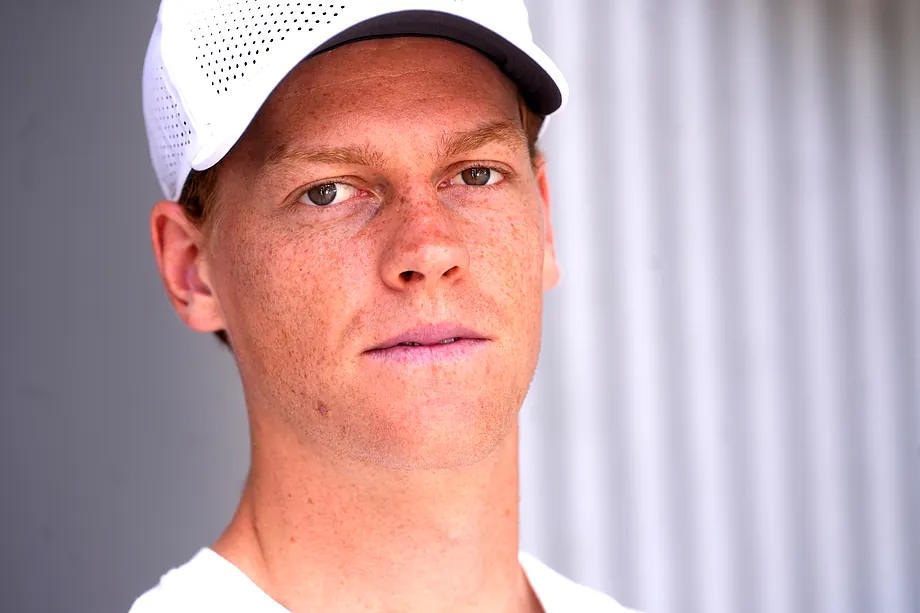
He hasn't had time to stroll around Madrid yet. He acknowledges this regretfully Jannik Sinner as he walks through the corridors of the Caja Mágica, where the world number one in tennis and star of the Mutua Madrid Open allows EL MUNDO to accompany him for a couple of hours in his busy schedule of commitments before the first training session on the Manolo Santana court. "I look forward to taking a walk, but I've only been here for two days and I'm prioritising rest a lot, trying to sleep as much as possible to arrive well at the tournament," he explains.
He doesn't smile often, but he expresses himself with a very personal sensitivity. The stereotype of the tennis machine is hard to maintain: he is a young man closer than he appears. "I'm a normal guy. I have a normal family, I have normal friends. All this [pointing to the television cameras] is chaos, but away from here, I can choose who I am and who I'm with. In reality, it's much easier than people think. Surrounded by my people, I don't have to think much to stay grounded."
Is your seriousness shyness?
It's part of my method. It's my way of being as focused as possible on the court. I know I don't make many gestures to the crowd, but it's the way I've found to compete. I love playing tennis. I don't play because I have to, I play because it's fun for me, even if I don't show it as much. Off the court, I really enjoy life and being with my people. I feel more fortunate for the family I have, the friends I have, the team I have, than for my titles.
You have started making vlogs of your daily life on YouTube. Do you want the public to get to know you better?
I'm not from the TikTok generation. If I need to distract myself during a tournament, I call a friend, play PlayStation, or simply watch YouTube for a while. I like watching long videos on different topics, science or geopolitics, also deeper things. The world is changing a lot, and knowing about everything is important. I also usually watch interviews or vlogs of other athletes, and I felt like showing my own things too.
When you're not playing, can you enjoy life at tournaments?
Yes, I can. Every week I experience something different, different environments, different people. Every year we go to the same cities, but it's nice to get to know them more each time, discover new places, explore the sites. That's the most beautiful part of life on the circuit.
And the least?
Giving interviews is tough, I can't deny it. But it's not about talking to journalists, it's because often they ask the same question. I understand it's part of my job, and I try not to let it drain my energy.
Sinner's Hobbies
If you're at home in Monaco, what do you enjoy when you're not training?
Being with my friends and, when I have some free time, driving. After training, sometimes I take the car and just drive around the roads there. Aimlessly, for pleasure. If I had more time, I would even like to go to circuits and practice my driving. I'm also a big fan of Formula 1, of course, I love watching it, especially now with Kimi [Antonelli, the championship leader].
You were born and raised in the Italian Alps, where your parents still run a refuge, the Rifugio Fondovalle. Do you miss the mountains?
I miss skiing, I really miss skiing. When I was a child, skiing was a big part of me as a person, and I would like to ski more. When I visit my parents in winter, I still do it, without thinking about injuries, because I need it. It gives me mental calm. I can't resist doing it, even though there may be risks. Skiing is also part of enjoying life.
Your Relationship with Alcaraz
It's interesting because he comes from a very different background to yourgreat rival, Carlos Alcaraz. Do you think it will be challenging to stay motivated without him in this Mutua Madrid Open?
Tennis needs Carlos, and I also need to see him in the draw. That's the truth. It's a bit different when he's not here. Seeing him injured is not what I want, and I hope he returns as soon as possible. I especially hope he'll be at Roland Garros. But that's how tennis is. I hope our careers are very long, and sometimes I'll skip some tournaments, and he'll skip some too. Sport also has that side.
Did you discuss his injury at the Laureus Awards gala?
No, it's very personal, very private. We all saw he had an immobilization brace and was injured, but we didn't talk about it.
You have a very close relationship, but most of the time, one's success depends on the other's failure. How do you know what topics to discuss and what not to?
Obviously, we don't talk about everything. It's normal too. We don't discuss personal matters. We talk about general things, and it's always nice to spend time with Carlos. He's a very kind guy, he always has been. But there are things that both of us prefer to keep to ourselves.
You haven't played much, but... Do you feel appreciated here in Spain?
The truth is, yes. I see that fans have a lot of passion, and I can have a good connection with the audience. I understand that this relationship comes from Carlos and the friendship we have off the court. People realize it's something nice and positive, not forced. He experiences the same in Italy. I look forward to acclimating, understanding this surface, and feeling comfortable. I remember as a child watching some matches here when the clay was blue, matches of Roger [Federer], for example. As a child, I found it curious.
After losing in the last US Open you promised changes in your game and now you have won in Indian Wells, Miami, and Monte Carlo. Has the transformation already finished?
It will never end. As a tennis player, you always try to improve, and you can always learn new things. Everyone does the same, not just me. Even those at the bottom of the rankings can play very well, and every detail can make a big difference. For example, in recent months, I've worked a lot on my serve, focused on it, and I continue to do so. Evolution must always continue; there is no finish line.
Alcaraz's comeback at Roland Garros last year was also seen as a learning experience. Have you never let frustration take over in your life?
I don't think so. Defeat is always an opportunity to win. It's clear that I can't always think positively and be happy. I would be lying if I said I do. But the most important thing in sports is to understand what happened and move forward. That's crucial. You have a lot to gain if you can quickly forget negative thoughts. I know it all depends on how you feel as a person. If you feel good, if you don't have problems off the court, it's a bit easier to turn defeats around.