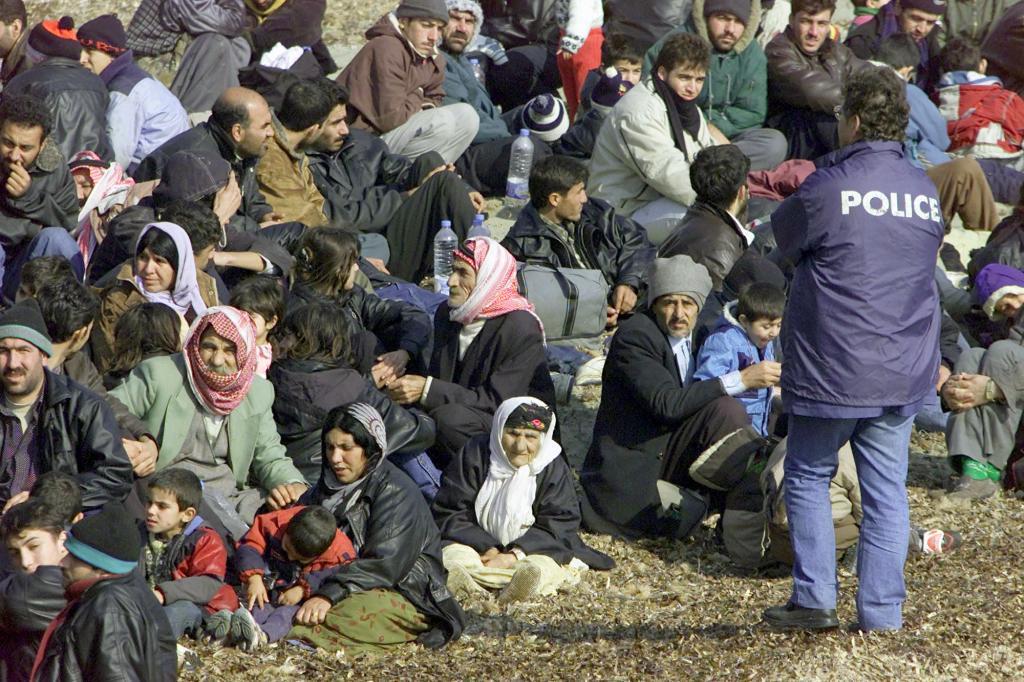
France will deploy up to 50 riot police officers on its coasts to disperse and deter immigrants attempting to make the crossing of the English Channel. The controversial measure, included in the new migration agreement announced this week, has drawn harsh criticism from NGOs, who months ago questioned aggressive tactics such as puncturing boats near the shore, considering that it endangers the lives of immigrants.
The new agreement, sealed on Thursday in Dunkirk by the French Interior Minister, Laurent Núñez, and the British Home Secretary, Shabana Mahmood, involves London providing 766 million euros to contain the arrival of irregular immigrants from French coasts, which last year reached 41,472 (the second-highest figure since 2018) and claimed 29 lives at sea.
So far in 2026, there have been over 6,000 crossings, a 36% decrease compared to last year, attributed by British authorities to the tightening of measures and the "one in, one out" policy that allows for a limited number of immigrants to be returned to France (in exchange for regularization of their status on British soil).
"Our work with France has enabled us to prevent thousands of crossings, and this Government has deported or returned 60,000 people who had no right to be here," stated British Prime MinisterKeir Starmer. "This historic agreement means we will go further: strengthening intelligence and surveillance and putting boots on the ground to protect our borders."
"By using police measures in the English Channel, the Government is addressing the symptom, not the cause," warned Imran Hussain, spokesperson for the Refugee Council. "More police will not prevent desperate people from embarking on the risky boat journey. Many who attempt it have family in the UK, speak English, and have cultural ties to our country, so they should be allowed access through legal routes."
"Boots and batons will be used indiscriminately against men, women, and children on the beaches of France," warned Sile Reynolds of the Freedom for Torture NGO, in statements to The Guardian. "Many people fleeing violence and persecution will have to deal with French riot police, who have been criticized by the UN for excessive use of force."
The new migration agreement foresees a more than 40% increase in the force dedicated to preventing crossings, reaching 1,400 officials. Among them, a unit of the Republican Security Companies (CRS), specialized in public order and crowd control. French and British authorities have justified their deployment due to the presence of "hostile groups" on the beaches and the "violent tactics" used by smugglers.
One-third of the money committed by the British Government will be used precisely "to attempt new methods," with the support of two new helicopters, drones, and a system of cameras and surveillance on the coasts. The agreement also aims to strengthen legal actions against human trafficking, such as the recent trial in the UK where a Sudanese citizen was charged with the deaths of four immigrants who attempted to cross the English Channel.
"The new agreement will prevent illegal immigrants from venturing on this dangerous journey and will put smugglers behind bars," warned Shabana Mahmood, daughter of Pakistani immigrants. Alongside her French counterpart, Laurent Núñez (descendant of a family of Algerian pieds noirs of Spanish origin), Mahmood will visit in Dunkirk the construction site of a new "administrative detention center" where immigrants awaiting extradition will be held.
The Mayor of Calais, Natacha Bouchart, has protested the marginalization of her city in the new migration agreement: "I strongly denounce the decision to ignore Calais, which remains the epicenter of the migration problem. Since taking office in September, Laurent Núñez has never been here despite my requests, nor has he met with me in Paris to resume discussions with his predecessor."