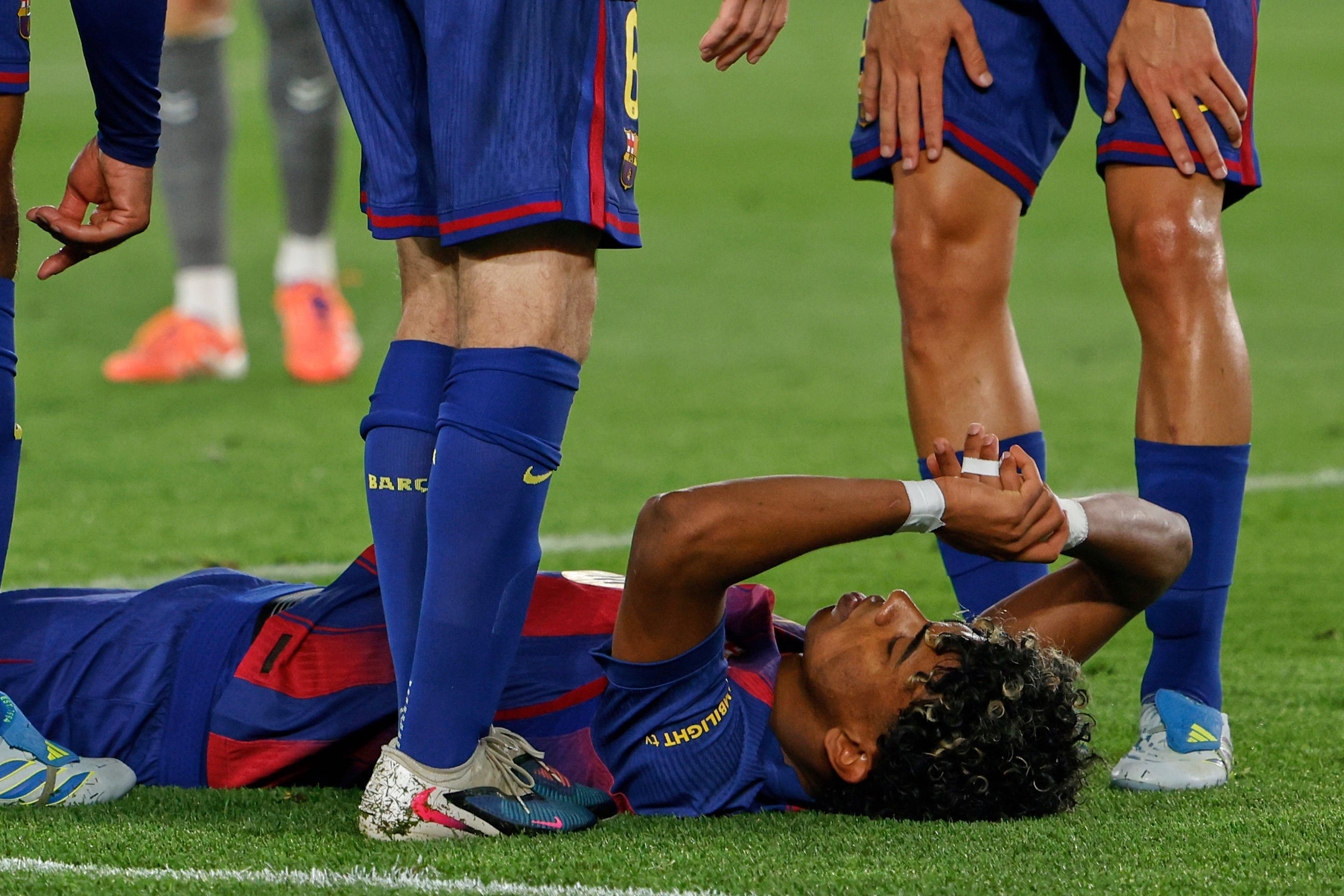
With the door to the League closed and the window to the World Cup open. Lamine Yamal, after the penalty kick that secured Barcelona's victory against Celta, suffered a hamstring injury in his left leg that prevents him from participating in the League. He could be out for a month and a half, just in time for the international championship, starting in 50 days. It is likely that the forward will not be in full condition for the early tournament matches. Spain will debut on June 15 against Cape Verde.
Luis de la Fuente breathes a sigh of relief, and Hansi Flick resigns to losing his most decisive player. Barcelona, on the verge of winning the League title, has six matches remaining against Getafe (tomorrow), Osasuna (May 2), Real Madrid (May 10), Alavés (13), Betis (17), and Valencia (24).
Barcelona confirmed yesterday that Lamine will undergo a conservative treatment. This is the second injury for the winger from Rocafonda this season. The previous one was a pubalgia that caused him to miss five matches. By the way, Real Madrid has also confirmed that Militao and Arda Güler are suffering from hamstring injuries: the Brazilian in the left leg and the Turkish in the right. The Bernabéu club believes that both players will miss the rest of the season and are doubtful for the World Cup.
Sports medicine experts maintain that hamstring injuries are one of the most common in footballers, especially in explosive players like Lamine. "This muscle works to the limit in actions such as sprinting or changes of pace. The key to Lamine Yamal's recovery will depend mainly on the location of the injury, being much more problematic if this tear is near the muscle-tendon junction (myotendinous junction)," warns Luis García, physiotherapist and osteopath, responsible for the Physiotherapy area at the iQtra Advanced Medicine Clinic.
"In this case, we would be talking about recovery times that could range from five to eight weeks, although in elite sports, these times are aimed to be shortened as much as possible through treatments such as Platelet-Rich Plasma (PRP), which provides growth factors and helps optimize muscle tissue repair, invasive physiotherapy such as Percutaneous Intratissue Electrolysis (EPI) or non-invasive treatments with high-power laser or radiofrequency; all aimed at improving vascularization and the biological environment of the injury," adds Luis García.
This specialist points out that the major challenge facing Lamine is not only recovery but also avoiding relapses: "The hamstrings, and the hamstring is one of the three muscles that make up the hamstrings, have a high recurrence rate if biological healing times and proper readaptation are not respected. A progressive approach is necessary, combining load control, strength work, and a gradual reintroduction to sports movements."
In this regard, he agrees with Dr. Pedro Luis Ripoll, who notes that this injury has a 30% relapse rate. "Care must be taken. We must be extremely cautious with recovery times... We must not pressure the player," he said on Radio Marca. The doctor also warned that this season, nine Barcelona players have suffered hamstring injuries, and six of them have had relapses.
Luis García emphasizes that the return to competition should not be dictated by the calendar but by the player's functionality: "He should return when there is no pain, complete recovery of strength, and the ability to make maximum efforts without risk. Forcing an early return can significantly increase the risk of relapse and prolong the total time off."