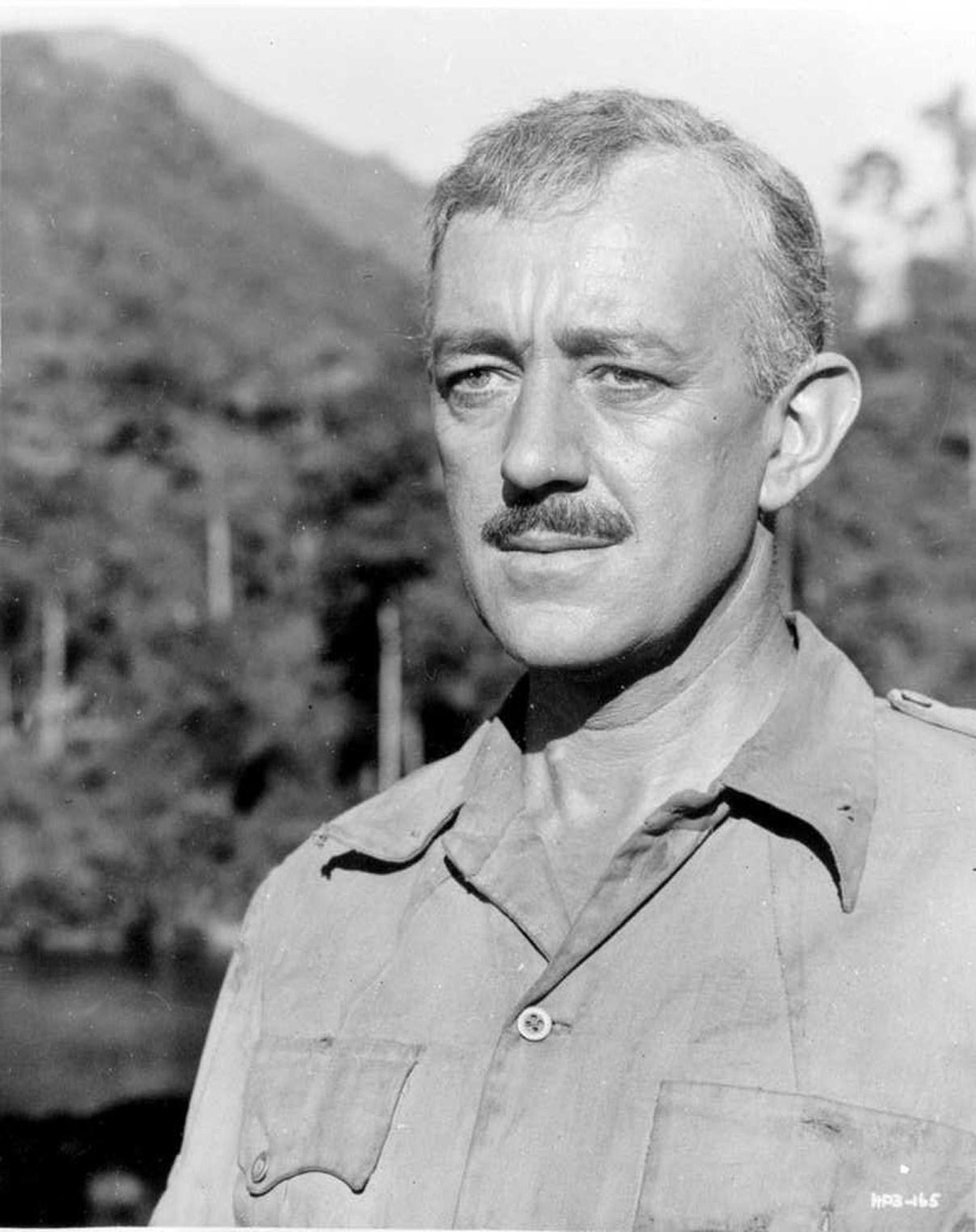
The decriminalization of homosexuality in England in 1967 was a sine qua non condition for some of the great names of the British scene to continue hidden in their respective closets. None wanted to be a standard-bearer for anything. When Sir John Gielgud -Julius Caesar (1953), Gandhi (1982) was arrested in 1953 in the London district of Chelsea for engaging in cottaging - a term that refers to anonymous gay sex in public bathrooms - the press attacked him, but the public welcomed him back to the theatre with thunderous applause. That social scandal served to some extent to highlight the much-needed reform of the country's penal code.
The actor never hid his sexual orientation, but he also did not publicize it widely. This was in stark contrast to the torment experienced by Sir Alec Guinness -Oliver Twist (1948), Lawrence of Arabia (1962) - another illustrious contemporary whose sexuality brought him much bitterness. He found necessary protection in secrecy and in marriage, a safe conduct to maintain an impeccable moral image. Undoubtedly, this duality conditioned his fate.
Since last January, on the occasion of the 25th anniversary of Guinness's death, the actor Zeb Soanes (49) has been touring England with the play Two Halves of Guinness, where he embodies his legendary colleague. With nearly 70 theatrical works, 50 films, and over a dozen TV dramas including some of the most notable classics, in addition to two Oscars, two BAFTAs, and a Golden Globe, Sir Alec Guinness feared being remembered only for one role, that of Obi-Wan Kenobi in Star Wars (1977). Regardless of his extensive resume, the play also delves into the grey area of his sexuality.
For Guinness, having a stain on his record was something he could not afford. Therefore, unlike Gielgud, when he was arrested in 1946, charged and fined in a Liverpool court after being caught in a public restroom, Guinness had the presence of mind to say his name was Herbert Pocket, like the character from Dickens he was about to portray in his film debut, Great Expectations (1946).
By then, Sir Alec had been married for eight years to the actress turned painter Merula Salaman, whom he had met at the acting temple of the Old Vic. In 1940, their only son, Matthew (85), was born, who also inherited some of his talents. Today, one of the most well-known descendants of the legendary star is professional footballer Nesta Guinness-Walker.
Privately, the illustrious actor's greatest obsession was to project respectability onto himself and, consequently, onto his family. Although his inner circle knew of his weakness for visiting certain Turkish baths and flirting with young gigolos, Guinness never spoke to the press about his rumoured bisexuality.
As his biographer Garry O'Connor commented to the Sunday Times, author of Alec Guinness: The Unknown, "the actor sought refuge in his acting and in the church as solace. The church provided Alec with much-needed security against the demons of his sexuality." During their 62-year marriage - Alec and Merula were born in 1914 and passed away in 2000 - the actor dedicated himself to maintaining a stable home. As highlighted by The Telegraph, the star of The Bridge on the River Kwai (1957) had the lingering regret of a troubled childhood.
His mother had slept with so many men that Alec never knew the identity of his father, a fact that he never forgave. Rumours suggested that it could have been a member of the Guinness clan during the time his mother worked as a waitress. "Decades later, the Guinnesses approached Alec, pointing out a family resemblance, but they had no proof that he was a relative," stated Zeb Soanes, who has extensively studied the personality of his childhood hero. Other rumours claimed it could have been a friend of the billionaire brewing clan, but for some reason, the actor suspected it might have been a banker named Andrew Geddes. However, Alec's resentment towards his mother persisted until his death in a nursing home. According to Piers Paul Read, the actor opened a bottle of champagne when he heard the news.
He never tolerated that his mother was a hardcore alcoholic who even married a violent man who abused the child by holding him upside down from a bridge intending to throw him into a river just to blackmail her. He also struggled with numerous relocations, fleeing hostels without paying, and frequent abandonments. It is not surprising that a raw obsession to escape his failed reality soon emerged in young Guinness. It was in this duality that his desire to become an actor thrived in a generation dominated by Sir Laurence Olivier, Sir John Mills, and Peggy Ashcroft. That unstable and impoverished youth, where secrecy and neglect ran rampant, shaped a man full of contradictions who eventually became one of the great Dickensian actors on screen.