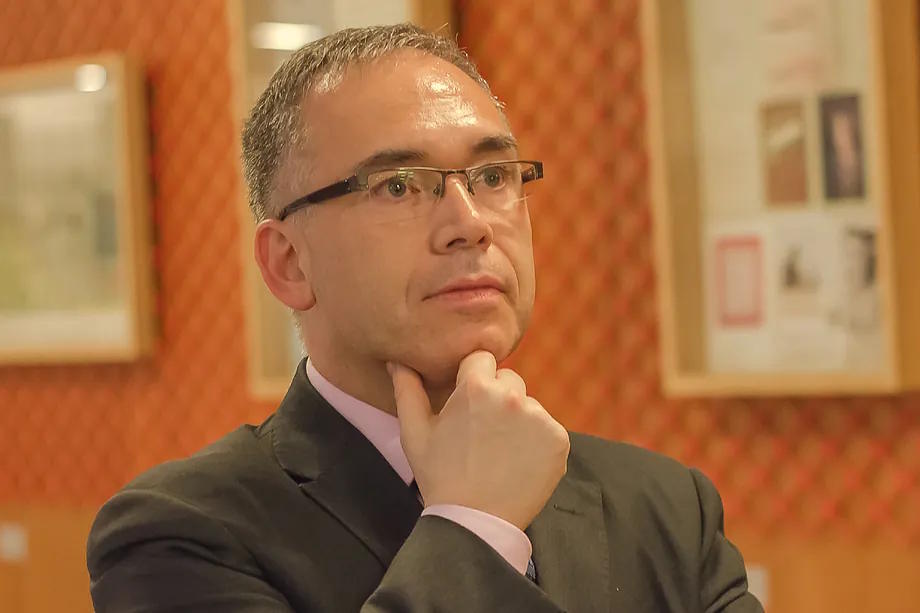
June 17 is a significant day in the life of Leandro Shara (Santiago de Chile, 1966). Not only was his daughter born on that day, but years later, on the same day in 2013, he had the first meeting with UEFA in Tel Aviv. "I met with Giorgio Marchetti [Deputy General Secretary] and his assistant, Lance Kelly. I have witnesses, as a Mexican partner accompanied me on a 36-hour trip from Chile," explains Shara to EL MUNDO. In that meeting, this mathematician and economist explained a competition format he first designed as a hobby and later turned into a profession. Nearly 13 years after that meeting, Leandro has taken UEFA to court for copying his format in the new Champions League without acknowledging him.
What started with a complaint in March 2025, to which UEFA responded disdainfully ("they replied that it was unjustified and just another example of similar actions against which the organization would defend its position"), has ended up in the Commercial Court No. 16 of Madrid, which declared its competence to handle the matter on March 23. "It's good news, but it's another brick in the house we are building. What I want is for my authorship to be recognized," he values.
This legal battle, he says, does not stem from resentment but from what he considers justice. MatchVision (Shara's company) continues with an open hand. "Between the initial announcement in 2021 and the draw in 2024, we tried to get UEFA to acknowledge the authorship before going to court. Even after they adopted the format without acknowledging us, we continued extending the hand," point out from the company he leads.
The idea emerged in 2003. Shara was at the doctor's office and saw Joseph Blatter, the former FIFA president, on TV talking to a journalist about the impossibility of expanding the World Cup (then with 32 teams) as there was no solution to go from 36 to 16. "I asked the secretary for a pencil and wrote down my idea on a piece of paper that I kept in my pocket," Shara recounts. Three days later, when he picked up his jacket again, the mathematician found the paper and decided to rewrite it neatly.
As Shara also heard Blatter say that they had consulted with four consulting firms and had not found anyone inside or outside FIFA capable of solving that problem, he realized the value of his achievement and took a plane to present his format to CONMEBOL. "They told me they wouldn't take it. Two weeks later, I pick up the newspaper and find my changes applied in the Libertadores," he recounts.
Shara learned the lesson and decided to patent his format with the World Intellectual Property Organization. With the intellectual property already registered since 2006, Shara's idea was first implemented in Chile for the 2011 Copa Chile and then in the 2015 Peru Cup, a tournament in which thousands of teams participate (over 27,000). But Shara's ability to devise competitions did not go unnoticed at FIFA, where he became an external consultant, and the Chilean even gave several talks in America, Asia, and mainly in Europe, where UEFA is involved. The dream of seeing his name in the biggest club competition was getting closer.
It was then that contacts between UEFA and Leandro began, with several formal meetings documented in the lawsuit and culminating in the famous 2013 meeting. From that meeting, he left with Marquetti's statement that football "is very traditional" for his format and with the assistant hinting that he had considered that idea before, as well as the fact that the largest European football organization does not work with companies from outside the old continent.
When the idea seemed to have been shelved, despite continued contacts even with the organization's president, Alexander Ceferin (according to his version), the emergence of the Super League accelerated changes in the Champions League. Clubs demanded more revenue, leading to a change in 2024, after 20 years, from the famous group and knockout format to introducing a group stage, increasing from 32 teams to 36. "UEFA did not test my format; they only reacted to the Super League," he explains.
When Leandro contacted UEFA, they claimed that what they initially called the "Swiss format" and later the "league type" was the result of "over 10,000 hours of work." "UEFA knows perfectly well what they did and its value. When they decide to act in accordance with their own obligations, the conversation will be short," the businessman maintains. So, feeling his effort vilified for the second time, this Chilean, who claims to have been creating competitions since the age of 6, decided to sue and demand compensation of 20 million euros, an amount that will increase for each season the format is applied and the trial continues to extend. "I claim less than 0.5% of the revenue generated by my format," he points out, adding that he has invested "a lot of money in R&D over 20 years." "I sold my apartment and my car," he argues.
Despite the numerous attempts by UEFA to delay the process and take it to Swiss courts, Commercial Court No. 16 of Madrid has already requested that Shara amend his complaint to pursue the harm caused by this format in Spain and has informed him that this will not prevent further claims within the European scope. "I hope to be alive when this ends. This will be applied in many sports, even in the Olympics," he concludes.