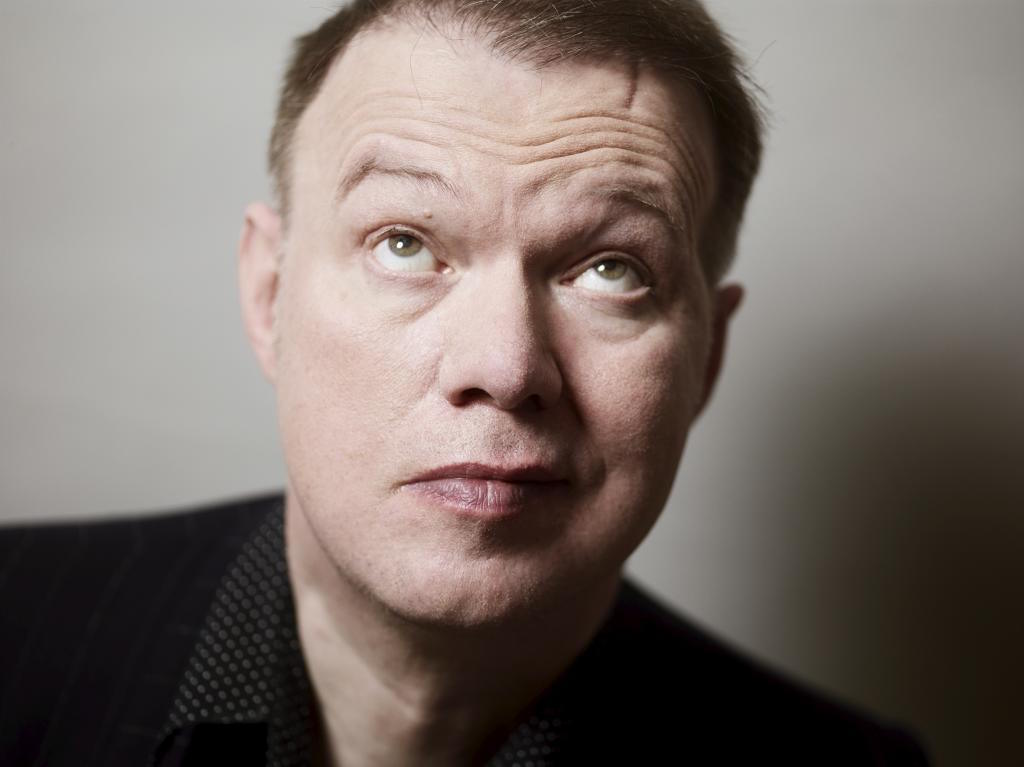
Having a conversation with Edwyn Collins (Edinburgh, 1959) and Grace Maxwell, his wife, manager, and assistant, is like attending a British comedy show. As if Eric Morecambe and Ernie Wise or The Two Ronnies had morphed into a couple who make themselves the subject of humor. Irony is the main element of the conversation between a duo who appear on the other side of the screen with the intense spring sun of London shining through the window.
Twenty years ago, two strokes affected the abilities of Edwyn Collins, the great cult figure of British indie, and since then, Grace has been assisting her husband in interviews. And it seems that something new has been developing in these exchanges they have in front of the press. He always blames his wife for everything with a mischievous smile, to which she responds with a certain theatrical indignation. "I plan to continue recording because I have an album in mind, but it was my wife who decided that I had to retire from the stage," states the Scottish musician, under the graceful gaze of his wife.
And, despite the humor, the retirement is real. Collins starts today in Bilbao what will be his last 10 times on stage, all consecutively in our country. In San Sebastián, Zaragoza, Valencia, Barcelona, Madrid, Santiago de Compostela, Cádiz, Seville, and finally, Ourense. There will be no more opportunities to see live the former lead singer of Orange Juice since the late 70s, the indie icon in the islands, the one who inspired much of Britpop, and who, after the two strokes, recovered and built five solo albums. The latest, Nation Shall Speak Unto Nation, last year with an opening track, Knowledge, in which he recounts his journey back to being able to speak, write, and, of course, make music.
"It's been 20 years since the illness, and I've had incredible adventures during this time. But I feel old, and this business becomes difficult as one ages. I know there are older people than me still doing it...," explains Collins. And Grace adds, "Spain will be the end for him because we would have to wait another four or five years to do something again. We would be in our 70s, it's crazy, for God's sake. It's time to stop because you're still good at this." The musician can't help but burst into laughter upon hearing this, in a dynamic that will be constant throughout the conversation.
However, bidding farewell to the stage is not the end of Edwyn Collins' music. A new album is already taking shape in his mind, which he will record in a house in the Scottish Highlands, his grandfather's birthplace, where they have built a studio for him to continue creating near the sea and mountains. "I don't want to stop making music, in any way. It's my great pleasure," he details initially. "Before, I think music was on an intellectual level after some things, now it's my life, it's my passion and my pastime. It was what saved my life after the stroke," he emphasizes in a second intervention.
In February 2005, during an interview, the musician began to feel unwell. Two days later, he had a first stroke. Five days later, he suffered a second hemorrhage. With Grace by his side, it took three years until he could return to music, accompanied by a cane, with no mobility in his right hand, and unable to play the guitar. "The older I get, the less secure I feel in this world. It's funny because I used to have faith. Not anymore. I'm happy to belong to the old school," recalls Collins, who shies away from the reference label that the musical reality of the islands has imposed on him. "You know, he leans back in his chair and says, 'My children, I'm glad to have given you all this wisdom.' It's like Hamlet with his skull," Grace jokes. With some modesty, after acknowledging that Robbie Williams has recently been recording in his studio, he continues, "I guess if you stick around long enough with your music, people start talking about your influence. That's happened to me."
The most paradigmatic thing is that the musician who always tried to escape fame, major record labels, and mainstream music became a reference in Britpop, a movement that ended up becoming the mainstream in the islands. As an example, his manager recounts one of the first meetings she witnessed in a record company's office. An executive told Edwyn Collins that if he didn't organize himself well to tour extensively in Europe, he couldn't have "a damn career." He leaned over his desk and shouted, "Don't mess with me, mate."
"I wasn't going to work with people who didn't understand me, I had no need," defends the musician, who also has a message for those starting out in music. "Never sell the rights to your music, that's what I have to tell young artists. We own our rights, and that's amazing."
-Did you always have it clear that you wanted your career to be that of independent artists? Were you never tempted by massive success?
-We always wanted to be independent, we found a way to survive without being involved and always from the periphery of the music business. We've had a whole life based on that, and it's been great-, Grace begins.
-Credibility is important, I was never a big star. You have to choose between success or credibility in this world. It's hard to have both at the same time. Apart from the time A Girl Like You, I never achieved great commercial success, but I have credibility.