Fatih Akin was born in Hamburg in 1973 and has lived there all his life. Yet, even today, more than half a century later, he still faces issues in his native Germany regarding "national priority". His Turkish ancestry family betrays him, or rather, betrays them, to others.
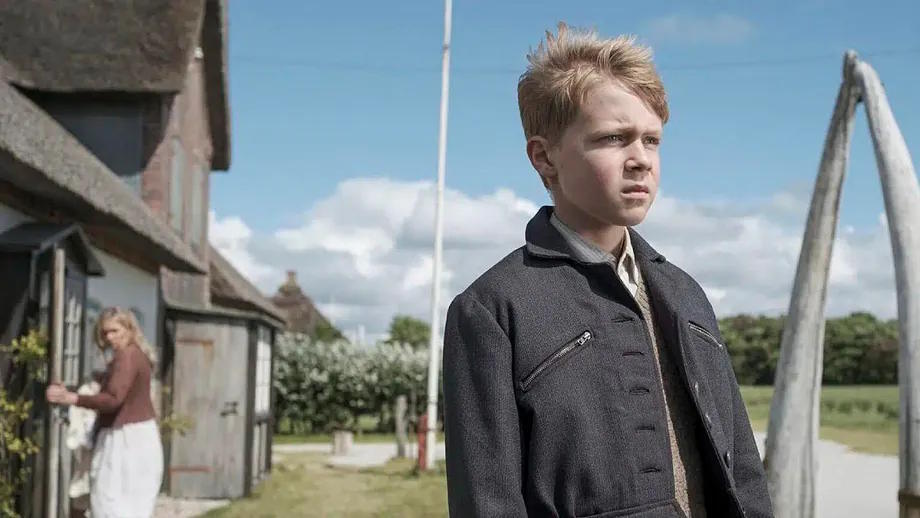
The proof is The Island of Amrum, his latest film. Perhaps somewhat different from the usual subjects that have marked an award-winning filmography at both the Berlin Film Festival (where he won the Golden Bear for Head-On) and Cannes (The Edge of Heaven won the Best Screenplay award), the film returns to World War II to focus on the story of another, a German like him, but from his very personal perspective. It tells the story of a boy, a boy from the Hitler Youth, in the final days of the war in a place far from the bombs and exterminations. Far from the genre's clichés, it is a gentle tale about, pay attention, a good Nazi.
Based on the personal story of actor Hark Bohm, a key figure in Fassbinder's cinema, controversy has surrounded the film since its premiere in... Germany.
I read echoes of controversy, but I find it hard to understand. Who can take it as a provocation to talk about a morally blameless Nazi, being a child in the rear guard?
It has simply been the excuse my enemies have used to attack me.
Do you have enemies?
Everyone has them. The argument used against me is the classic: "How dare a Turk speak about our history?". Let's say it wasn't the majority. It was only a few affiliated with the conservative press, but very vocal. The curious thing is that it wasn't the far-right press, which exists, but what we could call bourgeois conservative. They have been very harsh and, worst of all, very racist. It was people who didn't hesitate to point me out as someone non-German. Many of the conservative bourgeois in Germany are still very racist and are still there.
So they hadn't gone anywhere then?
They simply came out of the trenches. And it's good that, finally, they are seen. It's curious that a movie that doesn't deal with the present has served to unmask many right now.
On the other hand, the story being told is not yours. I mean, the reaction you speak of is even more incomprehensible or unfair...
It was a very beautiful experience. It was not so much about appropriating anyone's story, like an artist such as Hark Bohm, but about disappearing behind it. I saw myself a bit like John Ford or a Turkish director like Atif Yilmaz, who made almost 120 films in his life. The original idea when I received the script was not at all to make an auteur film. What happens is that you end up getting involved...
In fact, some of the themes in your filmography are there: the resistance of the solitary man, the family...
Yes, making a film is such an absorbing task that there is no choice but to immerse yourself in it. When you're filming, nothing else matters, not even the children or anything. You only have time for the film, and that ends up being revealed. Shortly after starting, I saw clearly that Nanning's family [the 12-year-old protagonist] was also mine.
Did you also have problems with your mother like him?
I had them with my father. Politically, we are at opposite extremes and that has been an endless source of conflicts. However, and despite everything, my father has been an exemplary father, a great guy. But for a while, he was the enemy to beat, my fiercest antagonist. It was very difficult for him to accept my political ideas. I remember that when he read an interview of mine, he couldn't believe it. His friends would say to him: "How can your son say such things?". And he struggled not so much with what I thought but with his colleagues reproaching him.
I imagine it's a universal argument.
Without a doubt. But what is relevant to me is not so much the conflict but the fact that, despite everything, the family is always there. And in that, I also identify with the character in the movie. He may argue with his mother, but mealtime is sacred. Conflicts shape us, but always from an unbreakable idea of family.
Going back to the beginning, why is it so difficult to talk about the past without stirring up trouble? And I'm not just talking about Germany.
It's a global situation right now. Americans find it difficult to talk about slavery as part of their past. We see how the Trump Administration censors books that recall the darkest parts of history. The Japanese, for the same reason, also do not want to remember how their imperialist ambitions ended. And the French, for example, have forgotten their collaborationist past with the Vichy regime. They only talk about the resistance. I imagine something similar happens in Spain. It's a very human thing related to shame. As it is known, history is written by the victors, and no one wants to remember themselves as they really were. Shame and defeat remind us of how weak we are. And that, right now, is not in vogue.
Would that explain Germany's stance towards Israel?
Undoubtedly. We do not support Israel out of conviction or empathy with the Jewish people. It has nothing to do with that. The real reason is that we take sides with Israel or against Palestine, convinced that our guilt will be forgotten. It's a mechanism to wash away guilt.
However, it has always been said that Germany made an exemplary process of admitting responsibility after the war.
It was a good marketing strategy, but nothing more. Everyone, including Hollywood, found it convenient to think of the Nazis as demons. Even Indiana Jones needed those Nazis. But Germany has not been exemplary in handling its past.
It sounds a bit radical.
It is. And how can I be so sure of all this? Well, very simple, if I weren't right, the Nazis wouldn't have resurfaced as they are doing with the far-right of Alternative for Germany. The trauma was repressed until it turned into a depression, but it was not really faced. And the evidence is clear.