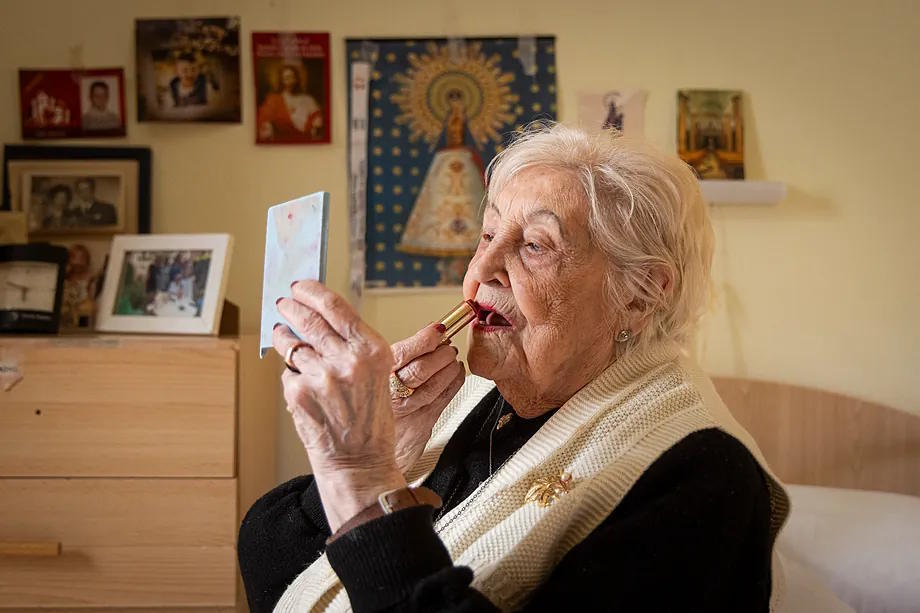
The real obsession of Silicon Valley is not artificial intelligence, but longevity. Tech millionaires are investing fortunes to reverse aging, but when science talks about longevity - although some treat it as if they could outsmart death - it actually refers to increasing healthy life expectancy, meaning having quality of life and reducing chronic diseases in those extended existences. Every day there are more centenarians (100 years or older) and research is focusing on trying to find out why more and more people manage to reach that age with certain health.
An international review published in Nature Reviews Immunology analyzes why many centenarians have greater resistance to age-related diseases and the key lies in their immune system. The publication brings together researchers from various institutions such as the European University, the University of California Irvine, Copenhagen University Hospital Hvidovre, Hospital 12 de Octubre, University of Oviedo (like Carlos López Otín), Nebrija University, Lobachevsky State University, and Ciberfes (the Biomedical Research Center Network on Fragility and Healthy Aging).
Genetics, an important factor
There are many factors and scientists do not really know how each one contributes. It is clear that genetic luck plays an important role, although in this sense "a supposedly protective gene in Japan does not have to be the same in Spain and vice versa," explains Alejandro Lucía, professor of Exercise Physiology at the European University and one of the authors of this international work. "Some studies on offspring of long-lived individuals show that there is a 55% heritability of being very long-lived," he adds.
Epigenetics also plays a role (the environment and lifestyle habits that can modify gene expression without altering DNA). Lifestyle is really important to avoid diseases and, therefore, to reach a certain age in better condition. "A study conducted in China has shown that even among centenarians, those who led a healthy life: eating healthily, being active, getting good sleep, engaging in physical activity, and not smoking or drinking excessively had a 7% higher chance of staying alive after 100 years.
And then there is also the luck you have had in your life. If, for example, a 90-year-old person has a fall and suffers a fracture and is hospitalized, many times that's when things start to go downhill. Functional reserve is like a spring that we humans have and it wears out with age, but there are some events that make it give out earlier: it could be a major upset or an acute illness that depletes your reserves," Lucía points out.
The researcher, who is also a member of Ciberfes, highlights that many of the studies in the review come from China because "it is relentlessly advancing in science. While Europe is regressing and the US is more concerned about other things, China is very focused on research and they also conduct extensive studies because they have a large population." In fact, they have a lower proportion of centenarians than other countries - "Japan already has 40 centenarians per 10,000 people and China has six per 10,000, even fewer than in the US," Lucía points out - but with the country's large population, they reach high numbers of people over 100 years old.
Lucía indicates that centenarians make up 0.09% of the global population. "That is, they are very special individuals and even more so when we talk about semi-supercentenarians (105 years) or supercentenarians (110 years), "they tend to be better off than those who are 100 years old," he emphasizes. "The problem with humans as we get much older is that it is the most heterogeneous group there is, and therefore, it is very difficult to draw conclusions."
The professor explains that centenarians "are like 85-year-olds: some are very well and independent, and others are in wheelchairs or have dementia." They are not immune to cardiovascular disease, but they have fewer consequences according to Lucía. "They have reached 100 without the therapeutic advances we have today because when they were at the age to suffer a heart attack, there were no statins for cholesterol or the drugs we have now. We are killed by two things: either cancer or cardiovascular disease, and in this sense, they develop it later and endure it better. There are autopsies of people from Okinawa, where the famous blue zone is, and some had very clean coronary arteries. There are autopsies of Italian centenarians where they found that they had fairly obstructed coronary arteries, as expected for a person of that age, but they did not have many areas of infarction."
They also do not escape chronic kidney disease, Lucía warns, "but it is mechanical damage in the end, as we age our kidneys fail."
However, they have managed to avoid cancer. A centenarian may have a tumor, but it is rarer and they are usually less devastating than in younger age. "We should rather talk about centenarians, because they are mostly women. They have managed to dodge cancer due to their super-trained immune system. Many of these individuals survived Covid because they lived in residences and contracted it when there were no vaccines yet. And those born before 1918 still have antibodies from the famous Spanish flu that devastated Europe," Lucía points out.
The researcher details that centenarians have a very special "immunobiography": "If it is very strong, the immune system kills cancer cells but can also cause autoimmune diseases. They have a very delicate balance to differentiate between self and non-self, among which are tumors.
Their immune system is the ideal that we should all have: very cytotoxic with precancerous cells to eliminate them immediately and very tolerant with our own tissues, it does not have autoimmunity." Additionally, he notes, their immune system destroys the remnants of cellular damage that accumulate as we age (autophagy) and they have managed to tame the so-called inflammageing (coined by another of the authors, the Italian Claudio Franceschi): the chronic low-grade inflammation that accompanies aging. Inflammation exists in centenarians, but their bodies have mechanisms to prevent it from negatively affecting them.
Another detail that Lucía emphasizes is that their microbiome, their gut flora, is "super-rich and super-diverse" and obesity is also not present in centenarians. "This is important because obesity causes us to store a lot of fat around our organs which is pro-inflammatory and that deregulates our immune system, leaving it confused instead of being where it should be. In fact, in Covid, obese individuals were the virus's major victims."
The professor highlights that they have not followed special diets: "Now that such and such diet and intermittent fasting are in vogue, centenarians have followed a normal diet: those from Galicia follow the more Galician Atlantic diet; those from Castile, the more Castilian diet; and those from Valencia, the more Mediterranean one." They also add sugar to their coffee, everything in moderation, and have led a rather healthy, but normal lifestyle, although physical activity was more common in the past than it is today, he points out.
Truly, no one has the answer as to why these individuals have won this genetic lottery to have such an immune system. Lucía insists on the combination of factors and personally considers that there is a kind of psychological factor. "They are individuals who stress very little and stress has an influence on our immune system. They take life very well, neither excessively nor defectively. They are very calm people and perhaps that has some reflection in having a more homogeneous immune system. It is also Claudio Franceschi's theory."