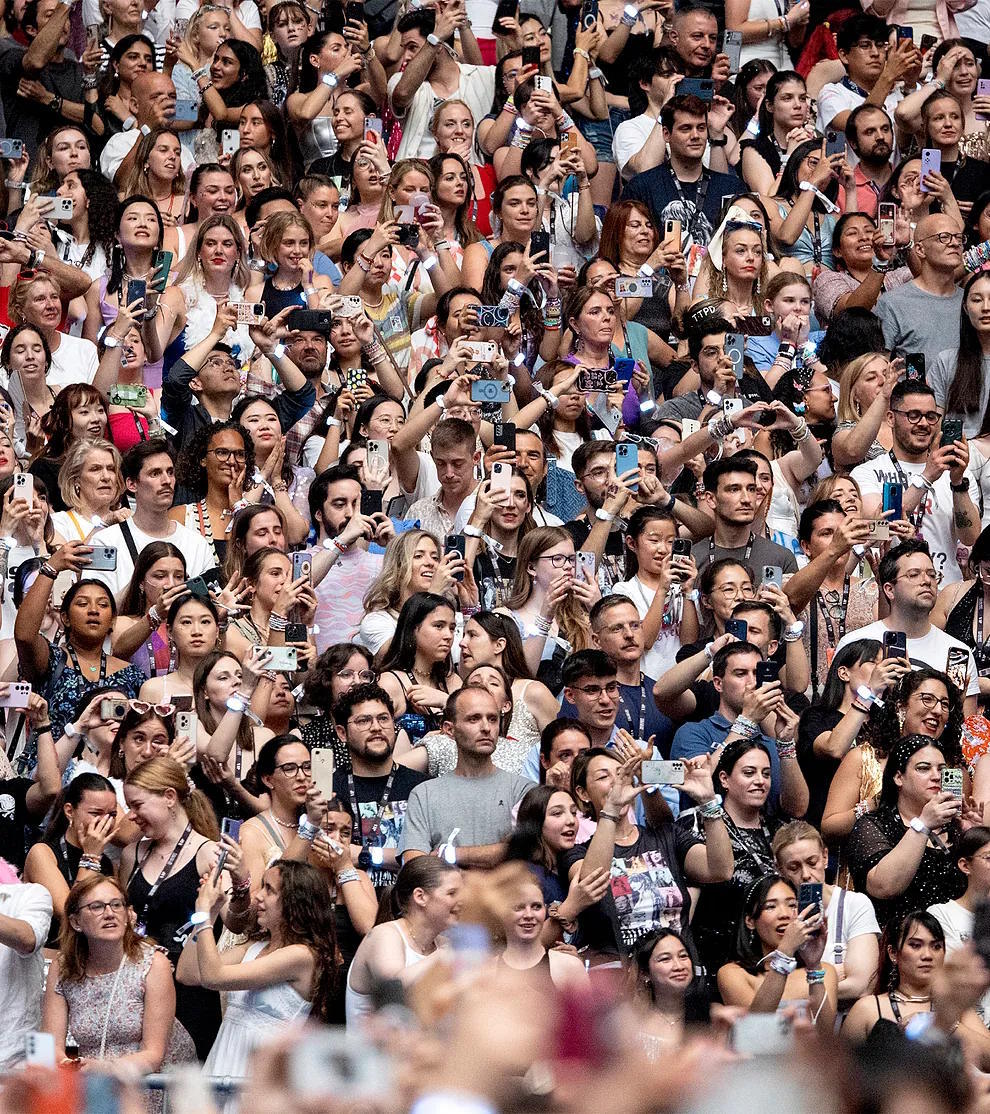
In July 1982, under a thunderous storm, the Rolling Stones appeared on the stage set up at the now-defunct Vicente Calderón stadium in Madrid. Mick Jagger and his band had already ushered in a new era for Spain in 1976, the era of democracy, with their concert in Barcelona, and on the wet grass of the athletic temple, they were inaugurating another: that of stadiums as concert venues. A year later, at the Santiago Bernabéu, Julio Iglesias became the first Spaniard to fill a stadium, with around 100,000 people. And in 2001, Alejandro Sanz embarked on his El alma al aire tour, filling 20 stadiums across Spain, plus three consecutive nights at the Palau Sant Jordi in Barcelona.
It has been four decades since Spain has offered its football fields for major musical events during the summer season. However, in recent years, particularly since the pandemic, something has changed. What was once exceptional has now become a trend. Filling stadiums has shifted from being a dream to becoming a milestone for artists to achieve. Especially for national artists. Cases like those of Julio Iglesias and Alejandro Sanz were rare exceptions. Not anymore. In 2025, the fourth Spanish artist with the most spectators of the year was Aitana with just three stadiums; the fourth was Dellafuente, with two more, and the seventh was Lola Índigo, with three more. Manuel Carrasco, second on that list, kicked off his tour at La Cartuja in Seville, and Natos y Waor celebrated their tenth anniversary at the Riyadh Air Metropolitano in Madrid.
Live music has seen four consecutive years of record numbers in Spain. According to the Live Music Yearbook of the Association of Music Promoters (APM), in 2025, revenue exceeded 800 million euros for the first time -specifically 807 million-, growing by 11% compared to the previous year. In 2026, the trend seems to continue to rise. The proliferation of stadiums is crucial in this economic boost. The three international artists with the highest attendance in 2025 were Ed Sheeran, Imagine Dragons, and AC/DC, all filling stadiums for two nights. This year, between Madrid and Barcelona, Bad Bunny will fill 12. Shakira will build her own in the capital, along with a theme park, to accommodate over 50,000 people for 11 nights at the Iberdrola Music. The Weeknd has four shows between the Metropolitano and the Olympic Stadium in Barcelona. BTS and Bruno Mars, two dates each at the Atlético de Madrid stadium.
And the national artists? Manuel Carrasco has already announced four consecutive concerts at La Cartuja stadium from June 13 to 20. El Último de la Fila, in their reunion three decades later, just filled the Olympic Stadium for two nights and still has one more night at the Metropolitano, another at La Cartuja, and two more at the Ciutat de València. Alejandro Sanz will perform in five more stadiums in Madrid, Barcelona, Mallorca, Seville, and Valencia. And Rels B will fill another Metropolitano on July 4. "The change in trend is undeniable, there is a greater consumption of live music, and that's why artists are creating stadium productions. This increased consumption allows for absorbing the cost of setting up a production in a stadium," explains Pascual Egea, president of the APM.
The residency model, brought this year by Bad Bunny and Shakira, is one of the keys explaining the consolidation of stadiums in Spain. Major international artists now include multiple dates within their tours. In fact, the 11 concerts by the Colombian artist throughout Europe will all be in Madrid. "The market leads us to this model. Now concerts are plans that go beyond the event. You see a great show, have fun with your friends, travel to another city... This is also why people are more demanding about what they go to see, they penalize what they don't find good, and the artist has to put on a better show to meet expectations in a stadium," emphasizes Egea.
Carlos Espinosa is the founder of Riff Producciones, a small company that started in 1994 in Cazorla (Jaén) and has become the promoter selling the most tickets in Spain for the past six years -in 2025, they exceeded 800,000 tickets-, driven by Joaquín Sabina's farewell tour or Manuel Carrasco's concerts. This is how the director of Riff explains the phenomenon taking place in Spain: "There has always been a certain complex in the Spanish industry about venturing into stadium concerts. First, due to the uncertainty about the artists' selling capacity, and then because major productions had always been on the Anglo side. And now, finally, we have overcome that complex," points out the person behind Manuel Carrasco's live journey.
The artist from Huelva inaugurated the Metropolitano -perhaps the first step towards this consolidation of stadiums-, was the first Spaniard to fill the renovated Santiago Bernabéu -now with concerts suspended due to neighborhood conflicts- and will be the first national artist to fill La Cartuja four times. "Spanish fans have normalized seeing their artist in a stadium as an epic gesture, a collective ritual, and feel they have to be there. For promoters, this is very important. Additionally, I believe that the drive and precision that a national band brings to a stadium, an international artist cannot provide because they are part of a routine. For a Spaniard, it's like their graduation party," concludes Espinosa.
The event Natos and Waor created at the Metropolitano on June 7 was more of a birthday celebration, but, in the end, a party. Two guys who started in small venues for a hundred people doing rap and within ten years were attracting almost 60,000 to a stadium with a genre they had never even dreamed of reaching those numbers in their beginnings. "It's a technical challenge if you want to do something big. Here, you only have one shot. On a tour, you can afford a weaker concert and improve in the next one, here you risk everything. And then there's the cost. We had several meetings because we weren't entirely sure at some point if it was viable. If we had lowered the ticket prices by 10 euros, we wouldn't have covered the costs even if we sold all tickets. Anything less than a full house would have been a failure, and not small amounts. But this serves to show other groups that are doing very well behind us that it is possible. If this serves as motivation to push harder and work more, then it's welcome," say Gonzalo Cidre and Fernando Hisado, the real names of the rap duo.
Next to them, from the beginning, Carlos Mata has been, founder of the booking and management office Taste The Floor, focused on rap and urban music. He was involved in the preparation of the Metropolitano for Natos and Waor and also at the Gran Canaria stadium where Quevedo performed as the closing act of his Buenas Noches Tour last May. "Years ago, this was unthinkable, but in the case of Natos and Waor, they have gone through all the stages, built a loyal fan base, and that has ended up turning into this stadium. In this case, I also believe it was an advantage that those fans were not used to seeing a concert of their idols in a stadium, so the celebration was also for them, who had been following them from smaller venues," he states.
More direct in his explanation is David Summers, leader of Hombres G, who were already performing in stadiums in Latin America in the 80s, filled the Vicente Calderón in 2006 alongside El Canto del Loco, and now they are once again filling stadiums in the Americas four decades later. "This is very simple, in a world where everything is fake, where everything is artificial intelligence, people want something they can feel together with others. Nothing gives you that like a concert. And if it's in a stadium, it's even more amazing," he says.
The explosion of live music has also brought about a tourism movement. Fans no longer just travel between regions but also between countries. According to a study by the consulting firm Credence Research, music tourism is growing by 18.6% annually worldwide and is expected to reach $400.5 billion by 2032. In 2018, the market in Europe was valued at $21.31 billion, the forecast for 2024 was $29.23 billion, and by 2032, that figure rises to $109.02 billion. This means that our continent accounts for a quarter of the total, and Spain is one of the four strongest markets alongside the United Kingdom, Germany, and France. "Our industry and our artists are ready to compete on equal terms with international artists, who were the ones who could afford the big stadiums and festivals for their tours. Now we have a good number of artists who can compete on an equal footing," says Soco Collado, managing director of Promusicae - the association of record companies - and the Federation of Music in Spain, which has just presented, together with the Ministry of Culture, the Spanish Music Export Office to try to open markets beyond our borders and also attract citizens of those countries to Spanish artists.
There are also those in the music industry who put a lot of quotes around this increase in concerts. The demand is undeniable, but some experts have doubts about whether it can be sustained or if it will fade away in a few years, and if this is the right format for some artists. "Not everything that glitters is gold in this change. There are Spanish artists who have benefited from the increased demand and fill stadiums, although usually at much lower prices than the big international artists. On the other hand, the new generations of artists have grown up in an era of immediacy and want to perform in stadiums as soon as possible. That's why there are artists who perform in stadiums with the main goal of being able to share it on social media, earning much less money than if they had played in a large indoor venue. In these cases, it's about appearing successful, which doesn't necessarily reflect reality," says Neo Sala, founder of Doctor Music and one of the historical promoters of the Spanish industry.
Alonso Remedios, booking manager at Last Tour, emphasizes that this is a "very localized phenomenon" in big cities like Madrid and Barcelona. "I don't see it easily extendable except in specific cases, but I don't think it will become a common model outside of big cities. Also, personally, I almost prefer it not to be. The real fabric of live music is in the city venues, which allow for the sustained development of both audiences and artists. They are essential for long-term careers," he points out.
These venues, as reported by the associations they are part of, are now selling more tickets despite some venues closing in certain Spanish cities, and they are part of a general growth in the music industry that was already emerging before the pandemic, was halted by COVID, and has surged right after. An example is that many artists who fill large venues no longer have to look outside of Spain for technical support. Manuel Carrasco's first stadiums had Belgian engineers, designers, and stage designers who had worked with Jean-Michel Jarre. Now, a Madrid-based company handles these tasks. For the past 30 years, Luis Berlanga has been leading Fluge Audiovisuales, which provides various technical services for tours of artists like Aitana, Alejandro Sanz, Dani Martín, or Dani Fernández, and in 2019, he founded a school for music production and DJing to provide the industry with more technical profiles. "We are growing with the support of those who buy tickets, but we have been seeing this growth for about ten years. We are advising companies from Germany or the United States to develop teams, both technologically and logistically," says the founder of this company.
Carlos Espinosa concludes: "At Riff, we can speak from the most absolute transversality. We have a venue in Seville, Custom, arena-format artists like Melendi, who sold over 300,000 tickets on his last tour, festival artists like Álvaro de Luna, and some who do studies. I have been hearing for a long time that there is a bubble in the music industry, and I'm glad it hasn't burst. In fact, I boast that it never will because I truly believe that all of this is based on the growing need of the public to attend concerts. Before, people would go to one concert a year, now there are people who attend more than one in the same month. Maybe there is a bubble of the audience. But if the audience has a demand, we must be here to give them what they want."