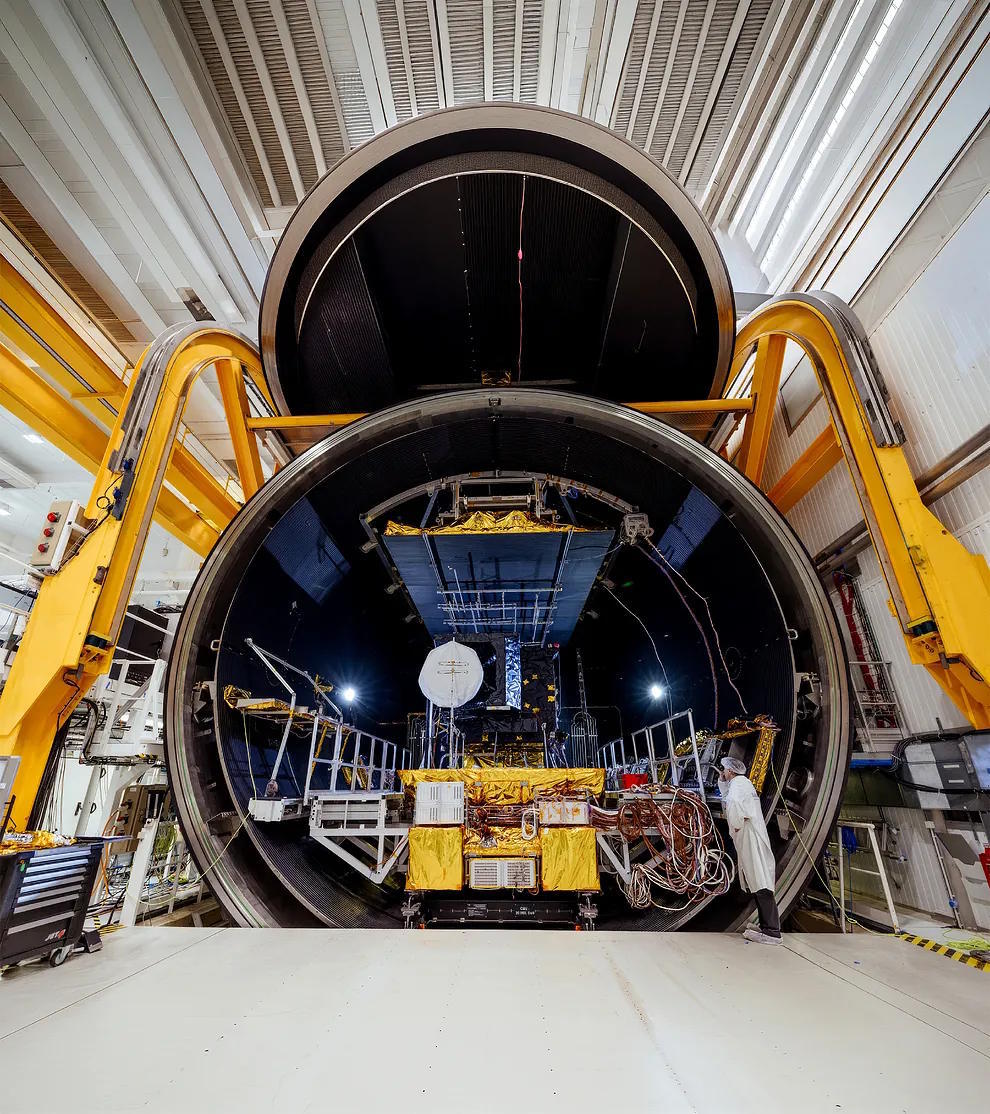
We visited the factory of the company Thales Alenia Space in Cannes where this technological gem has been assembled: "Studying the weather has never been as important as it is now".
In late 1970s Spain, the images from the Meteosat transformed the weather forecast and even became part of popular culture. Although the first successful meteorological satellite is considered to be the TIROS-1, launched by NASA in 1960, the Meteosat, launched into orbit in 1977, marked the beginning of a generation of European devices that have improved the way we observe Earth year after year.
A fundamental tool for meteorologists, for many years Spaniards made their plans based on the famous Meteosat images, a joint program of the European Space Agency (ESA), Eumetsat, and the European Commission. During the Transition period, predicting the weather through photographs taken from space was another symbol of the modernization process that our country was undergoing.
Since the Meteosat-1, a dozen satellites of the same family have been launched, replacing those that were no longer operational, each incorporating technological improvements. Over these 50 years, the evolution of the quality of the images and services they provide has been remarkable, as evidenced by comparing the first photo of Earth taken by Meteosat-1 with those captured by the satellite fleet launched in late 2022.
The program is now in its third generation of satellites, and the next Meteosat is currently at the facilities of the aerospace company Thales Alenia Space in Cannes (France), ready to be shipped by boat to French Guiana, from where it is scheduled to launch this summer aboard an Ariane 62 rocket. In a few days, it will be transported to the port of Nice to begin its journey to Kourou.
It is called MTG-I2 (Meteosat Third Generation Imager 2) and, like the other satellites in its family, it will operate at a distance of 36,000 kilometers from Earth, in a geostationary orbit, observing Europe and Africa. "It will be operational by early 2027," says Fabio Brandani, responsible for institutional payloads at Leonardo's Space Division, during an informative session in Cannes to which this newspaper was invited.
During this session organized by ESA and Thales Alenia Space, the main contractor of the mission, the program managers presented the next Meteosat and two other European Earth observation satellites that will be launched in September aboard the Vega-C rocket. These are Flex, the first mission to measure vegetation fluorescence to monitor plant health from space; the other satellite is Sentinel-3C, part of the Copernicus network that monitors the planet. Specifically, this space sentinel will provide real-time information for weather and ocean prediction.
"These three missions will improve our understanding of the Earth system and help us make predictions; they are three different programs aimed in the same direction," summarizes Dirk Bernaerts, head of the Earth Explorers mission program at ESA. "It's not just about observing, but using the data they provide in applications to improve citizens' lives," he emphasizes.
In addition to these three Earth observation satellites - MTG-I2, Sentinel-3C, and Flex - there are currently another ten space probes in various stages of development at Thales Alenia. They belong to different clients and are intended for different purposes: some will conduct scientific research, others will observe Earth; there are also telecommunication and defense satellites.
All Meteosat satellites have come out of this large aerospace factory in Cannes, located a few hundred meters from the Mediterranean coast. It covers a total of about 15,000 square meters of clean rooms (controlled environment) where the entire process of developing a satellite is carried out: from its design to the final tests before being sent to the launch platform for assembly on the rocket. Numerous companies participate in each mission, providing various components, but all come here for final assembly. Thus, around 70 companies from 17 European countries - including Spain - and Canada have contributed to the Meteosat MTG-I2. Over the 15 years it took to develop it, more than 2,000 people have been involved.
As is customary when visiting such facilities where cutting-edge technology is developed, we entered the clean room where the Meteosat MTG-I2 is located wearing protective gloves, gown, and cap. It is mounted on a mobile crane and measures 5.2 x 2.3 x 2.8 meters. It weighs about 3,800 kilograms, of which approximately two tons are fuel. 80% of that fuel will be used to reach and position itself in its work area, and the rest for orbit corrections when necessary during its operational time.
The lifespan of third-generation Meteosat satellites is 8.5 years, with the possibility of extension up to 10.7 years, as detailed by James Champion, head of the MTG program at ESA: "It is a historic moment because we will obtain unprecedented data," he asserts.
The third generation of Meteosat will consist of six satellites when fully deployed. Four of them will generate images, and the other two will be for atmospheric sounding. The one we are seeing in Cannes is the second image-generating satellite. While its twin (MTG-I1), launched in 2022, sends Earth images every 10 minutes, the MTG-I2 will provide updated images of Europe every 2.5 minutes.
In 2025, the MTG-S1, the first of the two atmospheric sounding satellites of the third generation of Meteosat, was launched. "Once the MTG-I2 is launched and the constellation of three satellites (MTG-I1, MTG-S1, and MTG-I2) is completed, Europe will have the most advanced meteorological forecasting services in the world," states Hervé Derrey, director of Thales Alenia Space. From his perspective, the combination of their instruments "will revolutionize weather forecasting".
Paul Counet from Eumetsat agrees: "Once deployed, the third-generation Meteosat system will be the most important in the world, surpassing those of China or the USA," states this strategic division head. "With this satellite system, we have been observing Earth for almost 50 years," he points out. However, he emphasizes, "studying the climate has never been as important as it is now," and "these satellites have great value for various fields."
Susanne Dieterle, head of the Third Generation Meteosat system at Eumetsat, warns that in the last half-century, disasters linked to meteorology have multiplied by five. Between 1970 and 2021, there have been 1,784 events resulting in 166,000 fatalities, and although improvements in early warning systems have significantly reduced the number of victims, economic losses continue to rise.
"We will now have a huge amount of data for weather forecasting," says Dieterle.
Sylvain Le Moal, a scientist from Météo France, the national meteorological agency of France, considers third-generation Meteosats as a "game changer" for monitoring atmospheric convection and "anticipating phenomena linked to severe convection." This expert refers to situations as serious as the one generated by the destructive storm Goretti on January 8th. A storm that alerted several European countries and rapidly evolved, causing snowfall, rain, and wind gusts of over 200 kilometers per hour, leaving hundreds of thousands of homes without electricity and forcing the cancellation of trains, flights, and road closures. "It is an example of how critical forecasting is," says Le Moal, emphasizing that "the information they provide is not only useful for meteorologists but also for civil protection services."
Furthermore, Paul Counet mentions monitoring wildfires as another crucial application of Meteosats: "It was used last year to monitor fires in France," he points out. Concerning these weather-related disasters, the increase in fires is worrying: "Large fires have increased every year between 2017 and 2024," Dieterle specifies, recalling that in 2023 alone, 500,000 hectares burned in the EU.
In addition to loss of human lives, extreme weather events cause million-euro losses. It is estimated that between 1980 and 2024, these events caused damages worth 822 billion euros in the EU, of which 208 billion euros correspond to the period between 2021 and 2024.
"Around a third of the European economy is sensitive to weather conditions, including agriculture, energy, transportation, search and rescue, infrastructure, real estate, tourism, or environmental protection," state sources from the ESA's Earth Observation Program to this newspaper.
The cost of the Third Generation Meteosat program over its lifespan, excluding the launch, amounts to 4.3 billion euros, of which Eumetsat contributes 2.9 billion euros and the ESA 1.4 billion euros, according to these sources, who emphasize that once in orbit, the socio-economic benefits of meteorological prediction in the EU are estimated at 61 billion euros per year.
Furthermore, the ESA highlights that "there are other additional benefits that are difficult to quantify, such as the number of lives that potentially will be saved or less threatened once the MTG is launched." And thirdly, it emphasizes its contribution "to Europe's technological and data sovereignty and autonomy: with its innovative design and instruments and its European data distribution infrastructure, the MTG will ensure both in the current complex geopolitical context."
"We aim for space to serve Earth; we seek how we can translate these missions into something useful for European citizens," notes Mauro Facchini, from the European Commission. The head of the Earth Observation Unit emphasizes the "truly European" nature of these missions that "take the pulse of our planet."