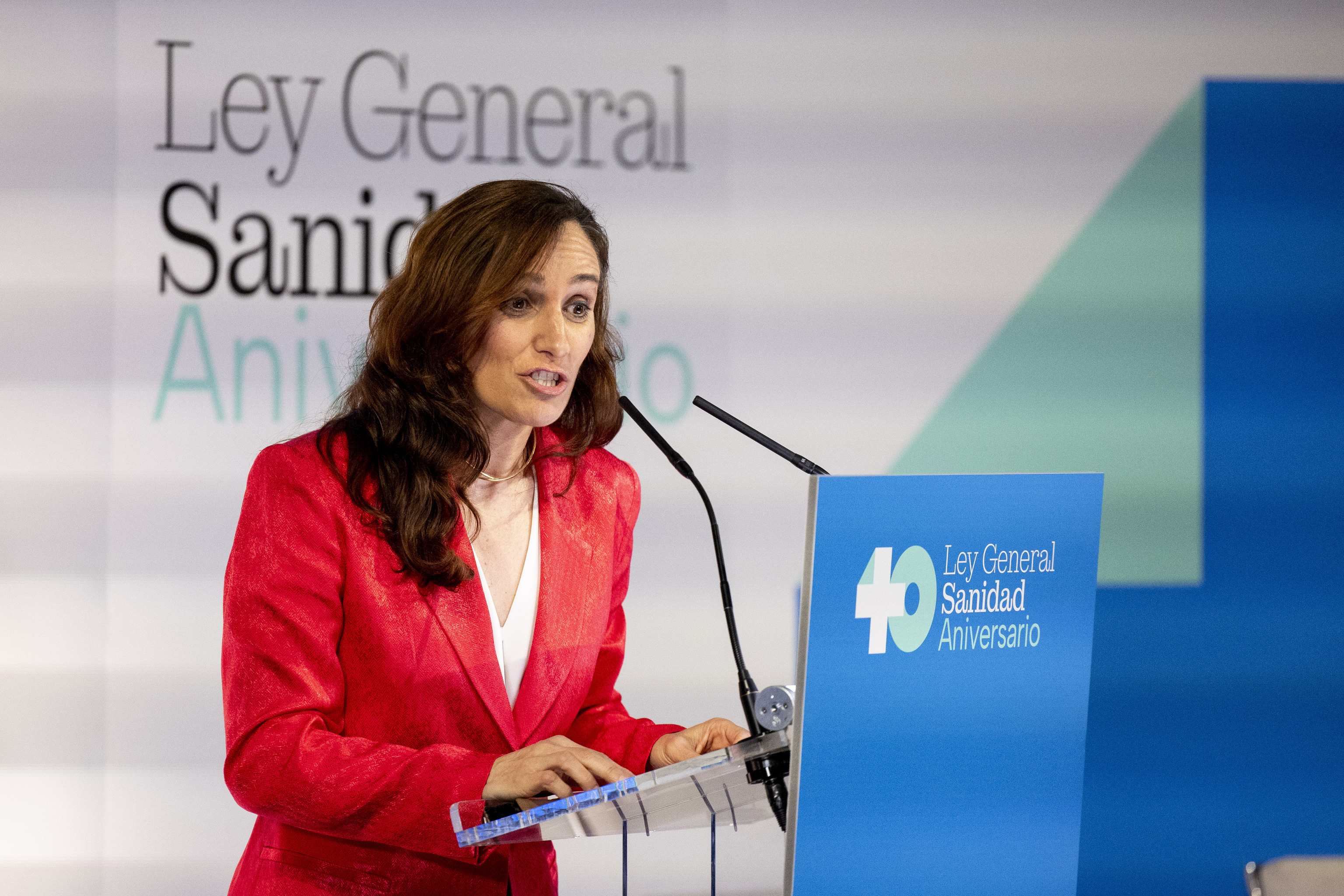
Nearly an hour after the ship departed for its home port in the Netherlands, Health confirmed on Monday the first Spanish positive for hantavirus. The cruise departed at 8:06 p.m., while Health Minister Mónica García was speaking. The now famous cruise sailed with 27 people of various nationalities, a doctor and a nurse from the World Health Organization (WHO), and 25 crew members. In Spain, we went from one front to another: from being responsible for bringing 147 people back home who were on board, to monitoring a virus inside the Gómez Ulla Hospital. As predicted a week ago by Tedros Adhanom Ghebreyesus, WHO Director: "We are prepared for more cases."
Of the 14 Spaniards, the positive case has been transferred to a High-Level Isolation and Treatment Unit (UATAN). He has been taken to the 22nd floor, where these spaces are located, through an isolation capsule in an exclusive elevator that only stops here. He will spend the rest of the quarantine in this unit, for now. The area is under 24-hour video surveillance by the attending healthcare professionals.
Since last night, the patient has had a low-grade fever and slight desaturation, although currently he is apparently stable with no evident clinical deterioration, as reported by Ministry of Health sources.
Health sources explain that "two samples are taken, and the second one is confirmatory." The latter, which tested positive, determines the actions to be taken. As it has been positive, according to protocols, the control test will be repeated in 24 hours.
It has been a week since Spain decided to not only provide the geographical location but also the means to end the hantavirus outbreak on the Dutch-flagged ship MV Hondius. On Monday afternoon, the WHO Director praised the operation as a "job well done." Seven days earlier, he urged the government of Pedro Sánchez to welcome the cruise in the Canary Islands: "It is a humanitarian imperative that we work collectively to avoid unnecessary restrictions without public health justification. (...) The passengers and crew of the MV Hondius must be able to disembark as soon as feasible." In a letter to Sánchez, the WHO Director invoked legislation that left no room for refusal, "besides, I remind you, there were 14 Spaniards on board," said Health Minister Mónica García on Monday morning to assess the situation.
"Mission accomplished." With these words, García closed the ship crisis and repatriation operation. "Between yesterday and today, we have evacuated 125 passengers and crew members from 23 countries who are now in their countries or are currently, as you have just seen, being transferred to their countries [by the last ones to leave the Netherlands and Australia]," the minister announced on Monday. Still no word on the infected case, which would be confirmed minutes later. In the final briefing, it was all about vindication, even with a nod to Trump, in the appeal to the success of "multilateralism" demonstrated in the health operation.
There are still 42 days of monitoring ahead for the 14 Spaniards who will remain at the Gómez Ulla Hospital fulfilling the prescribed quarantine. Tedros Adhanom, present at the operation's closure, emphasized that the scientifically recommended quarantine should last 42 days, "although he opened the door for the quarantine to be carried out in healthcare facilities or at home." At the same time, he called on all countries to comply, respecting each State's legislation.
The end of the operation also had an unexpected turn due to sea conditions, which required a land disembarkation. "The Maritime Captaincy informed us of the need to dock for this disembarkation to be done safely, and that's what we decided and what we did," the minister argued in her statement, after her department had previously informed that "the rough seas could cause sudden and unpredictable movements of both the cruise ship and the auxiliary vessel," as justified by the Ministry of Mónica García.
The President of the Canary Islands, Fernando Clavijo, expressed agreement with the decision on social media: "The priority is for the operation to be carried out with all guarantees, in the shortest time possible, and for the cruise to be able to depart for the Netherlands as soon as possible." These statements distanced themselves from the noise and clashes experienced in recent days between the Canary Islands and central government.
Outside our borders, the operation has been seen as a success. The President of the European Commission, Ursula von der Leyen, thanked the Spanish Government and all authorities involved on Monday for the "rapid and efficient disembarkation." The President of the European Council, António Costa, also did the same, highlighting on social media: "An excellent example of multilateral cooperation to effectively address health emergencies." Now, the work of control in each country remains, as reminded by the WHO Director, "to ensure similar measures are taken in all countries."