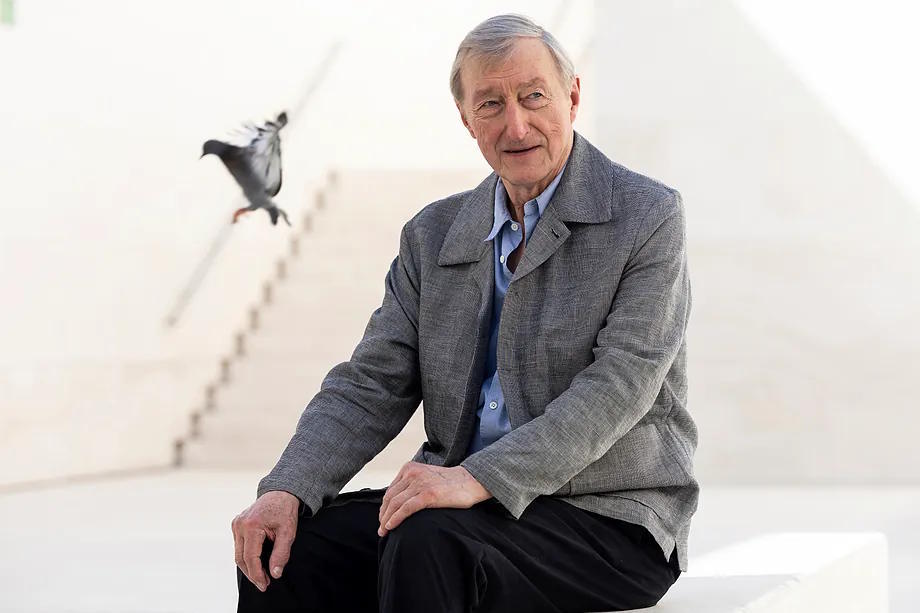
The literary farewell of Julian Barnes (Leicester, 1946) promises to bring a tear even to the toughest. He has said it in interviews and made it clear at the beginning of Farewells (Anagrama and, in Catalan, Angle): "This will be my last book." On the last page, he speaks directly to his reader, with a beautiful and moving metaphor. "Usually, I always give more thought to the first page. But with this book, the last one was the one that cost me the most. I rewrote it many times to find the exact tone," a smiling Barnes confessed yesterday at CaixaForum Barcelona.
His greeting upon arriving at the press conference was practically a comment on the Barça-Madrid match on Sunday: "An incredible Clásico, it has brought a lot of happiness to the world, I assure you." In the afternoon, he was one of the main protagonists of the Festival en Otras Palabras with a dialogue with the journalist and writer Lucía Lijtmaer significantly titled The Sense of an Ending: farewells and literature, which plays on one of his great works, The Sense of an Ending, which received the Booker in 2011.
But is this really going to be his last book? Skeptical journalists, readers, friends ask themselves. The writer smiles phlegmatically. "I have said all I had to say, leaving it here is the right thing to do. You know? At first, I wrote 'this will be my final novel,' but then I changed it to 'this will be my last book' because it seemed simpler and less melodramatic. 'Last' sounds more like a quiet acknowledgment than a drama," he explains. Spanish journalists bring up the example of Eduardo Mendoza, who has been saying for years that he is retiring but then comes back: "I am retired, what am I going to do with my time if I don't write?" he usually says. Barnes smiles and recounts an anecdote: "When my dear friend Ian McEwan found out, he said to his wife [in a deeper tone of voice, imitating him]: 'And what is he going to do all day now?' I still haven't found the answer, but I manage to fill the time with trips to Spain... I don't feel a terrible loss. If I were to write another book someday, it would have to be titled Sorry, it was a joke."
The truth is that his last page sounds like a definitive farewell. "I didn't like the idea of it being published after my death because then I couldn't attend the presentation party. Let's see... It's not that I'm going to stop writing. I have always been a journalist at the same time as a novelist and I will continue to write essays and reviews as long as they ask me to," he explains.
With Farewells, he has written another hybrid between fiction and essay, like the acclaimed Flaubert's Parrot. Although this one is more confessional and intimate, a reflection on memory and the past. Barnes speaks with total serenity about his blood cancer ("incurable but treatable") and his visits to the hospital. Despite the drama of the illness, he continues to write as always: with his delightful irony, that very British humor that is part of his DNA. "In my country, we take things much more seriously when they are funny. Our greatest writer, Shakespeare, never fails: even in the most serious or tragic works, there is always a comic character or a jester who ends up telling the truth. Being funny is, fundamentally, a way of being serious. That is, for me, the great innovation," considers the British author, capable of making jokes about his own death in a Monty Python style.
"Some have famous last words. My favorite is that of an English aristocrat who, as he was dying, said to his wife [now in a somewhat worried lord-like voice]: 'We are very low on marmalade.' I find it wonderful to have such a banal thought at the moment your heart stops. I hope my last words are something like 'We've won the World Cup!'. Something that would be quite epic... because you have to go back to 1966, when Barnes was 20 years old, to remember England winning a World Cup against West Germany and the controversial ghost goal that hit the crossbar: the Germans clearly remember that the ball didn't go in, but the British and the referee certainly considered it a goal.
But the memory of all of them - and of Barnes himself - will have changed over time, as it happens to his characters: university friends who meet again decades later. "Memory is much closer to imagination than to the exact recreation of a fact. Especially our favorite memories. The ones we tell the most are the least reliable because we slightly modify them each time we explain them. Neuroscience has shown that every time a memory is reactivated in the brain, it is slightly modified," points out Barnes, who starts his Farewells by quoting Proust and his famous madeleine soaked in a cup of tea that makes him go back to his childhood in Combray in his monumental In Search of Lost Time. "You can't write about memory without referring to Proust," admits the writer. Even if it's to question it: because the madeleine effect for a young Julian who grew up in the working-class and industrial Acton district, west of London, would rather be "the smell of glue and varnish when building model airplanes or the smell of bacon frying."
The fact is that Barnes rescues his friends from the past and in a funny conspiracy scene acts like a matchmaker: arranges a meeting with Jean, the girl Stephen, his colleague, has been in love with for half his life, and of course, she coincidentally shows up at the same café a few minutes later. More cannot be revealed without spoilers.
Barnes takes a sip of his milky coffee and sighs: "I don't write to feel better, or to solve problems, or to seek comfort. I haven't seen any book that provides comfort in the face of death, at least none that comforts me." But Farewells at least comforts his readers.