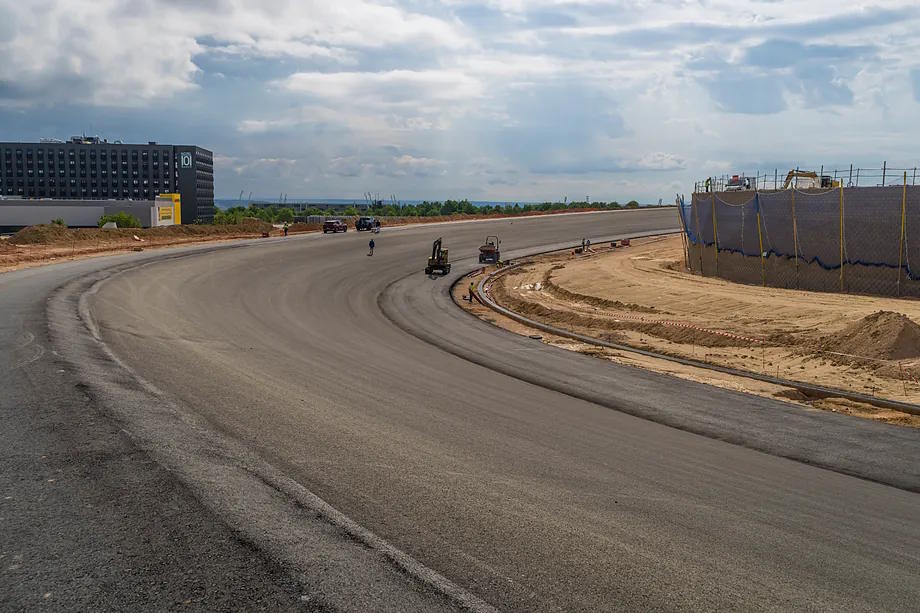
In the works of the Madring circuit, there will be no break for San Isidro this week. Just today in four months, on September 13, the green light will be given to the first Formula 1 race of the new grand prix in the capital. The schedule is tight, with workers on three shifts and a frenetic pace in every corner of the vast fairground, where classic activities, exhibitor events, and various congresses continue each week, albeit with visitors' shoes stained with dust and construction helmets in sight.
As happened at the Santiago Bernabéu, where Real Madrid football matches alternated with intense remodeling work, at Ifema, the transformation into a speed track must be combined with the scheduled fairs. "We're doing well, we're on time," say the race organizers during the incursion that EL MUNDO is making into one of the major works being carried out in the city. Undoubtedly, the most original, because turning an environment of pavilions, parking lots, vacant lots, and urban streets into a Formula 1 track where cars will circulate at nearly 300 kilometers per hour is quite a challenge.
"The asphalt operation is always delicate," announce the engineers on-site, already tense about what is coming on Friday and the weekend when the final layer will be applied to the track. The material arrives warm in trucks from a factory in Villaverde and, to maintain the temperature, it must be applied at a good pace, as long as the rain -persistent lately- allows it. The circuit will then have its official grip, the one required by F1 and which now, although the track may suggest otherwise, is not available, as those daring (and mischievous) workers found out a few weeks ago when they decided to test the curves aboard a van and ended up in a ditch, as seen in a viralized video.
Later, in mid-June, the official inauguration of Madring will take place, with Isabel Díaz Ayuso and José Luis Martínez Almeida at the helm and representatives from all the teams, who will take advantage after the Barcelona GP to visit the capital and get to know the debut track on the calendar, a real challenge for their cars and drivers. Many of them, both from F1 and other categories that will also have races here on the second weekend of September, are calling Ifema to request data or the possibility of discreetly taking a lap on the track when it is finished to avoid arriving unprepared.
The advanced simulators of the teams are being updated with the information sent from Madring, but even in this aspect, the machine does not match reality. "It will be a demanding track for the driver, with a lot of variety," the promoters say with a hint of pride, hopeful of projecting a fun race that contradicts the cliché associated with urban races, with few overtaking opportunities and, therefore, fewer points of excitement. "And it's good for the new regulations with hybrid cars," they add, looking at those moments of engine power and discharge depending on the faster or slower sections.
Madring is growing somewhat mischievous due to the irregular geographical profile of Valdebebas, with ups and downs, tunnels, and roundabouts. There are up to 16 meters of difference in height from one point of the circuit to another and very fast straights like Ribera del Sena, parallel to the M-40, which ends in a series of challenging curves, already in the most urban area of Madring, next to chalets with coveted terraces from where spectators will see the single-seaters pass by just a few meters away. After navigating the roundabouts, the designers have come up with some turns to force the drivers to lift off the accelerator before pressing it down again towards the circuit's icon, the Monumental, the corner they want to come to mind when Madring is mentioned, just like Eau Rouge in Spa, the 360 at Suzuka, or the Rascasse at Monte Carlo.
"It has more slope than the steepest ramps of Angliru," explain the technicians of the work, while positioning the car with the nose down so that the photograph shows the huge incline of the northern curve, named in honor of Las Ventas, as a nod to the traditional and bullfighting culture. It's challenging to maintain balance, and those with vertigo are better off not looking down. The drivers will have to overcome the forces of physics to complete it at nearly 300 kilometers per hour in a unique banked turn in the entire F1 World Championship. This impressive curved wall will be a canvas of single-seaters for the VIP stands that are also growing next to the asphalt. The two most luxurious areas, those with the most expensive tickets, will be located here and at the finish line, the famous Paddock Club, directly managed by F1. In the Monumental, important sponsors like the bank Santander will have their guest stand.
El Corte Inglés will also be present, and top Spanish insurance companies are negotiating their entry. Tourist destinations (Canary Islands) have also tried, although it will be the Community of Madrid itself that will be present, taking advantage of such an attractive showcase. "The numbers add up," the organizers are confident, something always challenging in the debut year. Sources from F1 consulted by this newspaper estimate the fee that Ifema will pay for the race at around 35 million euros per year, below the 40 million that Montmeló has had to negotiate with the Championship's owning company to continue on alternate years. "We are sold out," they point out about the general ticket office, with 100,000 tickets already sold.
In Madring's estimation, due to the circuit's layout, they could accommodate up to 120,000 spectators this year, but they doubt if they will have the appropriate license. A figure that would place the new Spanish Grand Prix squarely in the elite of races with the most audience, like Melbourne, Silverstone, or Austin. The most optimistic technicians, for the future, see capacity for up to 150,000 seats. But in this first edition, the promoters prefer to be cautious in all aspects, knowing they are also under political scrutiny. For example, holding large concerts within the circuit complex on those days has been ruled out to avoid straining the impact of noise on the neighbors.
There will be music and many leisure activities during the four-day event (from Thursday to Sunday), with Red Bull, for example, entertaining their guests with DJs, but not a super show, as initially thought, considering artists as renowned as Shakira or Coldplay.
The threat of a lawsuit for excessive decibels is on the table, which is why the Community of Madrid - as reported by EL MUNDO - is working on a regulatory change to safeguard a number of annual events of "great regional interest," as confirmed from Sol, to ensure the celebration of Formula 1, save the concerts at the Metropolitano or the Mad Cool, and bring back those at the Santiago Bernabéu. Miguel Garrido, president of Madrid's entrepreneurs, confirmed last week in these pages that they have included an allegation in this direction in the Spectacle Law from their association, trusting to obtain the legislative shield from Ayuso's Government in the coming months.
The peculiarities of a hybrid entity like Ifema, more public than private, and the political oversight of it, with the City Council and the Community along with the Chamber of Commerce responsible for its management, have marked the dawn of a complex event that, according to reports already in hand, will leave an impact of around 800 million euros per year in the region. The construction of the circuit will cost around 150 million euros, to be amortized over the 10 years of the contract signed. By utilizing Ifema's facilities, the cost is far from that of other modern tracks. The lavish Yas Marina in Abu Dhabi cost 1.8 billion euros.